


The association of comorbid depression with intensive care unit admission in patients with diabetes: a prospective cohort study
- PMID: 21397103
- PMCID: PMC3073638
- DOI: 10.1016/j.psym.2010.12.020
The association of comorbid depression with intensive care unit admission in patients with diabetes: a prospective cohort study
Abstract
Background: It is unknown if comorbid depression in patients with diabetes mellitus increases the risk of intensive care unit (ICU) admission.
Objective: This study examined whether comorbid depression in patients with diabetes increased risk of ICU admission, coronary care unit (CCU) admission, and general medical-surgical unit hospitalization, as well as total days hospitalized, after controlling for demographics, clinical characteristics, and health risk behaviors.
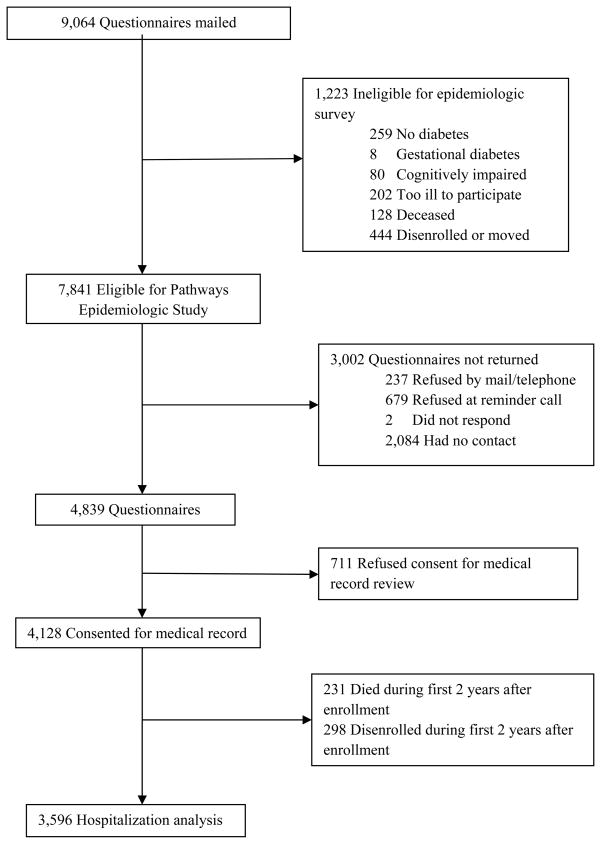
Method: This prospective cohort study included 3,596 patients with diabetes enrolled in the Pathways Epidemiologic Follow-Up Study. We assessed baseline depression with the Patient Health Questionnaire-9. We controlled for baseline demographics, smoking, BMI, exercise, hemoglobin A(1c), medical comorbidities, diabetes complications, type 1 diabetes, diabetes duration, and insulin treatment. We assessed time to any ICU, CCU, and/or general medical-surgical unit admission using Cox proportional-hazards regression. We used Poisson regression with robust standard errors to examine associations between depression and total days hospitalized.
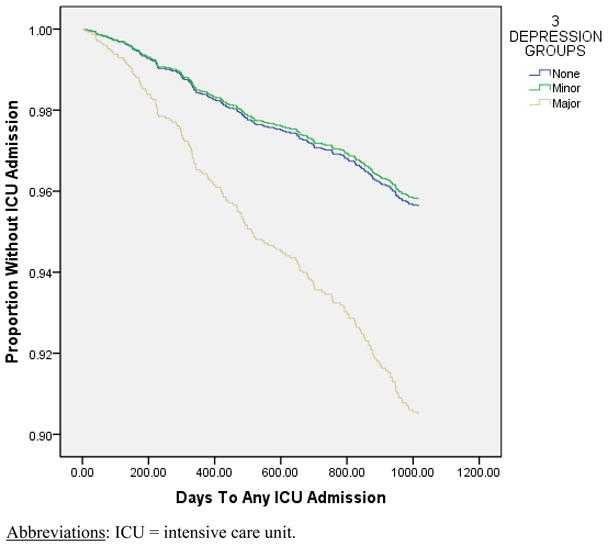
Results: Unadjusted analyses revealed that baseline probable major depression was associated with increased risk of ICU admission [hazard ratio (HR) 1.94, 95% confidence interval (95% CI)(1.34-2.81)], but was not associated with CCU or general medical-surgical unit admission. Fully adjusted analyses revealed probable major depression remained associated with increased risk of ICU admission [HR 2.23, 95% CI(1.45-3.45)]. Probable major depression was also associated with more total days hospitalized (Incremental Relative Risk 1.64, 95%CI(1.26-2.12)).
Conclusions: Patients with diabetes and comorbid depression have a greater risk of ICU admission. Improving depression treatment in patients with diabetes could potentially prevent hospitalizations for critical illnesses and lower healthcare costs.
Copyright © 2011 The Academy of Psychosomatic Medicine. Published by Elsevier Inc. All rights reserved.
Conflict of interest statement
Figures
References
-
- Karter AJ, Ferrara A, Liu YJ, Moffet HH, Ackerson LM, Selby JV. Ethnic disparities in diabetic complications in an insured population. JAMA. 2002;287:2519–2527. - PubMed
-
- Young B, Maynard C, Reiber G, Boyko EJ. Effects of ethnicity and nephropathy on lower extremity amputation risk among diabetic veterans. Diabetes Care. 2003;26:495–501. - PubMed
-
- Von Korff M, Katon W, Lin EH, Simon G, Ciechanowski P, Ludman E, Oliver M, Rutter C, Young B. Work disability among individuals with diabetes. Diabetes Care. 2005;28:1326–1332. - PubMed
-
- Hogan P, Dall T, Nikolov P American Diabetes Association. Economic costs of diabetes in the U.S. in 2002. Diabetes Care. 2003;26:917–932. - PubMed
-
- American Diabetes Association. Economic costs of diabetes in the U.S. in 2007. Diabetes Care. 2008;31:596–615. - PubMed
Publication types
MeSH terms
Grants and funding
LinkOut - more resources
Full Text Sources
Medical
