


Review
doi: 10.1016/j.semcdb.2011.03.003.
Epub 2011 Mar 21.
Newly identified prions in budding yeast, and their possible functions
Affiliations
- PMID: 21397710
- PMCID: PMC3155609
- DOI: 10.1016/j.semcdb.2011.03.003
Item in Clipboard
Review
Newly identified prions in budding yeast, and their possible functions
Semin Cell Dev Biol.
2011 Jul.
Abstract
Yeast prions are atypical genetic elements that are transmitted as heritable protein conformations. [PSI+], [URE3], and [PIN+] are three well-studied prions in the budding yeast, Saccharomyces cerevisiae. In the last three years, several additional prions have been reported in yeast, including [SWI+], [OCT+], [MCA], [GAR+], [MOT3+], [ISP+], and [NSI+]. The growing number of yeast prions suggests that protein-based inheritance might be a widespread biological phenomenon. In this review, we summarize the characteristics of each prion element, and discuss their potential functional roles in yeast biology.
Copyright © 2011 Elsevier Ltd. All rights reserved.
Figures
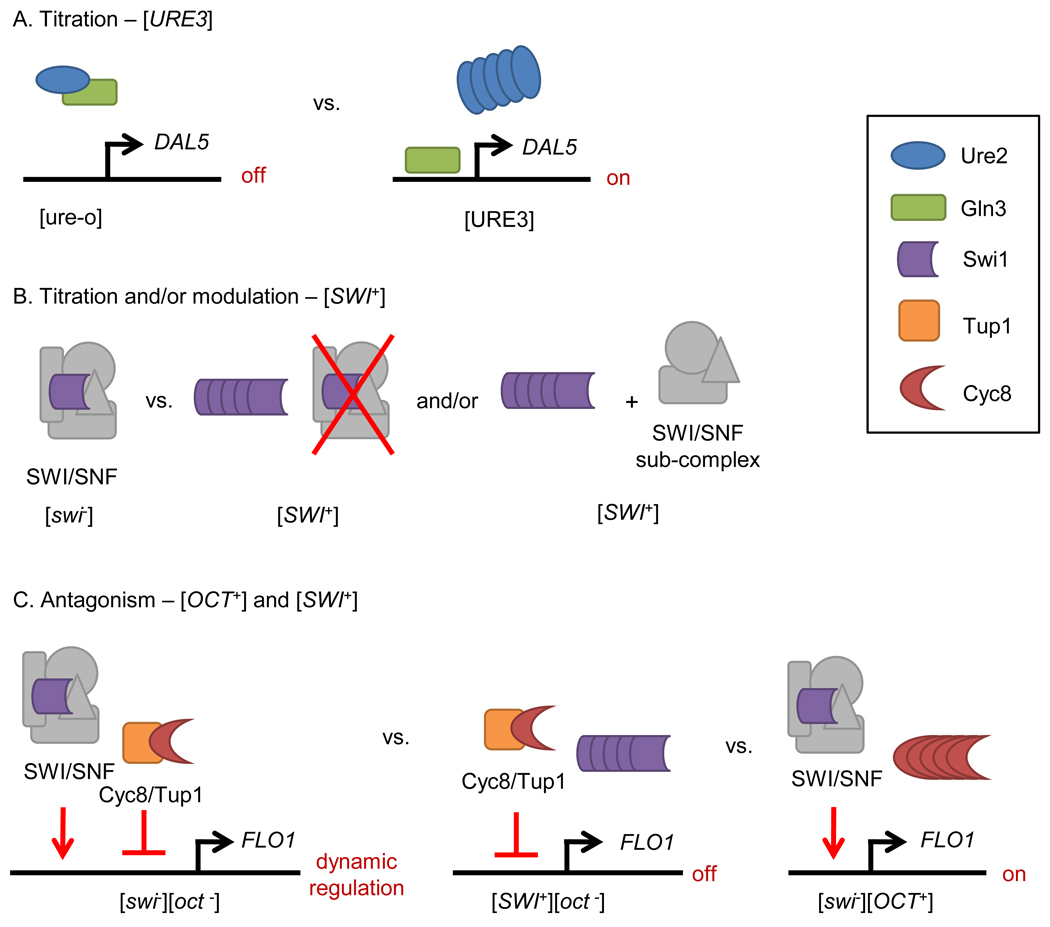
Postulated mechanisms for prion-mediated transcriptional regulation. A, A titration model shows that [URE3] formation leads to DAL5 activation due to Ure2 insufficiency. In [ureo] cells, Ure2 binds to the DAL5 activator Gln3 and as a consequence, DAL5 promoter is off. B, [SWI+] formation can lead to the destruction of SWI/SNF complex assembly and/or formation of Swi1-free SWI/SNF sub-complexes to further modulate gene expression. C, An antagonism model shows that formation of [SWI+] or [OCT+] can have opposite effects on FLO1 expression.
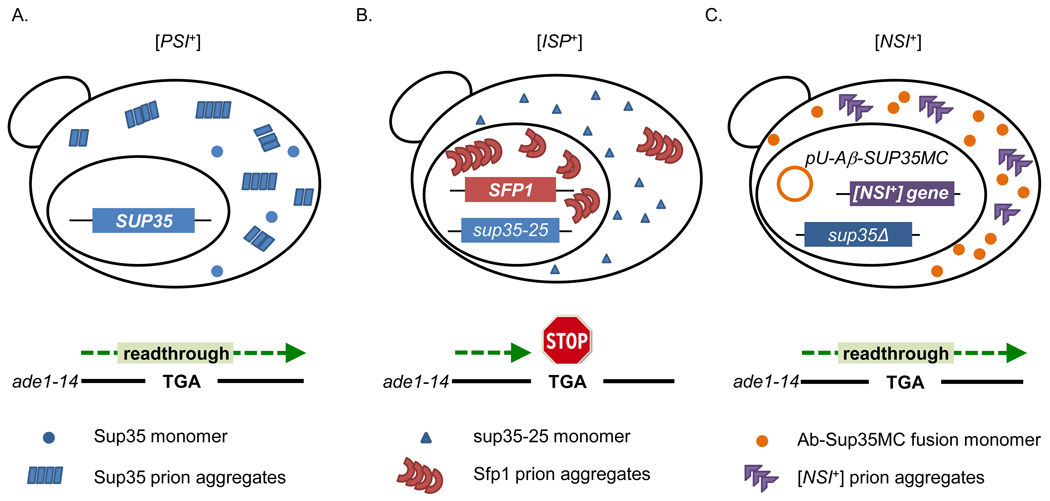
Three prions, [PSI+], [ISP+], and [NSI+], affect translation fidelity. A, In [PSI+] cells, the majority of Sup35 is sequestered in prion aggregates, resulting in partial read-through of nonsense translation codons, such as TGA in ade1-14. B, In [ISP+] cells, Sfp1 forms nuclear prion aggregates that result in suppression of nonsense read-through in some sup35 and sup45 mutant strains. C, In [NSI+] cells, an unidentified prion protein forms prion aggregates, resulting in nonsense codon read-through, a phenotype similar to that of [PSI+]. Aggregated Sup35 is not implicated in this phenotype.
References
-
- Cox B. [PSI], a cytoplasmic suppressor of super-suppression in yeast. Heredity. 1965;20:505–521.
-
- Wickner RB. [URE3] as an altered Ure2 protein: evidence for a prion analog in Saccharomyces cerevisiae. Science. 1994;264:566–569. - PubMed
-
- Derkatch IL, Bradley ME, Hong JY, Liebman SW. Prions affect the appearance of other prions: the story of [PIN+] Cell. 2001;106:171–182. - PubMed
Publication types
MeSH terms
Substances
Grants and funding
LinkOut - more resources
Full Text Sources
Molecular Biology Databases
