. 2011 May 20;286(20):17435-44.
doi: 10.1074/jbc.M110.137273. Epub 2011 Mar 11.

Mechanical stretch induces epithelial-mesenchymal transition in alveolar epithelia via hyaluronan activation of innate immunity

Affiliations

Mechanical stretch induces epithelial-mesenchymal transition in alveolar epithelia via hyaluronan activation of innate immunity

Rebecca L Heise et al. J Biol Chem. .

Abstract

Epithelial injury is a central event in the pathogenesis of many inflammatory and fibrotic lung diseases like acute respiratory distress syndrome, pulmonary fibrosis, and iatrogenic lung injury. Mechanical stress is an often underappreciated contributor to lung epithelial injury. Following injury, differentiated epithelia can assume a myofibroblast phenotype in a process termed epithelial to mesenchymal transition (EMT), which contributes to aberrant wound healing and fibrosis. We demonstrate that cyclic mechanical stretch induces EMT in alveolar type II epithelial cells, associated with increased expression of low molecular mass hyaluronan (sHA). We show that sHA is sufficient for induction of EMT in statically cultured alveolar type II epithelial cells and necessary for EMT during cell stretch. Furthermore, stretch-induced EMT requires the innate immune adaptor molecule MyD88. We examined the Wnt/β-catenin pathway, which is known to mediate EMT. The Wnt target gene Wnt-inducible signaling protein 1 (wisp-1) is significantly up-regulated in stretched cells in hyaluronan- and MyD88-dependent fashion, and blockade of WISP-1 prevents EMT in stretched cells. In conclusion, we show for the first time that innate immunity transduces mechanical stress responses through the matrix component hyaluronan, and activation of the Wnt/β-catenin pathway.


Figures

FIGURE 1.
FIGURE 1.
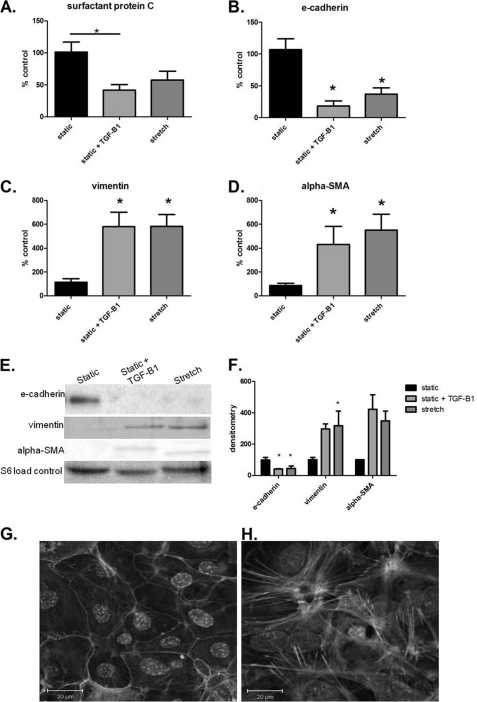
Stretch ± TGF-β1 induces EMT in AT2 cells. A, TGF-β1 significantly increased surfactant protein C gene expression. B, E-cadherin gene expression is significantly down-regulated in AT2 cells cultured with TGF-β1 or stretched AT2 cells, compared with static controls. C, vimentin gene expression is significantly increased in static + TGF-β1 and stretched AT2 cells compared with static cells. D, α-SMA gene expression is significantly increased in AT2 cells cultured with TGF-β1 or stretched AT2 cells compared with static controls. E, representative immunoblot from three independent experiments is shown. F, immunoblots were quantified by densitometry. E-cadherin protein is significantly diminished in all test groups compared with static. Vimentin in stretched cells is significantly increased compared with static. G, statically cultured cells were stained with F-actin at 4 days. H, stretched cells were stained with F-actin at 4 days. Data are normalized per loading controls and are representative of means ± S.E. (error bars), n = 3–6 per group.*, p < 0.05 ANOVA with Tukey's post hoc test.
FIGURE 2.
FIGURE 2.
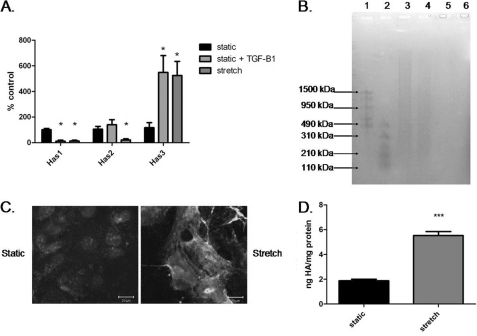
Stretch increased production of low molecular mass HA. A, quantitative RT-PCR of HA synthase genes (has) 1–3. has1 gene expression is significantly decreased with TGF-β1 or stretch compared with static culture. has2 gene expression is significantly decreased in the stretched AT2 cells compared with all other groups. has3 gene expression is significantly increased in static + TGF-β1 and stretched AT2 compared with static treated AT2 cells. B, agarose gel electrophoresis of AT2 supernatant. Lane 1, high molecular mass HA ladder; lane 2, low molecular mass HA ladder; lane 3, static culture supernatant; lane 4, stretch supernatant; lane 5, static supernatant with hyaluronidase treatment; lane 6, stretch supernatant with hyaluronidase treatment. C, immunohistochemistry for HA of statically cultured AT2 (left) and stretched AT2 (right). Nuclei are stained with DAPI. Scale bar, 20 μm. D, ELISA for HA concentration (normalized to protein concentrations) showing statistically significant higher HA in the stretched supernatant. Data are represented as means ± S.E. (error bars), n = 3/group. ***, p < 0.001 ANOVA with Tukey's post hoc test.
FIGURE 3.
FIGURE 3.
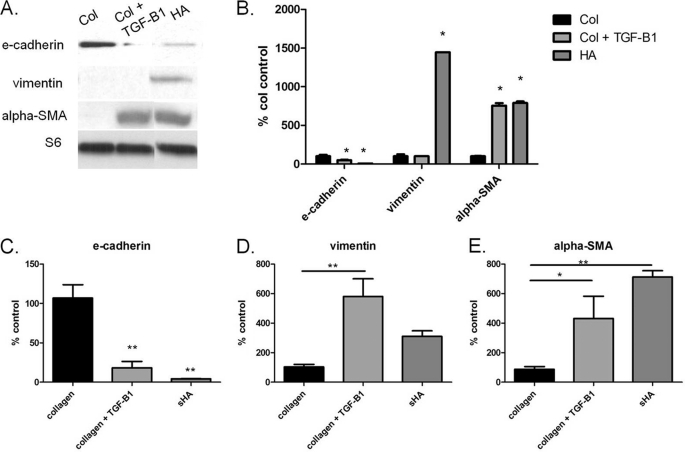
Addition of short fragment HA to AT2 static culture induces EMT with and without TGF-β1. A, representative immunoblot of three independent experiments. B, densitometry of immunoblots. E-cadherin is significantly decreased with TGF-β1 or HA. Vimentin is significantly greater in HA compared with collagen groups. α-SMA is significantly increased in TGF-β1 and HA groups compared with collagen control. C, mRNA expression of E-cadherin significantly decreased with TGF-β1 and HA compared with collagen control. D, vimentin mRNA expression significantly increased in the TGF-β1-treated group compared with collagen alone. E, α-SMA mRNA expression significantly increased in all groups compared with collagen controls. Data are represented as means ± S.E. (error bars), n = 3/group. *, p < 0.05; **, p < 0.01; ANOVA with Tukey's post hoc test.
FIGURE 4.
FIGURE 4.
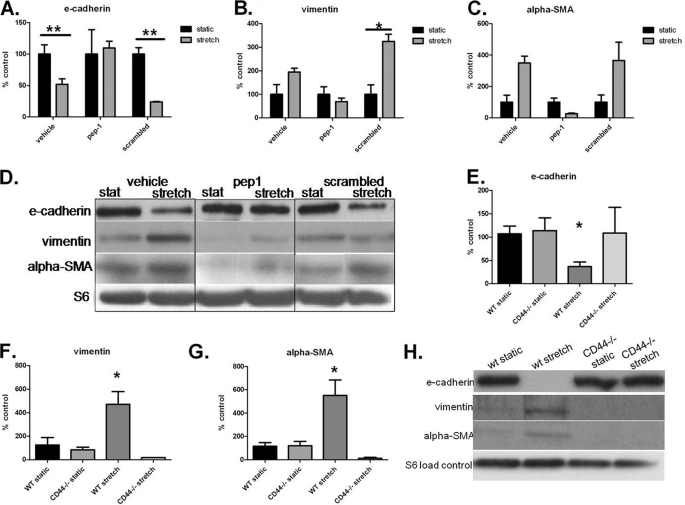
HA blockade inhibits stretch-induced EMT. A–C, mRNA expression of EMT markers with HA binding peptide (pep-1) treatment. A, E-cadherin significantly decreased with stretch in vehicle and scrambled groups. B, mRNA expression of vimentin significantly increased with stretch in the scrambled group and unchanged in the vehicle or pep-1 groups. C, mRNA expression of α-SMA significantly increased with stretch in the vehicle and scrambled groups. There is no significant change in the pep-1-treated cells. D, immunoblot of cell lysates from pep-1 experiments. E-cadherin protein is unchanged with stretch when treated with pep-1. pep-1-treated cells have decreased vimentin and α-SMA for both static and stretch compared with other treatments. E, mRNA expression of E-cadherin significantly decreased with stretch in wild-type cells. F, mRNA expression of vimentin significantly increased with stretch in the wild-type cells but not in the CD44−/− cells. G, mRNA expression of α-SMA significantly increased with stretch in the wild-type cells but not in the CD4−/− cells. G and H, immunoblot of cell lysates from CD44−/− experiments showing that E-cadherin is completely diminished with stretch in the wild-type cells but not in CD44−/− cells. Vimentin and α-SMA are increased with stretch in the wild-type cells but not in the CD44−/− cells. Data are represented as means ± S.E. (error bars), n = 3/group. *, p < 0.05; **, p < 0.01, ANOVA with Tukey's post-hoc test.
FIGURE 5.
FIGURE 5.
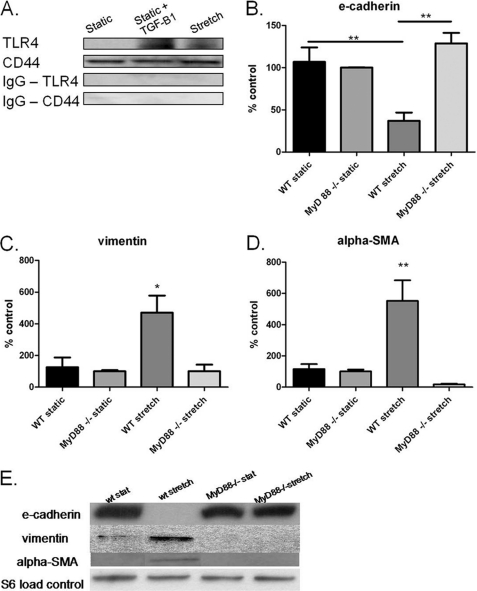
Cells deficient in the innate immune adaptor molecule MyD88 do not undergo stretch-induced EMT. A, immunoprecipitation with CD44 or IgG control and probed with an antibody to TLR-4 or CD44 as control. Stretch or TGF-β1 causes co-immunoprecipitation of TLR-4 and CD44. B, gene expression of E-cadherin significantly decreased with stretch in wild-type cells but not in MyD88−/− cells. C, gene expression of vimentin not significantly increased in stretched MyD88−/− cells. D, gene expression of α-SMA significantly increased with stretch in wild-type cells but not in MyD88−/− cells. E, representative Western blot of AT2 from wild-type and MyD88−/− static and stretched cells. Data are represented as means ± S.E. (error bars), n = 4/group. *, p < 0.05; **, p < 0.01 ANOVA with Tukey's post hoc test.
FIGURE 6.
FIGURE 6.
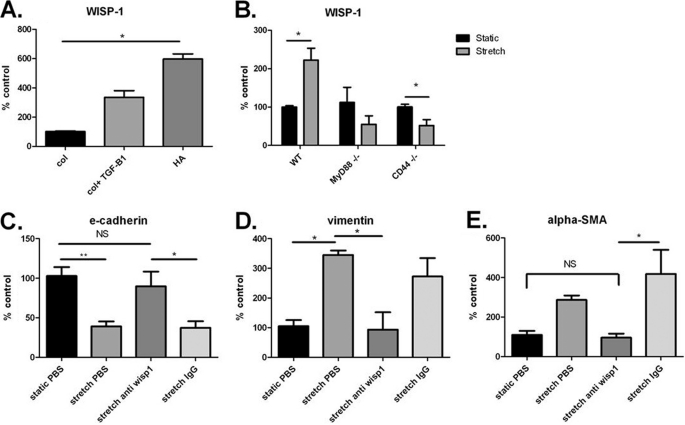
WISP-1 is necessary for EMT. A, gene expression of WISP-1 in static cells was significantly increased with the addition of low molecular mass HA. B, gene expression of WISP-1 was significantly up-regulated in wild-type stretched cells but not in MyD88−/− or CD44−/− cells. C, E-cadherin gene expression was not significantly changed in stretch cells treated with antibody to WISP-1. D, α-SMA gene expression was not significantly changed in stretched cells treated with antibody to WISP-1. Data are represented as means ± S.E. (error bars), n = 3–6/group. *, p < 0.05; **, p < 0.01 as indicated.

References

    1. Berthiaume Y., Lesur O., Dagenais A. (1999) Thorax 54, 150–160 - PMC - PubMed
    1. Corvol H., Flamein F., Epaud R., Clement A., Guillot L. (2009) Int. J. Biochem. Cell Biol. 41, 1643–1651 - PubMed
    1. Wurfel M. M. (2007) Proc. Am. Thorac. Soc. 4, 77–84 - PMC - PubMed
    1. Tremblay L. N., Miatto D., Hamid Q., Govindarajan A., Slutsky A. S. (2002) Crit. Care Med. 30, 1693–1700 - PubMed
    1. Lionetti V., Recchia F. A., Ranieri V. M. (2005) Curr. Opin. Crit. Care 11, 82–86 - PubMed

Publication types

MeSH terms