


Coronary calcium score and prediction of all-cause mortality in diabetes: the diabetes heart study
- PMID: 21398528
- PMCID: PMC3114476
- DOI: 10.2337/dc11-0008
Coronary calcium score and prediction of all-cause mortality in diabetes: the diabetes heart study
Abstract
Objective: In diabetes, it remains unclear whether the coronary artery calcium (CAC) score provides additional information about total mortality risk beyond traditional risk factors.
Research design and methods: A total of 1,051 participants, aged 34-86 years, in the Diabetes Heart Study (DHS) were followed for 7.4 years. Subjects were separated into five groups using baseline computed tomography scans and CAC scores (0-9, 10-99, 100-299, 300-999, and ≥1,000). Logistic regression was performed adjusting for age, sex, race, smoking, and LDL cholesterol to examine the association between CAC and all-cause mortality. Areas under the curve with and without CAC were compared. Natural splines using continuous measures of CAC were fitted to estimate the relationship between observed CAC and mortality risk.
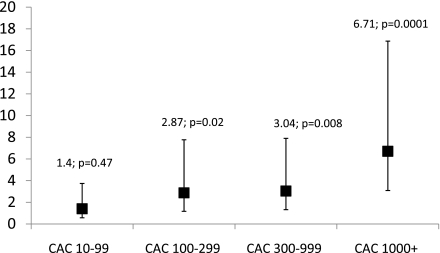
Results: A total of 17% (178 of 1,051) of participants died during the follow-up. In multivariate analysis, the odds ratios (95% CIs) for all-cause mortality, using CAC 0-9 as the reference group, were CAC 10-99: 1.40 (0.57-3.74); CAC 100-299: 2.87 (1.17-7.77); CAC 300-999: 3.04 (1.32-7.90); and CAC ≥ 1,000: 6.71 (3.09-16.87). The area under the curve without CAC was 0.68 (95% CI 0.66-0.70), and the area under the curve with CAC was 0.72 (0.70-0.74) (P = 0.0001). Using splines, the estimated risk (95% CI) of mortality for a CAC of 0 was 6.7% (4.6-9.7), and the risk increased nearly linearly, plateauing at CAC ≥ 1,000 (20.0% [15.7-25.2]).
Conclusions: In diabetes, CAC was shown to be an independent predictor of mortality. Participants with CAC (0-9) were at lower risk (0.9% annual mortality). The risk of mortality increased with increasing levels of CAC, plateauing at approximately CAC ≥ 1,000 (2.7% annual mortality). More research is warranted to determine the potential utility of CAC scans in diabetes.
Figures

References
-
- Wilson PW. Diabetes mellitus and coronary heart disease. Am J Kidney Dis 1998;32(Suppl. 3):S89–S100 - PubMed
-
- Grundy SM, Benjamin IJ, Burke GL, et al. Diabetes and cardiovascular disease: a statement for healthcare professionals from the American Heart Association. Circulation 1999;100:1134–1146 - PubMed
-
- Kannel WB, McGee DL. Diabetes and cardiovascular disease: the Framingham Study. JAMA 1979;241:2035–2038 - PubMed
-
- Wagenknecht LE, Bowden DW, Carr JJ, Langefeld CD, Freedman BI, Rich SS. Familial aggregation of coronary artery calcium in families with type 2 diabetes. Diabetes 2001;50:861–866 - PubMed
Publication types
MeSH terms
Substances
Grants and funding
LinkOut - more resources
Full Text Sources
Medical
