


Effect of age and comorbidity on the treatment and survival of older patients with vulvar cancer
- PMID: 21402401
- PMCID: PMC4589275
- DOI: 10.1016/j.ygyno.2011.02.005
Effect of age and comorbidity on the treatment and survival of older patients with vulvar cancer
Abstract
Objective: To determine the disease characteristics and comorbidities predictive of vulvar cancer specific mortality and five year overall survival among older women, ages 65 and above.
Methods: A retrospective analysis was conducted of women diagnosed with vulvar cancer at a single regional cancer center from 1989 to 2003, with a follow up to 2009. Treatment records were extracted for: demographics and treatment information, Eastern Cooperative Oncology Group (ECOG) performance status and Charlson comorbidity index score. Probability of death from vulvar cancer was estimated using cumulative incidence, treating death by other known and unknown causes as competing risks. Predictors of overall survival were determined using multivariate Cox regression analyses.
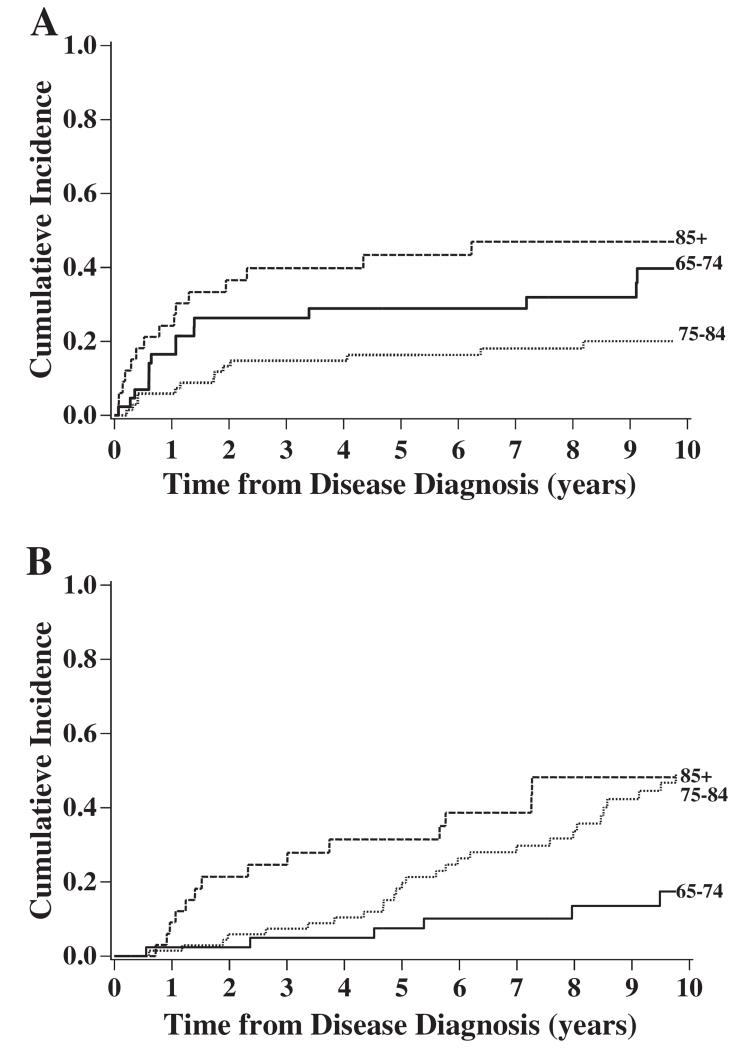
Results: One hundred forty-six women were identified, with a median age at diagnosis of 79 years (range 65-95). Median follow up was 5.0 years (range 0.1-16.7 years). The cumulative incidence of vulvar cancer-specific mortality was 13% (95% CI: 0.08-0.19) at year one, 24% (95% CI: 0.17-0.31) at year three and 26% (95% CI: 0.19-0.33) at year five. Use of adjuvant therapy or surgical procedure performed did not differ by age at diagnosis (p=0.807 and 0.663) according to age group (65-74, 74-84 and 85+). Increasing age, Charlson comorbidity index score, lymph node involvement and type of surgery performed were associated with increased risk of death from any cause (all p<0.05).
Conclusion: Among women aged ≥65, vulvar cancer specific mortality was most significant in the first three years after diagnosis. Conversely other causes of mortality which can be attributed to comorbid conditions steadily increased with time.
Copyright © 2010. Published by Elsevier Inc.
Figures

References
-
- Saraiya M, Watson M, Wu X, King JB, Chen VW, Smith JS, et al. Incidence of in situ and invasive vulvar cancer in the US, 1998–2003. Cancer. 2008;113:2865–72. - PubMed
-
- Judson PL, Habermann EB, Baxter NN, Durham SB, Virnig BA. Trends in the incidence of invasive and in situ vulvar carcinoma. Obstet Gynecol. 2006;107:1018–22. - PubMed
-
- Arias E. National vital statistics reports. 21. Vol. 58. National Center for Health Statistics; Hyattsville, MD: 2010. United States life tables, 2006. - PubMed
-
- Homesley HD, Bundy BN, Sedlis A, Yordan E, Berek JS, Jahshan A, et al. Assessment of current International Federation of Gynecology and Obstetrics staging of vulvar carcinoma relative to prognostic factors for survival (a Gynecologic Oncology Group study) Am J Obstet Gynecol. 1991;164:997–1003. - PubMed
-
- Landrum LM, Lanneau GS, Skaggs VJ, Gould N, Walker JL, McMeekin DS, et al. Gynecologic Oncology Group risk groups for vulvar carcinoma: improvement in survival in the modern era. Gynecol Oncol. 2007;106:521–5. - PubMed
Publication types
MeSH terms
Grants and funding
LinkOut - more resources
Full Text Sources
Medical
