


Human papillomavirus infection with multiple types: pattern of coinfection and risk of cervical disease
- PMID: 21402543
- PMCID: PMC3068034
- DOI: 10.1093/infdis/jiq139
Human papillomavirus infection with multiple types: pattern of coinfection and risk of cervical disease
Abstract
Objective: We investigated coinfection patterns for 25 human papillomavirus (HPV) types and assessed the risk conferred by multiple HPV types toward cervical disease.
Methods: Sexually active women (n=5,871) in the NCI-sponsored Costa Rica HPV Vaccine Trial's prevaccination enrollment visit were analyzed. Genotyping for 25 HPVs was performed using SPF(10)/LiPA(25). We calculated odds ratios (ORs) to assess coinfection patterns for each genotype with 24 other genotypes. These ORs were pooled and compared with pair-specific ORs to identify genotype combinations that deviated from the pooled OR. We compared risk of CIN2+/HSIL+between multiple and single infections and assessed additive statistical interactions.
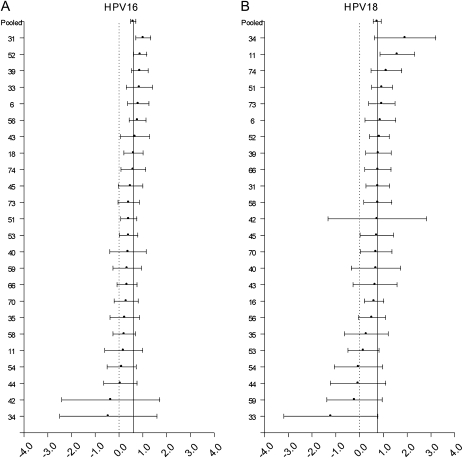
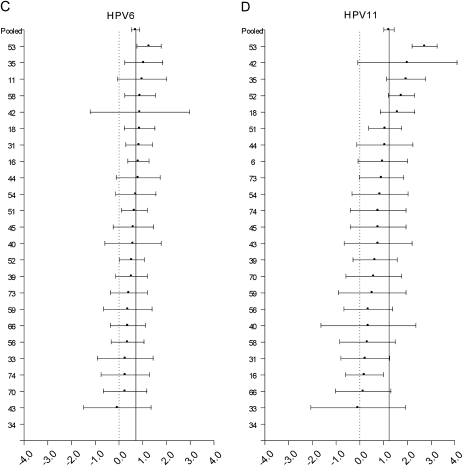
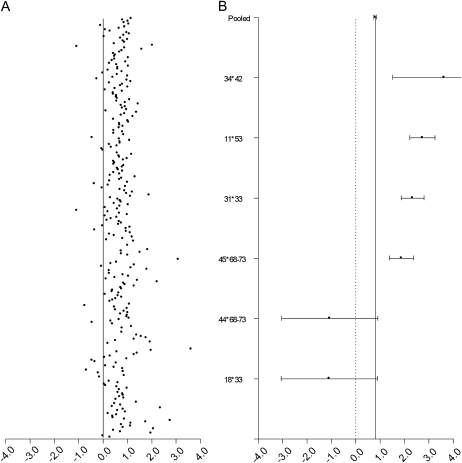
Results: Of the 2478 HPV-positive women, 1070 (43.2%) were infected with multiple types. Multiple infections occurred significantly more frequently than predicted by chance. However, this affinity to be involved in a coinfection (pooled OR for 300 type-type combinations=2.2; 95% confidence interval [CI]=2.1-2.4) was not different across HPV type-type combinations. Compared with single infections, coinfection with multiple α9 species was associated with significantly increased risk of CIN2+(OR=2.2; 95% CI=1.1-4.6) and HSIL+(OR=1.6; 95% CI=1.1-2.4). However, disease risk was similar to the sum of estimated risk from individual types, with little evidence for synergistic interactions.
Conclusions: Coinfecting HPV genotypes occur at random and lead to cervical disease independently.
Figures
Comment in
-
Multiple human papillomavirus infections: the exception or the rule?J Infect Dis. 2011 Apr 1;203(7):891-3. doi: 10.1093/infdis/jiq146. J Infect Dis. 2011. PMID: 21402540 No abstract available.
-
Multiple human papillomavirus infection: don't forget the genetic background.J Infect Dis. 2011 Dec 1;204(11):1816; author reply 1816-7. doi: 10.1093/infdis/jir626. Epub 2011 Oct 10. J Infect Dis. 2011. PMID: 21987666 No abstract available.
References
-
- Vaccarella S, Franceschi S, Snijders PJ, Herrero R, Meijer CJ, Plummer M. Concurrent infection with multiple human papillomavirus types: pooled analysis of the IARC HPV Prevalence Surveys. Cancer Epidemiol Biomarkers Prev. 2010;19:503–10. - PubMed
-
- Thomas KK, Hughes JP, Kuypers JM, et al. Concurrent and sequential acquisition of different genital human papillomavirus types. J Infect Dis. 2000;182:1097–102. - PubMed
-
- Liaw KL, Hildesheim A, Burk RD, et al. A prospective study of human papillomavirus (HPV) type 16 DNA detection by polymerase chain reaction and its association with acquisition and persistence of other HPV types. J Infect Dis. 2001;183:8–15. - PubMed
-
- Rousseau MC, Pereira JS, Prado JC, Villa LL, Rohan TE, Franco EL. Cervical coinfection with human papillomavirus (HPV) types as a predictor of acquisition and persistence of HPV infection. J Infect Dis. 2001;184:1508–17. - PubMed
-
- Chaturvedi AK, Myers L, Hammons AF, et al. Prevalence and clustering patterns of human papillomavirus genotypes in multiple infections. Cancer Epidemiol Biomarkers Prev. 2005;14:2439–45. - PubMed
