Review
. 2011 Apr 27;366(1568):1234-49.
doi: 10.1098/rstb.2010.0227.

Clinical and experimental advances in congenital and paediatric cataracts

Affiliations
Review

Clinical and experimental advances in congenital and paediatric cataracts

Amanda Churchill et al. Philos Trans R Soc Lond B Biol Sci. .

Abstract

Cataracts (opacities of the lens) are frequent in the elderly, but rare in paediatric practice. Congenital cataracts (in industrialized countries) are mainly caused by mutations affecting lens development. Much of our knowledge about the underlying mechanisms of cataractogenesis has come from the genetic analysis of affected families: there are contributions from genes coding for transcription factors (such as FoxE3, Maf, Pitx3) and structural proteins such as crystallins or connexins. In addition, there are contributions from enzymes affecting sugar pathways (particularly the galactose pathway) and from a quite unexpected area: axon guidance molecules like ephrins and their receptors. Cataractous mouse lenses can be identified easily by visual inspection, and a remarkable number of mutant lines have now been characterized. Generally, most of the mouse mutants show a similar phenotype to their human counterparts; however, there are some remarkable differences. It should be noted that many mutations affect genes that are expressed not only in the lens, but also in tissues and organs outside the eye. There is increasing evidence for pleiotropic effects of these genes, and increasing consideration that cataracts may act as early and readily detectable biomarkers for a number of systemic syndromes.


Figures
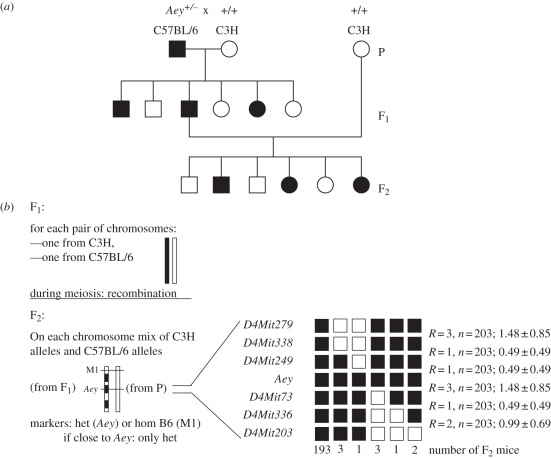
Figure 1.
Figure 1.
(a) Linkage analysis: general schedule for dominant mutations. A mutant mouse with a dominant phenotype (abnormality of the eye, Aey) was identified in a C57BL/6 colony after treatment with a mutagen (e.g. ethylnitroso urea, ENU). It is crossed with a wild-type mouse of a different inbred strain (e.g. C3H); in the F1 generation, 50% of the offspring show the mutant phenotype. A mutant F1 mouse with the clinical phenotype is backcrossed to the wild-type parental strain (C3H) leading again in the F2 generation to 50% mice with the clinical phenotype. (b) The F1 mice have one chromosome from each parent. During meiosis, in a few cases, recombination processes occur between the parental chromosomes, which can be visualized in the F2 generation using different genetic markers (M1, Aey). The example shows 10 recombinations among 203 F2 mice. Recombinations are (in a first approximation) randomly distributed among the chromosome; their relative frequency increases with the distance from a given point (here: Aey). Analysis of haplotypes (carrying the same combination of marker alleles) indicates the individual recombination events in each F2 mouse and allows the precise localization of the mutation. The distance of the markers is given in genetic units (here: 2 cM), but by comparison with the already published sequence of the mouse genome, the physical distances can be calculated. The critical interval in the example given here is 1.1 MB (genomic position of the marker D4Mit249 is 125.4 MB and of the marker D4Mit73 is 126.5 MB). It is obvious that the acuracy of the position increases with the number of F2 mice analysed. This positional cloning approach allowed the identification of a point mutation in the Col8a2 gene, which is responsible for a thinner cornea in this mutant. Filled symbols represent heterozygotes, clinical phenotype present; open symbols represent homozygous wild-type; (b) modified according to Puk et al. [30]; with permission from ARVO.
Figure 2.
Figure 2.
Cataractous lenses from mouse Cryaa mutations. The panels show different mouse mutations affecting Cryaa leading to (a) recessive or (b) dominant cataracts. In the recessive mode of inheritance, only the homozygous carriers suffer from severe nuclear cataracts associated with a small lens size. In dominant mutations the heterozygotes show cataracts, but in the cases reported here, the homozygous mutants are more severely affected. Since the pictures are from different sources and represent different ages, the lens size cannot be compared directly. (According to [57], with permission from PNAS; [58] and [59], with permissions from ARVO.)
Figure 3.
Figure 3.
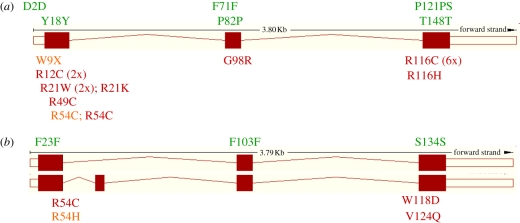
Mutations in CRYAA/Cryaa gene of humans and mice. Sequence alterations in (a) the human CRYAA and (b) mouse Cryaa gene are shown as amino-acid exchanges (single-letter code) at the corresponding position. The mouse Cryaa has two alternative transcripts, the insertion between exons 1 and 2 is present in approximately 10% of the transcripts and is not observed in humans. It is obvious that most of the cataract-causing mutations affect the first or third exons. Mutations in the second exon are rare. SNPs (above the exons) are synonymous; only the human polymorphism P121PS shows an insertion of 3 bp leading to an additional serine residue. Mutations in the CRYAA/Cryaa gene lead mainly to dominant cataracts (dark grey), but in some cases also to a recessive mode of inheritance (light grey). (Data from www.ensembl.org; www.informatics.jax.org; www.ncbi.nlm.nih.gov/snp.)
Figure 4.
Figure 4.
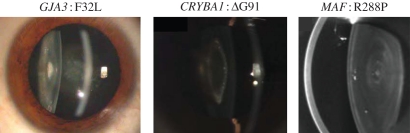
Genetic heterogeneity of pulverulent cataracts. Phenotype–genotype correlations in hereditary, congenital cataracts are generally not possible. For example, several pulverulent cataracts are shown, caused by mutations in different genes as indicated above by corresponding slit-lamp or Scheimpflug photographs. Similar examples could be given for any other type of cataract. (According to [58], with permission from the BJM group; [122] and [123], with permission from Mol. Vis.; [124] with permission from the BMJ group.)

References

    1. Wilson M. E., Pandey S. K., Thakur J. 2003. Paediatric cataract blindness in the developing world: surgical techniques and intraocular lenses in the new millennium. Br. J. Ophthalmol. 87, 14–19 10.1136/bjo.87.1.14 (doi:10.1136/bjo.87.1.14) - DOI - PMC - PubMed
    1. Rahi J. S., Dezateux C. 2001. Measuring and interpreting the incidence of congenital ocular anomalies: lessons from a national study of congenital cataract in the UK. Invest. Ophthalmol. Vis. Sci. 42, 1444–1448 - PubMed
    1. Evans J. 1995. Causes of blindness and partial sight in England and Wales 1990–91. Studies on medical and population subjects, vol. 57 London, UK: HMSO
    1. Kim K.-H., Ahn K., Chung E.-S., Chung T.-Y. 2008. Clinical outcomes of surgical techniques in congenital cataracts. Korean J. Ophthalmol. 22, 87–91 10.3341/kjo.2008.22.2.87 (doi:10.3341/kjo.2008.22.2.87) - DOI - PMC - PubMed
    1. Birch E. E., Stager D. R. 1996. The critical period for surgical treatment of dense congenital unilateral cataract. Invest Ophthalmol. Vis. Sci. 37, 1532–1538 - PubMed