doi: 10.1085/jgp.201110596.
Epub 2011 Mar 14.
Lysosomal pH and analysis of the counter ion pathways that support acidification
Affiliations
- PMID: 21402887
- PMCID: PMC3068279
- DOI: 10.1085/jgp.201110596
Item in Clipboard
Lysosomal pH and analysis of the counter ion pathways that support acidification
J Gen Physiol.
2011 Apr.
No abstract available
Figures
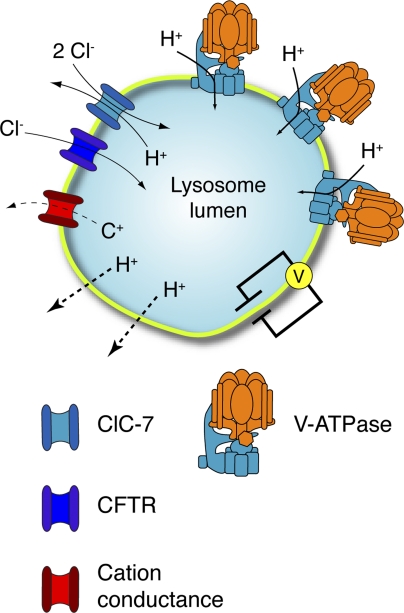
Determinants of lysosomal pH. Lysosomal acidification is dependent on V-ATPase, a large multimeric enzyme complex that transforms the energy of ATP hydrolysis into the movement of protons across the lysosome membrane. Electrogenic proton transport creates an electrical gradient that must be dissipated to establish the substantial chemical proton gradient. Electroneutrality can be maintained through the parallel influx of anions alongside protons. ClC-7, a chloride proton antiporter, and CFTR have been proposed to constitute the counter ion pathways in the lysosome membrane, as described in the text. The efflux of cations (C+) through distinct channels or transporters can also occur. Parallel proton leak pathways (dotted lines) are also known to exist and require continued V-ATPase activity to maintain a steady-state pH. Acidification kinetics are also contingent on the luminal buffering power (not depicted).
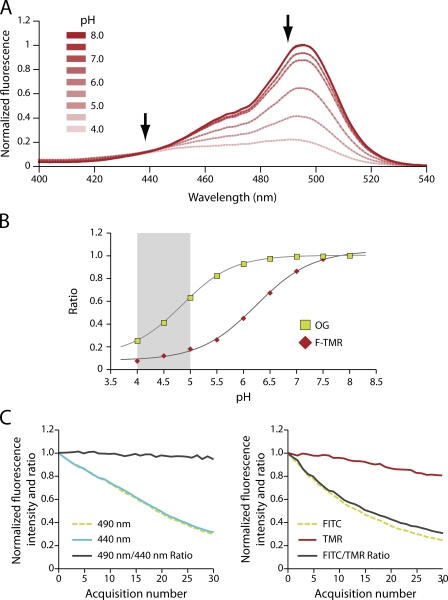
Ratiometric pH measurements. (A) pH sensitivity of the excitation spectra of Oregon Green (OG)-labeled dextran between pH 4.0 and 8.0. The arrows indicate the wavelengths used to construct a ratiometric pH titration curve. (B) In vitro pH titration of OG dextran (green squares) and fluorescein-TMR (F-TMR) dextran (red diamonds). The normalized excitation fluorescence intensity ratio of 490:440 nm and 490:550 nm are plotted for the OG dextran and F-TMR dextran, respectively. The gray bar indicates the range of recently reported lysosome pH values (Christensen et al., 2002; Trombetta et al., 2003; Kasper et al., 2005; Lange et al., 2006; Poët et al., 2006; Tabeta et al., 2006; Haggie and Verkman, 2007). (C) Macrophage lysosomes were loaded with either OG dextran (left) or F-TMR dextran (right), and their pH clamped at pH 7.4 using ionophores before repeated illumination of the sample. For the OG dextran, the normalized fluorescence intensity of the 490-nm (dotted green) and the 440-nm (blue) channels are shown along with the 490:440 nm ratio (black). F-TMR was imaged in both the FITC (dotted green) and TMR (red) channels, with the FITC/TMR ratio given by the black line. The latter is unstable even in conditions of constant pH because of the differential photobleaching of the FITC and TMR. This is in contrast to the intramolecular ratio of OG that remains uniform.
References
-
- Barriere H., Bagdany M., Bossard F., Okiyoneda T., Wojewodka G., Gruenert D., Radzioch D., Lukacs G.L. 2009. Revisiting the role of cystic fibrosis transmembrane conductance regulator and counterion permeability in the pH regulation of endocytic organelles. Mol. Biol. Cell. 20:3125–3141 10.1091/mbc.E09-01-0061 - DOI - PMC - PubMed
-
- Christensen K.A., Myers J.T., Swanson J.A. 2002. pH-dependent regulation of lysosomal calcium in macrophages. J. Cell Sci. 115:599–607 - PubMed
-
- Deriy L.V., Gomez E.A., Zhang G., Beacham D.W., Hopson J.A., Gallan A.J., Shevchenko P.D., Bindokas V.P., Nelson D.J. 2009. Disease-causing mutations in the cystic fibrosis transmembrane conductance regulator determine the functional responses of alveolar macrophages. J. Biol. Chem. 284:35926–35938 10.1074/jbc.M109.057372 - DOI - PMC - PubMed
Publication types
MeSH terms
Substances
Grants and funding
LinkOut - more resources
Full Text Sources