


Mechanism for selectivity-inactivation coupling in KcsA potassium channels
- PMID: 21402935
- PMCID: PMC3069191
- DOI: 10.1073/pnas.1014186108
Mechanism for selectivity-inactivation coupling in KcsA potassium channels
Abstract
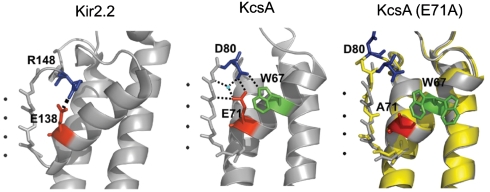
Structures of the prokaryotic K(+) channel, KcsA, highlight the role of the selectivity filter carbonyls from the GYG signature sequence in determining a highly selective pore, but channels displaying this sequence vary widely in their cation selectivity. Furthermore, variable selectivity can be found within the same channel during a process called C-type inactivation. We investigated the mechanism for changes in selectivity associated with inactivation in a model K(+) channel, KcsA. We found that E71A, a noninactivating KcsA mutant in which a hydrogen-bond behind the selectivity filter is disrupted, also displays decreased K(+) selectivity. In E71A channels, Na(+) permeates at higher rates as seen with and flux measurements and analysis of intracellular Na(+) block. Crystal structures of E71A reveal that the selectivity filter no longer assumes the "collapsed," presumed inactivated, conformation in low K(+), but a "flipped" conformation, that is also observed in high K(+), high Na(+), and even Na(+) only conditions. The data reveal the importance of the E71-D80 interaction in both favoring inactivation and maintaining high K(+) selectivity. We propose a molecular mechanism by which inactivation and K(+) selectivity are linked, a mechanism that may also be at work in other channels containing the canonical GYG signature sequence.
Conflict of interest statement
The authors declare no conflict of interest.
Figures
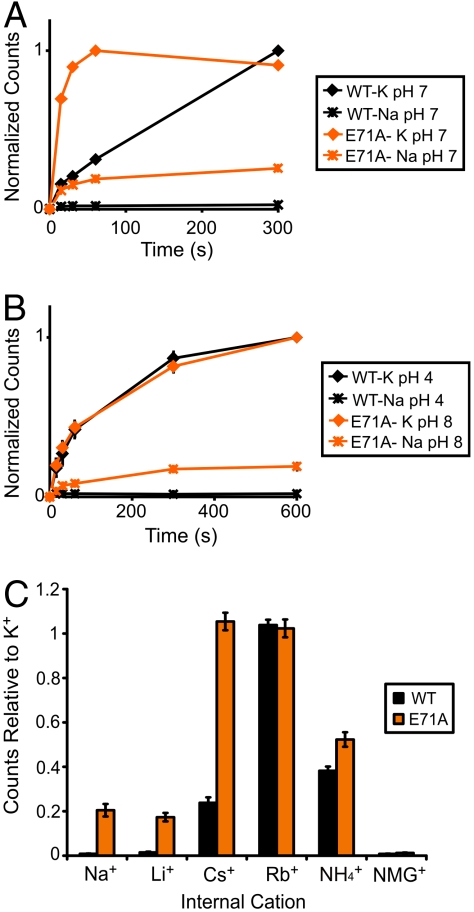
 . (A) Representative time courses of a liposomal
  flux assay of WT and E71A at pH 7 driven by intraliposomal K+ or Na+. Each time course is normalized to its own maximum level of uptake. (B) Same as A except assay performed at pH 4 for WT and pH 8 for E71A (n = 4, mean ± SEM). (C) Maximum
  uptake for WT and E71A at pH 7 driven by different intraliposomal cations and normalized to uptake driven by K+ (n = 5, mean ± SEM).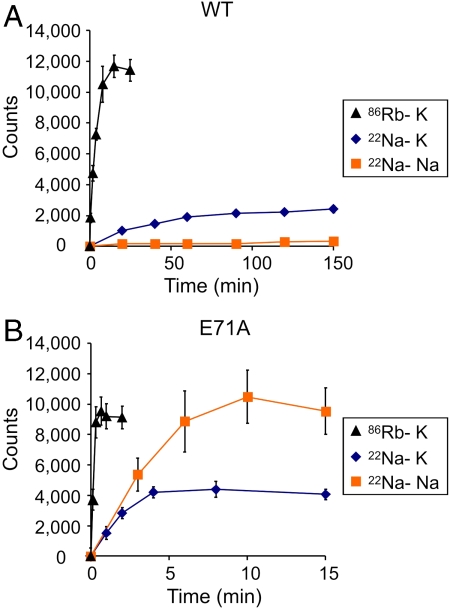
 uptake (black), K+-driven
  uptake (blue), and Na+-driven
  uptake (orange) (n = 3, mean ± SEM). (B) Same as A except for E71A (n = 3, mean ± SEM).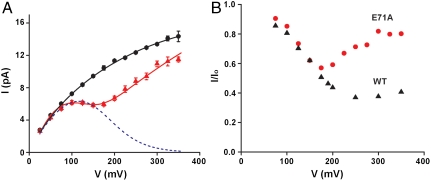
 and QK and QB are Michaelis-type constants for K+ and Na+ (see ref. 28). Fitted parameters are as follows: QK is 6.1 exp(z1FV/RT), where z1 is 0.34, QB was set to 0.5 exp(-z1FV/RT), and KB is 283 exp(-z2FV/RT), where z2 is 0.9. (B) Plot of the ratio of Na+-blocked and control currents (I/I0) for E71A KcsA (red) and WT (black) showing the much larger increase in Na+-modified E71A currents in the punch-through region.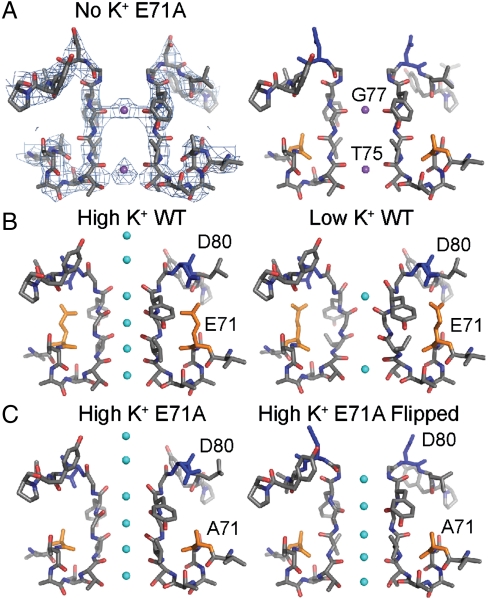
References
-
- Doyle DA, et al. The structure of the potassium channel: Molecular basis of K+ conduction and selectivity. Science. 1998;280:69–77. - PubMed
-
- Dibb KM, et al. Molecular basis of ion selectivity, block, and rectification of the inward rectifier Kir3.1/Kir3.4 K(+) channel. J Biol Chem. 2003;278:49537–49548. - PubMed
Publication types
MeSH terms
Substances
Associated data
- Actions
Grants and funding
LinkOut - more resources
Full Text Sources
Molecular Biology Databases
