


Platelet protease nexin-1, a serpin that strongly influences fibrinolysis and thrombolysis
- PMID: 21403095
- PMCID: PMC3316939
- DOI: 10.1161/CIRCULATIONAHA.110.000885
Platelet protease nexin-1, a serpin that strongly influences fibrinolysis and thrombolysis
Abstract
Background: Protease nexin-1 (PN-1) is a serpin that inhibits plasminogen activators, plasmin, and thrombin. PN-1 is barely detectable in plasma, but we have shown recently that PN-1 is present within the α-granules of platelets.
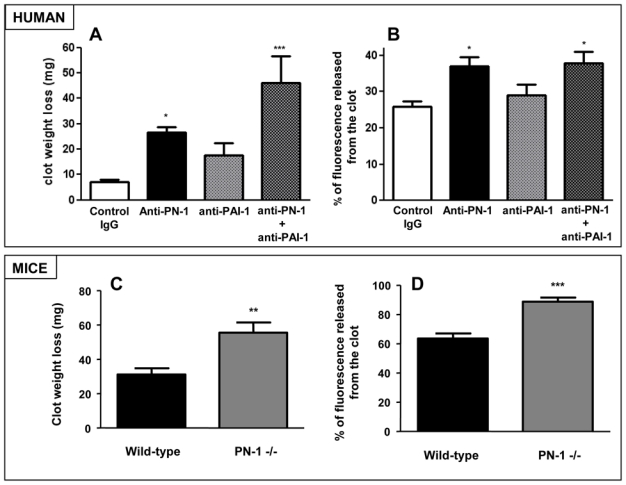
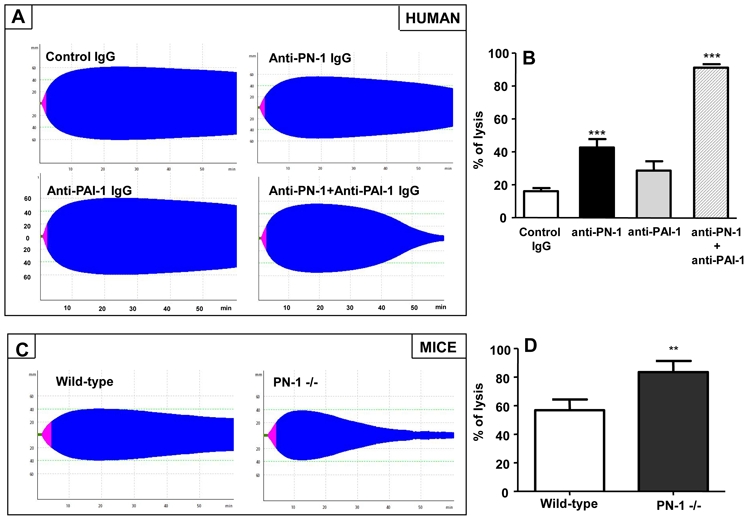
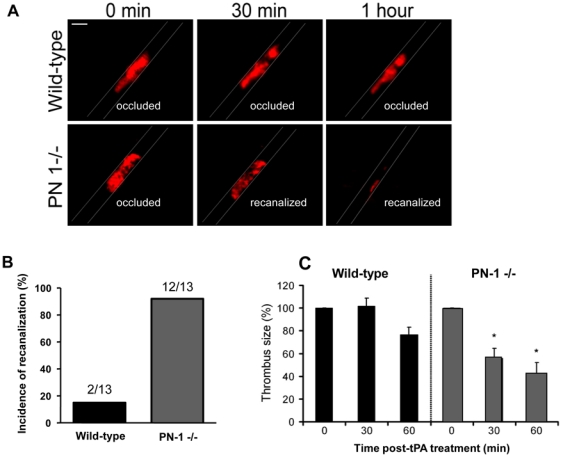
Methods and results: In this study, the role of platelet PN-1 in fibrinolysis was investigated with the use of human platelets incubated with a blocking antibody and platelets from PN-1-deficient mice. We showed by using fibrin-agar zymography and fibrin matrix that platelet PN-1 inhibited both the generation of plasmin by fibrin-bound tissue plasminogen activator and the activity of fibrin-bound plasmin itself. Rotational thromboelastometry and laser scanning confocal microscopy were used to demonstrate that PN-1 blockade or deficiency resulted in increased clot lysis and in an acceleration of the lysis front. Protease nexin-1 is thus a major determinant of the lysis resistance of platelet-rich clots. Moreover, in an original murine model in which thrombolysis induced by tissue plasminogen activator can be measured directly in situ, we observed that vascular recanalization was significantly increased in PN-1-deficient mice. Surprisingly, general physical health, after tissue plasminogen activator-induced thrombolysis, was much better in PN-1-deficient than in wild-type mice.
Conclusions: Our results reveal that platelet PN-1 can be considered as a new important regulator of thrombolysis in vivo. Inhibition of PN-1 is thus predicted to promote endogenous and exogenous tissue plasminogen activator-mediated fibrinolysis and may enhance the therapeutic efficacy of thrombolytic agents.
Conflict of interest statement
The authors have no conflicting financial interests.
Figures



References
-
- Alexandrov AV. Current and future recanalization strategies for acute ischemic stroke. J Intern Med. 2010;267:209–219. - PubMed
-
- Armstrong PW, Collen D. Fibrinolysis for acute myocardial infarction: current status and new horizons for pharmacological reperfusion, part 1. Circulation. 2001;103:2862–2866. - PubMed
-
- Hamsten A, de Faire U, Walldius G, Dahlen G, Szamosi A, Landou C, Blomback M, Wiman B. Plasminogen activator inhibitor in plasma: risk factor for recurrent myocardial infarction. Lancet. 1987;2:3–9. - PubMed
-
- Smith A, Patterson C, Yarnell J, Rumley A, Ben-Shlomo Y, Lowe G. Which hemostatic markers add to the predictive value of conventional risk factors for coronary heart disease and ischemic stroke? The Caerphilly Study. Circulation. 2005;112:3080–3087. - PubMed
-
- Levi M, Biemond BJ, van Zonneveld AJ, ten Cate JW, Pannekoek H. Inhibition of plasminogen activator inhibitor-1 activity results in promotion of endogenous thrombolysis and inhibition of thrombus extension in models of experimental thrombosis. Circulation. 1992;85:305–312. - PubMed
Publication types
MeSH terms
Substances
LinkOut - more resources
Full Text Sources
Other Literature Sources
Molecular Biology Databases
Miscellaneous
