Patients' preferences for ways to communicate benefits of cardiovascular medication
- PMID: 21403138
- PMCID: PMC3056859
- DOI: 10.1370/afm.1193
Patients' preferences for ways to communicate benefits of cardiovascular medication
Abstract
Purpose: We wanted to determine patients' willingness to take preventive cardiovascular disease (CVD) medication in relation to their 5-year CVD risk score and modes of communicating benefits of therapy.
Methods: Study participants were 934 consecutive patients drawn from family practitioners' waiting rooms in Auckland, New Zealand, who knew their 5-year CVD risk (ranging from 5% to 30%) and who completed a questionnaire asking them to rate how much various modes of communicating the benefits of therapy would encourage them to take medication daily, where the benefits from medication were proportional to their estimated CVD risk score.
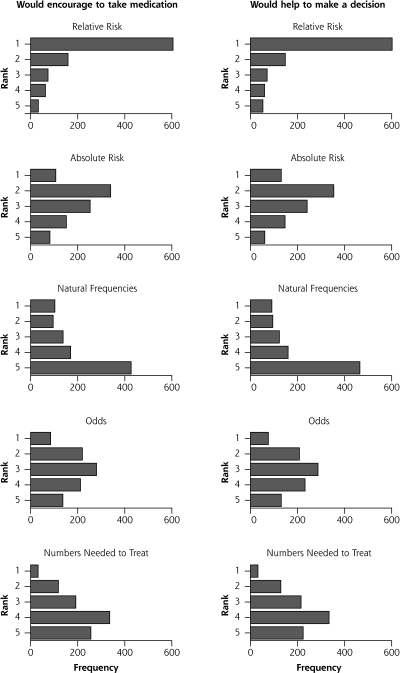
Results: Patients' rankings for modes of communicating the benefits of therapy were little influenced by sex, age, ethnicity, numeracy score, 5-year CVD risk, or concern about a heart attack. Patients clearly found relative risk reduction most encouraging, with absolute risk reduction rated second overall and numbers needed to treat the least likely to be persuasive, although preferences covered the full range and were not predictable from demographic or 5-year CVD risk data. Pictures were preferred to numbers by 55.1%, with a people-chart or a bar chart being equally favored. Even so, 61.8% preferred a doctor's opinion to any presentation by numbers or pictures.
Conclusions: Patients' willingness to take preventive cardiovascular medication depends more on mode of communicating treatment benefit than on their short-term CVD risk score or their level of concern about a future cardiovascular event. Because individual preferences were not predictable, more than 1 modality is likely to be clinically useful for each patient.
Figures
References
-
- New Zealand Guidelines Group. New Zealand Cardiovascular Guidelines Handbook. A Summary Resource for Primary Care Practitioners. Wellington: New Zealand Guidelines Group; 2009.
-
- Edwards A, Elwyn G, Covey J, Matthews E, Pill R. Presenting risk information—a review of the effects of “framing” and other manipulations on patient outcomes. J Health Commun. 2001;6(1):61–82. - PubMed
Publication types
MeSH terms
LinkOut - more resources
Full Text Sources
Medical