. 2011 Apr;121(4):1519-23.
doi: 10.1172/JCI43220. Epub 2011 Mar 14.

Dysregulated brain creatine kinase is associated with hearing impairment in mouse models of Huntington disease

Affiliations

Dysregulated brain creatine kinase is associated with hearing impairment in mouse models of Huntington disease

Yow-Sien Lin et al. J Clin Invest. 2011 Apr.

Abstract

Huntington disease (HD) is a degenerative disorder caused by expanded CAG repeats in exon 1 of the huntingtin gene (HTT). Patients with late-stage HD are known to have abnormal auditory processing, but the peripheral auditory functions of HD patients have yet to be thoroughly assessed. In this study, 19 HD patients (aged 40-59 years) were assessed for hearing impairment using pure-tone audiometry and assessment of auditory brainstem responses (ABRs). PTA thresholds were markedly elevated in HD patients. Consistent with this, elevated ABR thresholds were also detected in two mouse models of HD. Hearing loss thus appears to be an authentic symptom of HD. Immunohistochemical analyses demonstrated the presence of mutant huntingtin that formed intranuclear inclusions in the organ of Corti of HD mice, which might interfere with normal auditory function. Quantitative RT-PCR and Western blot analyses further revealed reduced expression of brain creatine kinase (CKB), a major enzyme responsible for ATP regeneration via the phosphocreatine-creatine kinase (PCr-CK) system, in the cochlea of HD mice. Treatment with creatine supplements ameliorated the hearing impairment of HD mice, suggesting that the impaired PCr-CK system in the cochlea of HD mice may contribute to their hearing impairment. These data also suggest that creatine may be useful for treating the hearing abnormalities of patients with HD.


Figures
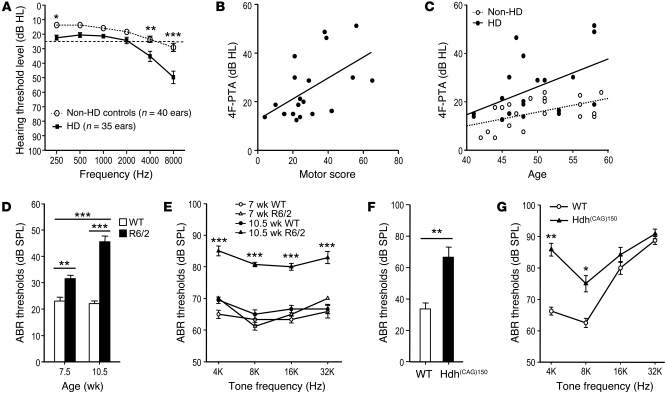
Figure 1
Figure 1. Hearing loss in HD.
(A) Mean value of the PTTs of HD patients at each specific frequency (n = 35 ears) and of the non-HD controls (n = 40 ears). The dotted line indicates the normal hearing level (25 dB HL). *P < 0.05, **P < 0.01, ***P < 0.001. Three ears of HD patients were excluded because of middle ear pathologies. (B) The 4F-PTAs of HD patients were significantly correlated with the total motors score of HD patients (P < 0.05, r = 0.5274; Pearson’s correlation). (C) The 4F-PTAs of HD patients (n = 19, P < 0.05, r = 0.4789) and non-HD controls (n = 20, P < 0.05, r = 0.5196) were associated with age. ABR thresholds of WT and R6/2 mice were measured by click (D) and tone-burst (E) stimuli at the ages of 7.5 and 10.5 weeks (n = 10 per group). Click ABR (F) and tone-burst ABR (G) analysis of WT (n = 4) and Hdh(CAG)150 (n = 6) mice at the age of 15 months. SPL, sound pressure level. *P < 0.05, **P < 0.01, ***P < 0.001.
Figure 2
Figure 2. Auditory dysfunction in HD mice.
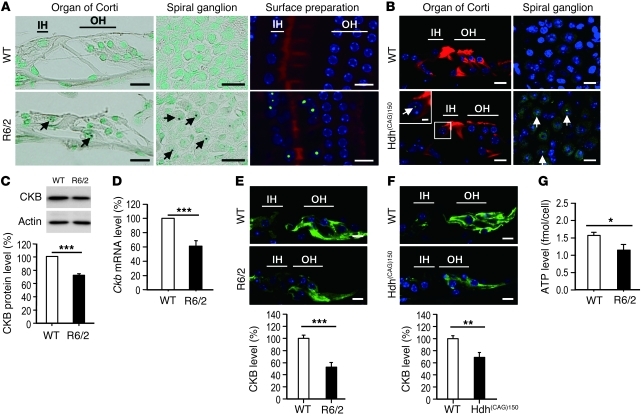
(A) Cochleae (mid-basal turn) of 10.5-week-old mice were visualized by immunohistochemistry (Htt, dark brown deposits; nuclei, green). NIIs (arrows) were detected in the spiral ganglion (middle panels) and in the organ of Corti (left panels) of R6/2 mice. Surface preparations (right panels; mid-basal turn) of 10.5-week-old mice were performed to detect NIIs using an anti-Htt antibody (green), nuclei using Hoechst 33258 (blue), and the organ of Corti using rhodamine phalloidin (red). IH, inner hair cell; OH, outer hair cell. (B) Cryosections of the cochlea of 15-month-old mice (mid-basal turn) were stained with an anti-ubiquitin antibody (green) and with rhodamine phalloidin (red). Arrows indicate NIIs. (C) Total protein (30 μg per lane) from the cochleae of 10.5-week-old WT and R6/2 mice was analyzed for the expression of CKB protein, which was normalized to that of actin. (D) RNA from cochleae of 10.5-week-old WT and R6/2 mice (n = 6 per group) was used to determine the level of the Ckb transcript using an RT-qPCR method. The expression levels of Ckb were normalized to those of a reference gene (Gapdh). (E) CKB immunostaining (green) of the cochlea of 12-week-old WT and R6/2 mice. (F) CKB immunostaining (green) of the cochleae of 20-month-old WT and Hdh(CAG)150 mice. Scale bars: 10 μm (A, B, E, and F) and 2 μm (inset in B). Quantitative analyses are shown in the lower panels (C, E, and F). (G) ATP level in isolated hair cells of 12-week-old WT and R6/2 mice. *P < 0.05, **P < 0.01, and ***P < 0.001.
Figure 3
Figure 3. Beneficial effects of creatine supplementation on auditory dysfunction in HD mice.
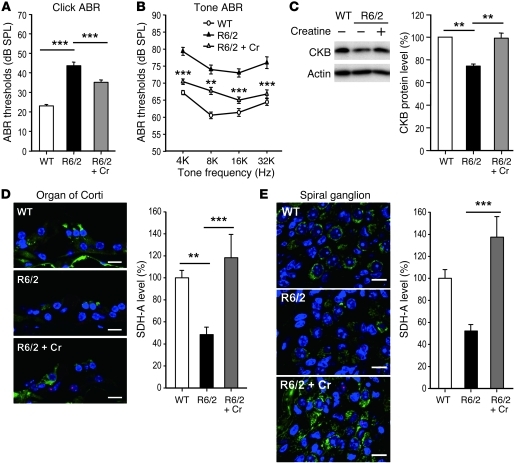
Male mice (WT, control diet, n = 18; R6/2, control diet, n = 15; and R6/2 mice, 2% creatine [Cr], n = 11) were fed the indicated diet from the age of 4 weeks. The ABR thresholds upon application of click stimuli (A) or tone-burst stimuli (B) to the indicated mice at the age of 10.5 weeks are shown. (C) Total lysates were harvested from cochlea at the age of 10.5 weeks. Expression of the CKB protein was determined using Western blot analyses and normalized to that of actin as an internal control. Quantitative data are shown in the right panel. Immunostaining of the organ of Corti (D) and spiral ganglion (E) of WT and R6/2 mice (10.5 weeks of age) was conducted to determine the expression of SDH-A (green) and NIIs (red). Scale bars (D and E): 10 μm. Quantitative analyses are shown in the right panels. Data are presented as the mean ± SEM. **P < 0.01 and ***P < 0.001.

References

    1. Martin JB, Gusella JF. Huntington’s disease. Pathogenesis and management. N Engl J Med. 1986;315(20):1267–1276. - PubMed
    1. [No authors listed]. A novel gene containing a trinucleotide repeat that is expanded and unstable on Huntington’s disease chromosomes. The Huntington’s Disease Collaborative Research Group. Cell. 1993;72(6):971–983. doi: 10.1016/0092-8674(93)90585-E. - DOI - PubMed
    1. Chiang MC, et al. The A2A adenosine receptor rescues the urea cycle deficiency of Huntington’s disease by enhancing the activity of the ubiquitin-proteasome system. Hum Mol Genet. 2009;18(16):2929–2942. - PubMed
    1. Beste C, Saft C, Gunturkun O, Falkenstein M. Increased cognitive functioning in symptomatic Huntington’s disease as revealed by behavioral and event-related potential indices of auditory sensory memory and attention. J Neurosci. 2008;28(45):11695–11702. doi: 10.1523/JNEUROSCI.2659-08.2008. - DOI - PMC - PubMed
    1. Saft C, Schuttke A, Beste C, Andrich J, Heindel W, Pfleiderer B. fMRI reveals altered auditory processing in manifest and premanifest Huntington’s disease. Neuropsychologia. 2008;46(5):1279–1289. doi: 10.1016/j.neuropsychologia.2007.12.002. - DOI - PubMed

Publication types

MeSH terms