. 2011 Jun;21(6):934-43.
doi: 10.1038/cr.2011.36. Epub 2011 Mar 15.

Ras1(CA) overexpression in the posterior silk gland improves silk yield

Affiliations

Ras1(CA) overexpression in the posterior silk gland improves silk yield

Li Ma et al. Cell Res. 2011 Jun.

Erratum in

  • Cell Res. 2011 Jun;21(6):991

Abstract

Sericulture has been greatly advanced by applying hybrid breeding techniques to the domesticated silkworm, Bombyx mori, but has reached a plateau during the last decades. For the first time, we report improved silk yield in a GAL4/UAS transgenic silkworm. Overexpression of the Ras1(CA) oncogene specifically in the posterior silk gland improved fibroin production and silk yield by 60%, while increasing food consumption by only 20%. Ras activation by Ras1(CA) overexpression in the posterior silk gland enhanced phosphorylation levels of Ras downstream effector proteins, up-regulated fibroin mRNA levels, increased total DNA content, and stimulated endoreplication. Moreover, Ras1 activation increased cell and nuclei sizes, enriched subcellular organelles related to protein synthesis, and stimulated ribosome biogenesis for mRNA translation. We conclude that Ras1 activation increases cell size and protein synthesis in the posterior silk gland, leading to silk yield improvement.


Figures
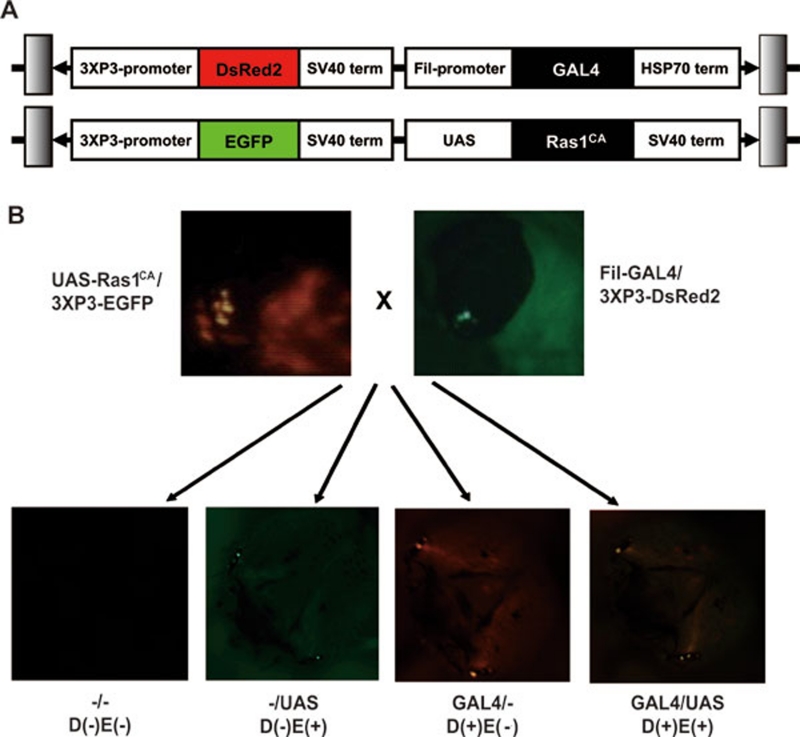
Figure 1
Figure 1
The binary GAL4/UAS transgenic silkworm system and 4 different phenotypes. (A) The GAL4 (pBac{Fil-GAL4-3XP3-DsRed}) and UAS (pBac{UAS-Ras1v12-3XP3-EGFP}) plasmid constructs. (B) The UAS lines are crossed with the GAL4 lines to generate the Fil-GAL4/UAS-Ras1CA lines, in which Ras1CA was specifically overexpressed in the posterior silk gland. The progeny of this crossing shows four different phenotypes in terms of eye color (1) neither DsRed2-positive nor EGFP-positive, wild type, [D(−)E(−)]; (2) only DsRed2-positive, GAL4 lines, [D(+)E(−)]; (3) only EGFP-positive, UAS lines, [D(−)E(+)]; and (4) both DsRed2-positive and EGFP-positive, GAL4/UAS lines, [D(+)E(+)].
Figure 2
Figure 2
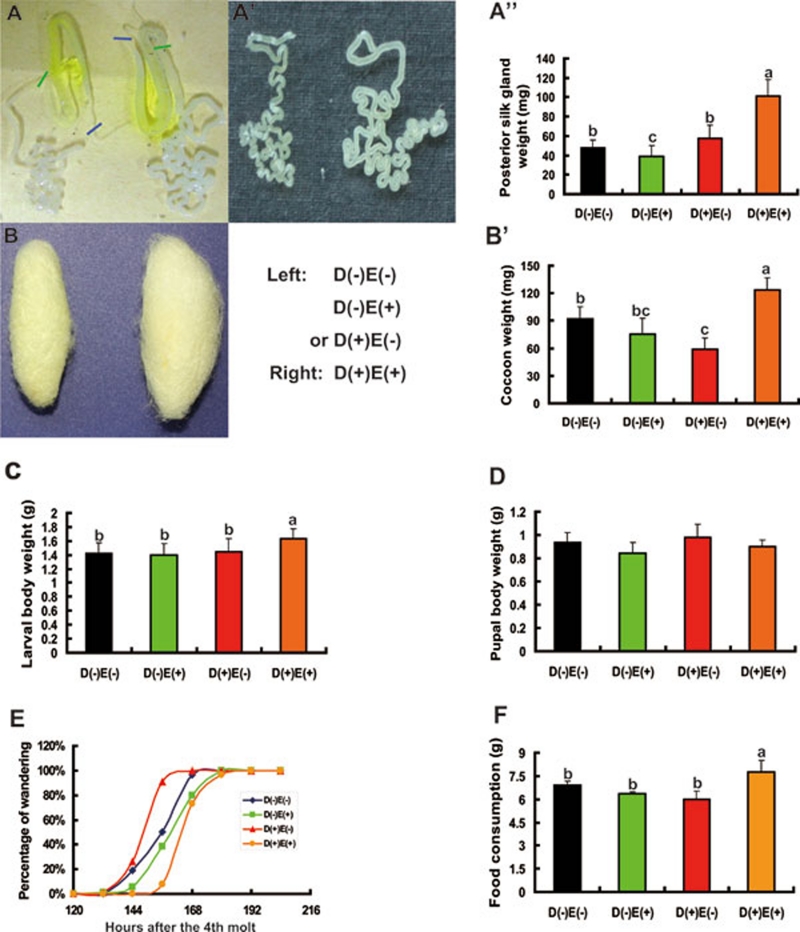
Increasing posterior silk gland size by Ras1CA overexpression greatly improves silk yield but has relatively little effects on food consumption. Three biological replicates are conducted and results from one replicate are presented. Mean ± SEM, n ≥ 25. The bars labeled with different lowercase letters are significantly different (P < 0.05, ANOVA). Data from females are shown. (A-A”) In comparison with the control silkworms: wild type [D(−)E(−)], Fil-GAL4 [D(+)E(−)], and UAS-Ras1CA [D(−)E(+)], posterior silk gland size in the transgenic silkworm Fil-GAL4/UAS-Ras1CA [D(+)E(+)] is significantly increased. (A) The anterior silk gland and the middle silk gland sizes from [D(+)E(+)] are not altered but its posterior silk gland size is increased. Blue arrow points to the area separating the anterior silk gland and the middle silk gland and green arrow points to the area separating the middle silk gland and the posterior silk gland. (A' and A”) A comparison of the posterior silk gland. (B and B') The cocoon weight of female [D(+)E(+)] is increased. (C) The larval body weight of female [D(+)E(+)] is increased. (D) The pupal body weight of female [D(+)E(+)] is not altered. It takes [D(+)E(+)] > 6 more hours to complete the feeding stage of the 5th instar. Food consumption by [D(+)E(+)] is increased.
Figure 3
Figure 3
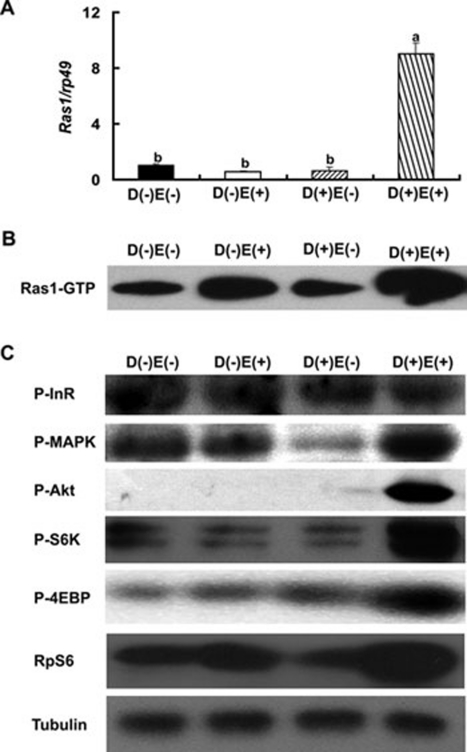
Ras1CA overexpression in the posterior silk gland increases Ras1 activity and stimulates phosphorylation of Ras downstream effectors as well as RpS6 protein level. Three biological replicates are conducted and results from one replicate are presented. Mean ± SEM. Five males and five females are used in each replicate. (A) Ras1 mRNA level in the posterior silk gland from [D(+)E(+)] is ∼10-fold higher than those from the control silkworms [D(−)E(−)], [D(+)E(−)] and [D(−)E(+)]. The bars labeled with different lowercase letters are significantly different (P < 0.05, ANOVA). (B) Ras activity in the posterior silk gland of [D(+)E(+)] is increased. (C) Phosphorylation levels of MAPK, Akt, S6K and 4EBP as well as RpS6 protein level, but not InR phosphorylation level in the posterior silk gland from [D(+)E(+)] is increased. Tubulin is used as a loading control.
Figure 4
Figure 4
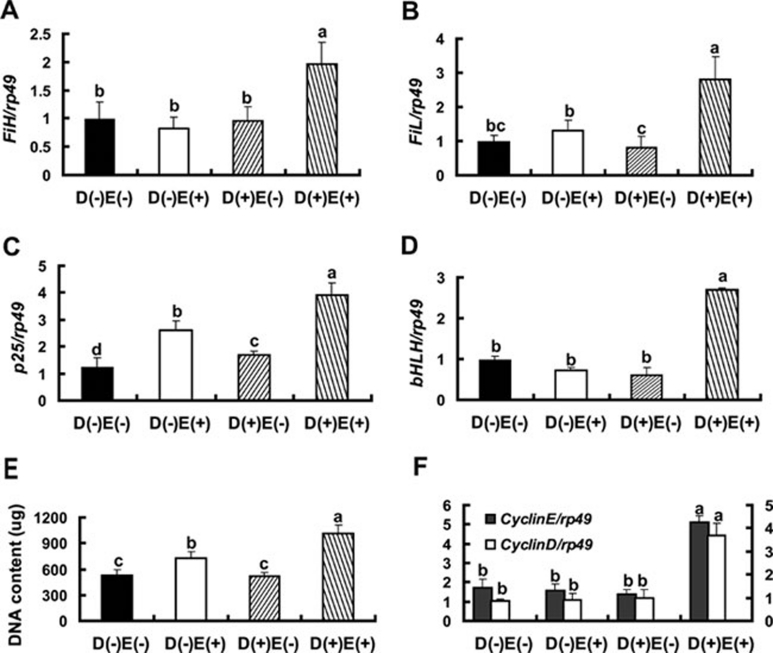
Ras1 activation in the posterior silk gland up-regulates fibroin protein mRNA levels, increases total DNA content, and stimulates endoreplication. Three biological replicates are conducted and results from one replicate are presented. Mean ± SEM. Five males and five females are used in each replicate. The bars labeled with different lowercase letters are significantly different (P < 0.05, ANOVA). (A-D) The mRNA levels of three major fibroin proteins genes, fibroin heavy chain (Fih) (A), fibroin light chain (Fil) (B) and p25 (C) as well as a transcription factor gene bHLH (D) in the posterior silk gland from [D(+)E(+)] are 2-3-fold in comparison with those in the control silkworms [D(−)E(−)], [D(+)E(−)] and [D(−)E(+)]. (E and F) Total DNA content (E) and the mRNA levels of Cyclin E (CycE) and Cyclin D (CycD) (F) in the posterior silk gland from [D(+)E(+)] are 2-3-fold in comparison with those in the controls.
Figure 5
Figure 5
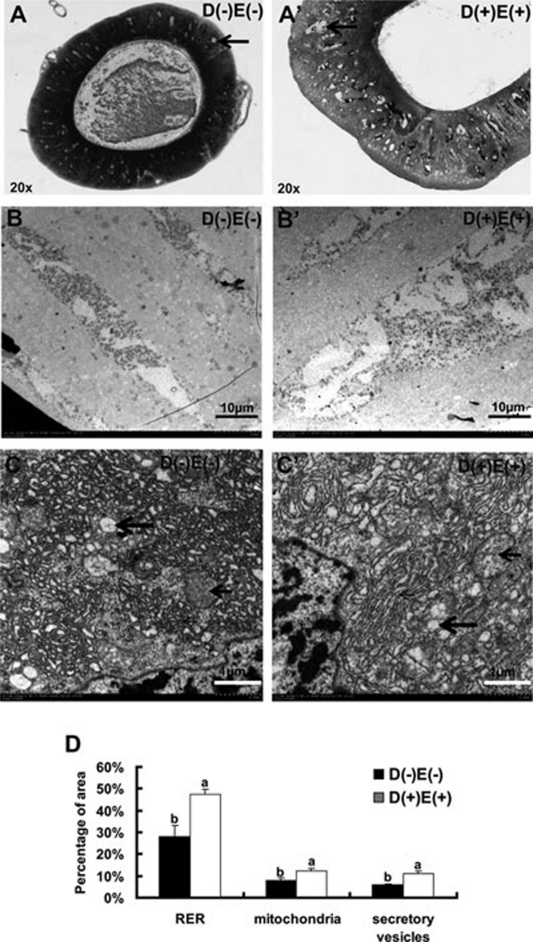
Ras1 activation in the posterior silk gland increases cell and nucleolus size and enriches subcellular organelles related to protein synthesis. (A and A') Optical microscopy observations of the posterior silk gland. Cell size and nuclei size (pointed by arrows) in the posterior silk gland of [D(+)E(+)] (A') was increased in comparison with [D(−)E(−)] (A). Females are used in these experiments. (B-C') Transmission electron microscopy observations of the posterior silk gland cell. The nuclei size of posterior silk gland cell from [D(+)E(+)] (B') is enlarged with regular morphology compared to [D(−)E(−)] (B). Subcellular organelles related to protein synthesis, including layer rough endoplasmic reticula (RER, short arrows), mitochondria (middle arrows) and secretory vesicles (long arrows) are enriched in the posterior silk gland cell of [D(+)E(+)] (C') in comparison with [D(−)E(−)] (C). (D) A statistic comparison of RER, mitochondria and secretory vesicles in the posterior silk gland cell of [D(+)E(+)] and [D(−)E(−)]. Mean ± SEM. The bars labeled with different lowercase letters are significantly different (P < 0.05, ANOVA).
Figure 6
Figure 6
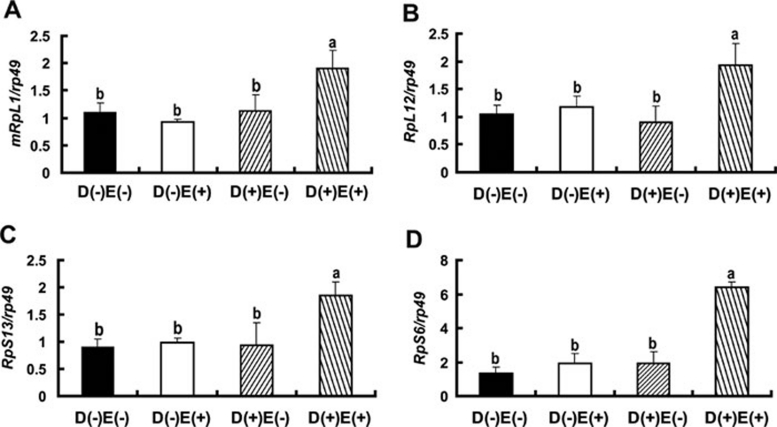
Ras1 activation in the posterior silk gland up-regulates ribosomal protein genes. The mRNA levels of 4 ribosomal protein genes, including mRpl1 (A), Rpl12 (B), RpS13 (C) and RpS6 (D) in the posterior silk gland from [D(+)E(+)] are 2-3-fold in comparison with those in the control silkworms [D(−)E(−)], [D(+)E(−)] and [D(−)E(+)].Three biological replicates are conducted and results from one replicate are presented. Mean ± STEDV. Five males and five females are used in each replicate. The bars labeled with different lowercase letters are significantly different (P < 0.05, ANOVA).

References

    1. Ribaut JM, de Vicente MC, Delannay X. Molecular breeding in developing countries: challenges and perspectives. Curr Opin Plant Biol. 2010;13:1–6.
    1. Yoshiaki M, Hirovvo I, Kiyoshi S, Keiko I, Yoichi M, Shuji H. Studies on the protein synthesis in silkglands V. The relation of ribosomes to endoplasmic reticulum during fibroin synthesis. J Biochemi. 1964;55:623–628. - PubMed
    1. Tashiro Y, Morimoto T, Matsuura S, Nagata S. Studies on the posterior silk gland of the silkworm Bombyx mori I. Growth of posterior silk gland cells and biosynthesis of fibroin during the fifth larval instar. J Cell Biol. 1968;38:574–588. - PMC - PubMed
    1. Shigematsu H, Kurata K, Takeshita H. Nucleic acids accumulation of silk gland of Bombyx mori in relation to silk protein. Comp Biochem Physiol B. 1978;61:237–242.
    1. Blaes N, Couble P, Prudhomme JC. The programming of silk-gland development in Bombyx mori. I. Effects of experimental starvation on growth, silk production, and autolysis during the fifth larval instar studied by electron microscopy. Cell Tissue Res. 1980;213:311–324. - PubMed

Publication types

MeSH terms