


Hepatic lipase, high density lipoproteins, and hypertriglyceridemia
- PMID: 21406176
- PMCID: PMC3078429
- DOI: 10.1016/j.ajpath.2010.12.050
Hepatic lipase, high density lipoproteins, and hypertriglyceridemia
Abstract
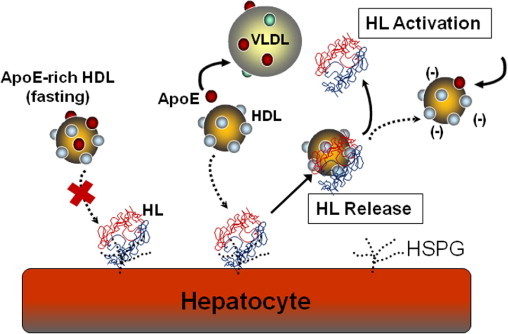
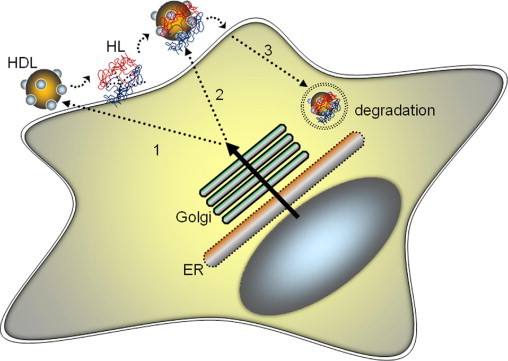
Hepatic lipase (HL) is a lipolytic enzyme that contributes to the regulation of plasma triglyceride (TG) levels. Elevated TG levels may increase the risk of developing coronary heart disease, and studies suggest that mutations in the HL gene may be associated with elevated TG levels and increased risk of coronary heart disease. Hepatic lipase facilitates the clearance of TG from the very low density lipoprotein (VLDL) pool, and this function is governed by the composition and quality of high density lipoprotein (HDL) particles. In humans, HL is a liver resident enzyme regulated by factors that release it from the liver and activate it in the bloodstream. HDL regulates the release of HL from the liver and HDL structure controls HL transport and activation in the circulation. Alterations in HDL-apolipoprotein composition can perturb HL function by inhibiting the release and activation of the enzyme. HDL structure may therefore affect plasma TG levels and coronary heart disease risk.
Copyright © 2011 American Society for Investigative Pathology. Published by Elsevier Inc. All rights reserved.
Figures
References
-
- Davignon J., Cohn J.S. Triglycerides: a risk factor for coronary heart disease. Atherosclerosis. 1996;124(Suppl):S57–S64. - PubMed
-
- Sarwar N., Sandhu M.S., Ricketts S.L., Butterworth A.S., Di Angelantonio E., Boekholdt S.M., Ouwehand W., Watkins H., Samani N.J., Saleheen D., Lawlor D., Reilly M.P., Hingorani A.D., Talmud P.J., Danesh J., Triglyceride Coronary Disease Genetics Consortium and Emerging Risk Factors Collaboration Triglyceride-mediated pathways and coronary disease: collaborative analysis of 101 studies. Lancet. 2010;375:1634–1639. - PMC - PubMed
-
- Goldberg I.J. Lipoprotein lipase and lipolysis: central roles in lipoprotein metabolism and atherogenesis. J Lipid Res. 1996;37:693–707. - PubMed
-
- Zambon A., Deeb S.S., Pauletto P., Crepaldi G., Brunzell J.D. Hepatic lipase: a marker for cardiovascular disease risk and response to therapy. Curr Opin Lipidol. 2003;14:179–189. - PubMed
-
- Baroni M.G., Berni A., Romeo S., Arca M., Tesorio T., Sorropago G., Di Mario U., Galton D.J. Genetic study of common variants at the Apo E, Apo AI, Apo CIII, Apo B, lipoprotein lipase (LPL), and hepatic lipase (LIPC) genes and coronary artery disease (CAD): variation in LIPC gene associates with clinical outcomes in patients with established CAD. BMC Med Genet. 2003;4:8–15. - PMC - PubMed
Publication types
MeSH terms
Substances
LinkOut - more resources
Full Text Sources
Medical
Miscellaneous
