


Dietary manipulation reveals an unexpected inverse relationship between fat mass and adipose 11β-hydroxysteroid dehydrogenase type 1
- PMID: 21406612
- PMCID: PMC3605916
- DOI: 10.1152/ajpendo.00531.2010
Dietary manipulation reveals an unexpected inverse relationship between fat mass and adipose 11β-hydroxysteroid dehydrogenase type 1
Abstract
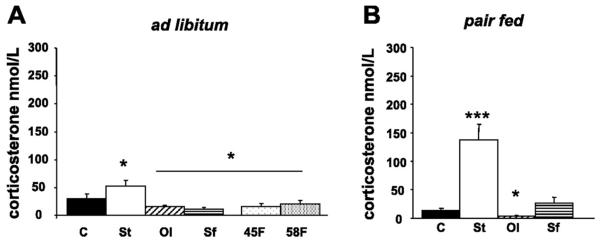
Increased dietary fat intake is associated with obesity, insulin resistance, and metabolic disease. In transgenic mice, adipose tissue-specific overexpression of the glucocorticoid-amplifying enzyme 11β-hydroxysteroid dehydrogenase type 1 (11β-HSD1) exacerbates high-fat (HF) diet-induced visceral obesity and diabetes, whereas 11β-HSD1 gene knockout ameliorates this, favoring accumulation of fat in nonvisceral depots. Paradoxically, in normal mice HF diet-induced obesity (DIO) is associated with marked downregulation of adipose tissue 11β-HSD1 levels. To identify the specific dietary fats that regulate adipose 11β-HSD1 and thereby impact upon metabolic disease, we either fed mice diets enriched (45% calories as fat) in saturated (stearate), monounsaturated (oleate), or polyunsaturated (safflower oil) fats ad libitum or we pair fed them a low-fat (11%) control diet for 4 wk. Adipose and liver mass and glucocorticoid receptor and 11β-HSD1 mRNA and activity levels were determined. Stearate caused weight loss and hypoinsulinemia, partly due to malabsorption, and this markedly increased plasma corticosterone levels and adipose 11β-HSD1 activity. Oleate induced pronounced weight gain and hyperinsulinemia in association with markedly low plasma corticosterone and adipose 11β-HSD1 activity. Weight gain and hyperinsulinemia was less pronounced with safflower compared with oleate despite comparable suppression of plasma corticosterone and adipose 11β-HSD1. However, with pair feeding, safflower caused a selective reduction in visceral fat mass and relative insulin sensitization without affecting plasma corticosterone or adipose 11β-HSD1. The dynamic depot-selective relationship between adipose 11β-HSD1 and fat mass strongly implicates a dominant physiological role for local tissue glucocorticoid reactivation in fat mobilization.
Figures



References
-
- Arner P. Differences in lipolysis between human subcutaneous and omental adipose tissues. Ann Med. 1995;27:435–438. - PubMed
-
- Berthiaume M, Laplante M, Festuccia W, Gélinas Y, Poulin S, Lalonde J, Joanisse DR, Thieringer R, Deshaies Y. Depot-specific modulation of rat intraabdominal adipose tissue lipid metabolism by pharmacological inhibition of 11beta-hydroxysteroid dehydrogenase type 1. Endocrinology. 2007;148:2391–2397. - PubMed
-
- Brown MS, Goldstein JL. Selective versus total insulin resistance: a pathogenic paradox. Cell Metab. 2008;7:95–96. - PubMed
Publication types
MeSH terms
Substances
Grants and funding
LinkOut - more resources
Full Text Sources
Research Materials
Miscellaneous
