. 2011 Mar;23(3):984-99.
doi: 10.1105/tpc.111.083071. Epub 2011 Mar 15.

Multiple facets of Arabidopsis seedling development require indole-3-butyric acid-derived auxin

Affiliations

Multiple facets of Arabidopsis seedling development require indole-3-butyric acid-derived auxin

Lucia C Strader et al. Plant Cell. 2011 Mar.

Abstract

Levels of auxin, which regulates both cell division and cell elongation in plant development, are controlled by synthesis, inactivation, transport, and the use of storage forms. However, the specific contributions of various inputs to the active auxin pool are not well understood. One auxin precursor is indole-3-butyric acid (IBA), which undergoes peroxisomal β-oxidation to release free indole-3-acetic acid (IAA). We identified ENOYL-COA HYDRATASE2 (ECH2) as an enzyme required for IBA response. Combining the ech2 mutant with previously identified iba response mutants resulted in enhanced IBA resistance, diverse auxin-related developmental defects, decreased auxin-responsive reporter activity in both untreated and auxin-treated seedlings, and decreased free IAA levels. The decreased auxin levels and responsiveness, along with the associated developmental defects, uncover previously unappreciated roles for IBA-derived IAA during seedling development, establish IBA as an important auxin precursor, and suggest that IBA-to-IAA conversion contributes to the positive feedback that maintains root auxin levels.


Figures
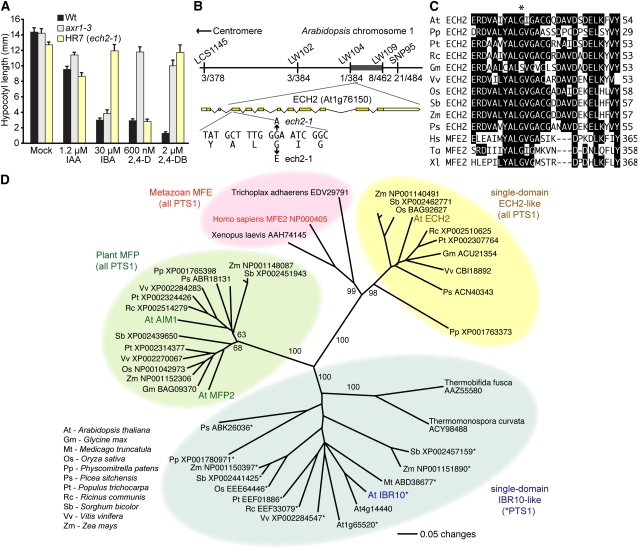
Figure 1.
Figure 1.
ECH2 Is Required for Hypocotyl IBA Response. (A) Mean hypocotyl lengths (+se; n ≥ 14) of dark-grown wild type (Wt), axr1-3, and isolate HR7 (ech2-1) on various natural and synthetic auxins. (B) Recombination mapping with the indicated markers (see Supplemental Table 2 online) localized HR7 to a 2-Mb region on chromosome 1 (dark bar) containing 592 predicted genes between LW104 and LW109 with 1/384 and 8/462 flanking recombinants. Examination of the ECH2 (At1g76150) gene in this region revealed a G-to-A mutation at position 371 in HR7 DNA that results in a Gly36-to-Glu substitution. (C) The ech2-1 mutation disrupts a conserved Gly (asterisk). Sequences from predicted ECH2 homologs (accession numbers in [D]) and MFE2 homologs were aligned using the MegAlign program (DNAStar; full alignment and accession numbers are in Supplemental Figure 5 online). (D) Phylogenetic tree of ECH2, IBR10, MFE2, MFP2, AIM1, and relatives. Protein portions corresponding to the hydratase domains were aligned using ClustalW (alignment in Supplemental Figure 6 online and Supplemental Data Set 1 online), and the unrooted phylogram was generated using PAUP 4.05b (Swofford, 2001) by performing the bootstrap method with 500 replicates. Bootstrap values are shown at the nodes.
Figure 2.
Figure 2.
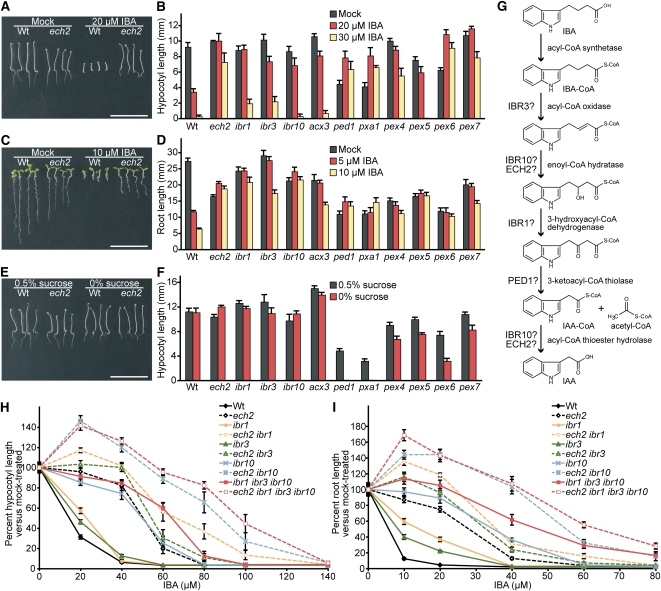
Hormone Responses of ech2 and Other Peroxisomal Mutants. (A) Five-day-old wild-type (Wt) and ech2-1 seedlings following growth in the dark on medium supplemented with ethanol (Mock) or 20 μM IBA. Bar = 1 cm. (B) Mean hypocotyl lengths (+se; n ≥ 12) of 5-d-old dark-grown wild-type, ech2-1, ibr1-2, ibr3-1, ibr10-1, acx3-6, ped1-96, pxa1-1, pex4-1, pex5-1, pex6-1, and pex7-2 grown on medium supplemented with ethanol (Mock) or IBA at concentrations indicated. (C) Eight-day-old wild-type and ech2-1 seedlings following growth in the light on medium supplemented with ethanol (mock) or 10 μM IBA. Bar = 1 cm. (D) Mean root lengths (+se; n ≥ 10) of 8-d-old seedlings listed in (B) grown in the light on medium supplemented with ethanol (Mock) or IBA at concentrations indicated. (E) Five-day-old wild-type and ech2-1 seedlings following growth in the dark in the presence (0.5%) and absence of an exogenous carbon source (sucrose). Bar = 1 cm. (F) Mean hypocotyl lengths (+se; n ≥ 12) of 5-d-old seedlings listed in (B) grown as in (E). (G) Schematic of a proposed IBA-to-IAA conversion pathway (Zolman et al., 2008) showing possible enzymatic activities for ECH2, IBR1, IBR3, and IBR10, along with the PED1 thiolase, which may act in both IBA and fatty acid β-oxidation. (H) ech2 enhances IBA resistance of ibr mutant hypocotyls. Mean hypocotyl lengths (+se; n ≥ 12) of 7-d-old wild-type, ech2-1, ibr1-2, ech2-1 ibr1-2, ibr3-1, ech2-1 ibr3-1, ibr10-1, ech2-1 ibr10-1, ibr1-2 ibr3-1 ibr10-1, and ech2-1 ibr1-2 ibr3-1 ibr10-1 pregerminated and then grown in the dark on medium supplemented with ethanol (0 μM IBA) or 20 to 140 μM IBA. (I) ech2 enhances IBA resistance of ibr mutant roots. Mean root lengths (+se; n ≥ 12) of 10-d-old lines listed in (H) that were pregerminated and then grown in the light on medium supplemented with ethanol (0 μM IBA) or 10 to 80 μM IBA.
Figure 3.
Figure 3.
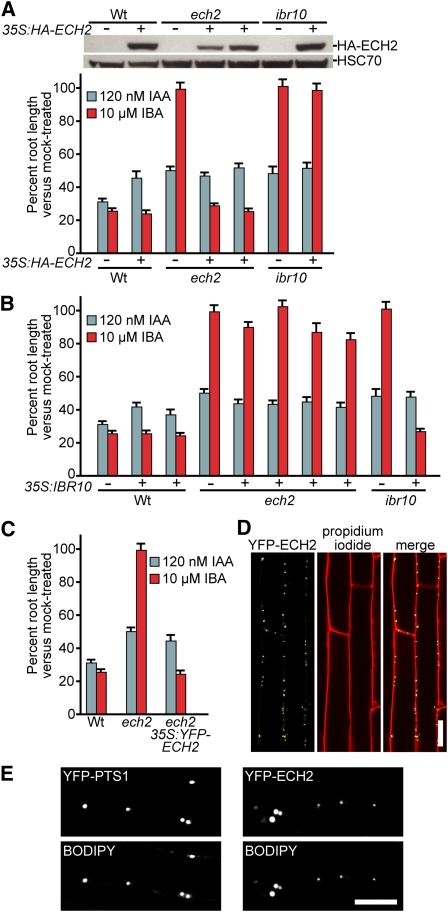
ech2 Is Rescued by ECH2 but Not IBR10. (A) Overexpression of HA-tagged ECH2 restores IBA sensitivity to ech2-1 but not ibr10-1. Top: Immunoblot analysis of (left to right) 5-d-old light-grown wild type (Wt), wild type carrying 35S:HA-ECH2, ech2-1, two independent ech2-1 lines carrying 35S:HA-ECH2, ibr10-1, and ibr10-1 carrying 35S:HA-ECH2. Anti-HA and anti-HSC70 antibodies were used to detect HA-ECH2 and HSC70 (loading control), respectively. Bottom: Mean normalized root lengths (+se; n ≥ 11) of 8-d-old light-grown lines shown in the immunoblot above the graph. (B) Overexpression of IBR10 restores IBA sensitivity to ibr10-1 but not ech2-1. Mean normalized root lengths (+se; n ≥ 9) of 8-d-old light-grown wild type, two independent wild-type lines carrying 35S:IBR10, ech2-1, four independent ech2-1 lines carrying 35S:IBR10, ibr10-1, and ibr10-1 carrying 35S:IBR10. (C) YFP-tagged ECH2 rescues ech2-1. Mean normalized root lengths (+se; n ≥ 11) of 8-d-old light-grown wild type, ech2-1, and ech2-1 carrying 35S:YFP-ECH2. (D) YFP-ECH2 localizes to punctate structures in Arabidopsis cells. Confocal images of root epidermal cells from 4-d-old ech2-1 expressing YFP-ECH2 counterstained with propidium iodide to visualize cell walls. Bar = 20 μm. (E) YFP-ECH2 localizes to peroxisomes in Arabidopsis cells. Confocal images of root epidermal cells from 4-d-old wild type expressing a peroxisomally targeted YFP derivative (YFP-PTS1; left panels) (px-yk; Nelson et al., 2007) and ech2-1 expressing YFP-ECH2 (right panels). The top panel of each pair shows the fusion protein fluorescence and the bottom panel of each pair shows fluorescence from 8-(4-nitrophenyl)-BODIPY, which allows visualization of peroxisomes (Landrum et al., 2010). Bar = 10 μm.
Figure 4.
Figure 4.
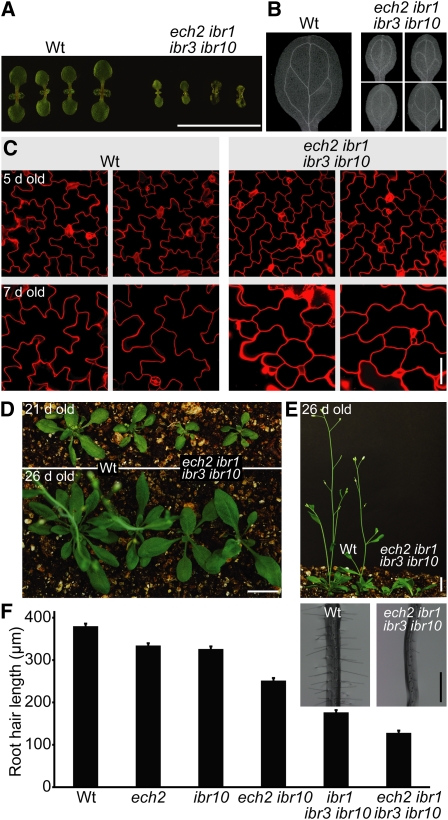
ech2 Enhances ibr1 ibr3 ibr10 Cell Expansion Defects. (A) Seven-day-old light-grown ech2-1 ibr1-2 ibr3-1 ibr10-1 seedlings display decreased cotyledon size compared with wild-type (Wt) seedlings. Bar = 1 cm. (B) Eight-day-old light-grown ech2-1 ibr1-2 ibr3-1 ibr10-1 seedlings display aberrant vascular patterning. Bar = 1 mm. (C) Five-day-old (top panels) and 7-d-old (bottom panels) ech2-1 ibr1-2 ibr3-1 ibr10-1 seedlings display small cotyledon epidermal cells. Confocal images of propidium iodide–stained cells are shown. Bar = 50 μm. (D) Soil-grown ech2-1 ibr1-2 ibr3-1 ibr10-1 plants are smaller than the wild type at 21 d (top panel) but begin to recover by 26 d (bottom panel). Two wild-type (left) and quadruple mutant (right) plants are shown. Bar = 1 cm. (E) Soil-grown ech2-1 ibr1-2 ibr3-1 ibr10-1 plants flower later than the wild type. Profile of plants shown in (D). Bar = 1 cm. (F) ech2 mutants display short root hairs. Mean root hair lengths (+se; n = 500) of 5-d-old wild-type, ech2-1, ibr10-1, ech2-1 ibr10-1, ibr1-2 ibr3-1 ibr10-1, and ech2-1 ibr1-2 ibr3-1 ibr10-1 light-grown seedlings. Inset: Root hairs from 5-d-old wild-type and ech2-1 ibr1-2 ibr3-1 ibr10-1 light-grown seedlings. Bar = 500 μm.
Figure 5.
Figure 5.
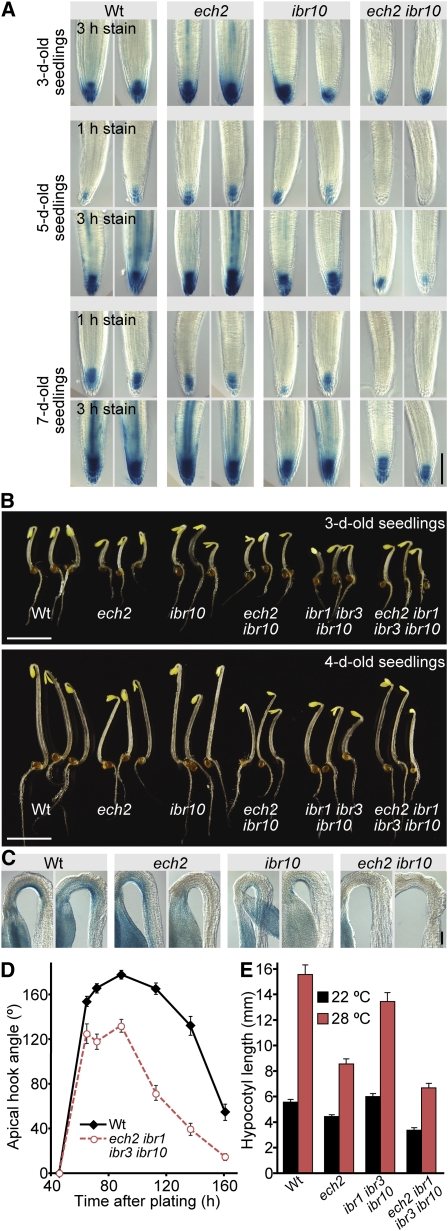
ech2 ibr10 Displays Decreased Auxin Reporter Activity, Apical Hook Formation, and High-Temperature Hypocotyl Elongation. (A) ech2 ibr10 displays decreased DR5-GUS activity in root tips. Three-, five-, and seven-day-old light-grown wild-type (Wt), ech2-1, ibr10-1, and ech2-1 ibr10-1 seedlings carrying the DR5-GUS construct (Ulmasov et al., 1997; Zolman et al., 2008) were stained for GUS activity for 1 or 3 h. Bar = 100 μm. (B) ech2 mutants display decreased apical hook formation. Three-day-old (top panel) or 4-d-old (bottom panel) wild-type, ech2-1, ibr10-1, ech2-1 ibr10-1, ibr1-2 ibr3-1 ibr10-1, and ech2-1 ibr1-2 ibr3-1 ibr10-1 dark-grown seedlings are shown. Bar = 0.5 cm. (C) ech2 ibr10 displays decreased DR5-GUS reporter activity in apical hooks. Three-day-old dark-grown wild-type, ech2-1, ibr10-1, and ech2-1 ibr10-1 seedlings carrying the DR5-GUS construct were stained for GUS activity for 4 h. Bar = 100 μm. (D) ech2 ibr1 ibr3 ibr10 displays decreased apical hook formation and maintenance. Mean apical hook angles (±se; n ≥ 20) of wild-type and ech2-1 ibr1-2 ibr3-1 ibr10-1 dark-grown seedlings are shown. (E) ech2 mutants display decreased high temperature–induced hypocotyl elongation. Mean hypocotyl lengths (+se; n = 16) of wild-type, ech2-1, ibr1-2 ibr3-1 ibr10-1, and ech2-1 ibr1-2 ibr3-1 ibr10-1 seedlings grown for 8 d at 22 or 28°C under yellow-filtered light.
Figure 6.
Figure 6.
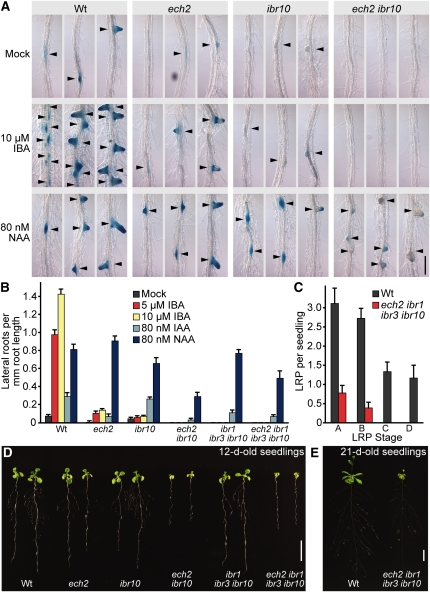
ech2 ibr10 and ech2 ibr1 ibr3 ibr10 Are Defective in Lateral Root Production. (A) ech2 ibr10 displays decreased DR5-GUS activity in lateral roots. Four-day-old light-grown wild-type (Wt), ech2-1, ibr10-1, and ech2-1 ibr10-1 seedlings carrying DR5-GUS were transferred to medium supplemented with ethanol (mock) or the indicated auxin and grown for an additional 4 d under yellow-filtered light at 22°C prior to staining for GUS activity for 1 h. Lateral roots and LRPs are highlighted with arrowheads. Bar = 200 μm. (B) ech2 mutants produce fewer lateral roots than the wild type. Emerged lateral roots of wild-type, ech2-1, ibr10-1, ech2-1 ibr10-1, ibr1-2 ibr3-1 ibr10-1, and ech2-1 ibr1-2 ibr3-1 ibr10-1 were counted 4 d after transfer of 4-d-old seedlings to medium supplemented with either ethanol (mock) or the indicated auxins (mean + se, n ≥ 12). (C) ech2 ibr1 ibr3 ibr10 displays fewer LRPs. Eight-day-old wild-type and ech2-1 ibr1-2 ibr3-1 ibr10-1 seedlings were cleared, and the number and stage of LRPs recorded (+se, n = 18). Stage A spans of the first anticlinal division of a pericycle cell to an LRP with three cell layers. Stage B includes unemerged lateral roots with more than three cell layers. Stage C includes emerged lateral roots shorter than 0.5 mm. Stage D consists of emerged lateral roots longer than 0.5 mm. (D) Twelve-day-old wild-type, ech2-1, ibr10-1, ech2-1 ibr10-1, ibr1-2 ibr3-1 ibr10-1, and ech2-1 ibr1-2 ibr3-1 ibr10-1 light-grown seedlings. Bar = 1 cm. (E) Twenty-one-day-old wild-type and ech2-1 ibr1-2 ibr3-1 ibr10-1 light-grown plants. Bar = 1 cm.
Figure 7.
Figure 7.
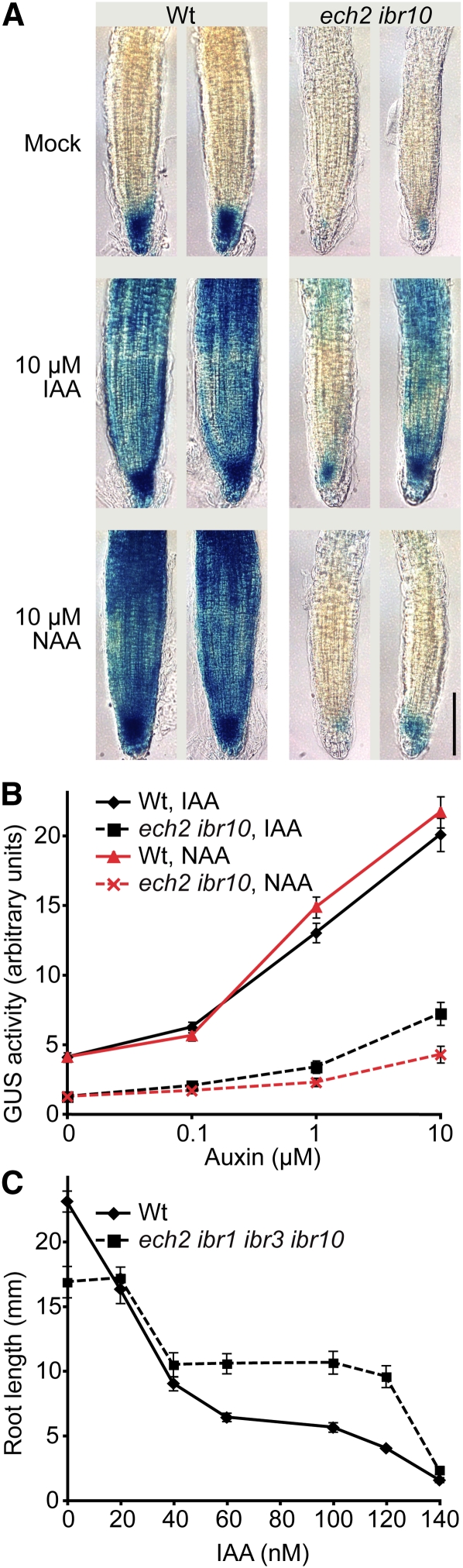
ech2 ibr10 Displays Decreased Auxin Reporter Activity in Response to Active Auxins. (A) Seven-day-old light-grown wild-type (Wt) and ech2-1 ibr10-1 seedlings carrying DR5-GUS were transferred to medium supplemented with ethanol (mock) or the indicated auxin and were incubated for 2 h at 22°C prior to staining for GUS activity for 1.5 h. Bar = 100 μm. (B) Mean GUS activity (±se; n = 16) of 7-d-old light-grown wild-type and ech2-1 ibr10-1 seedlings carrying DR5-GUS treated for 2 h with ethanol (mock treatment; 0 μM auxin) or the indicated auxin. (C) Mean root lengths (±se; n = 13) of 8-d-old light-grown wild-type and ech2-1 ibr1-2 ibr3-1 ibr10-1 seedlings grown on medium supplemented with ethanol (mock treatment; 0 nM IAA) or various concentrations of IAA.
Figure 8.
Figure 8.
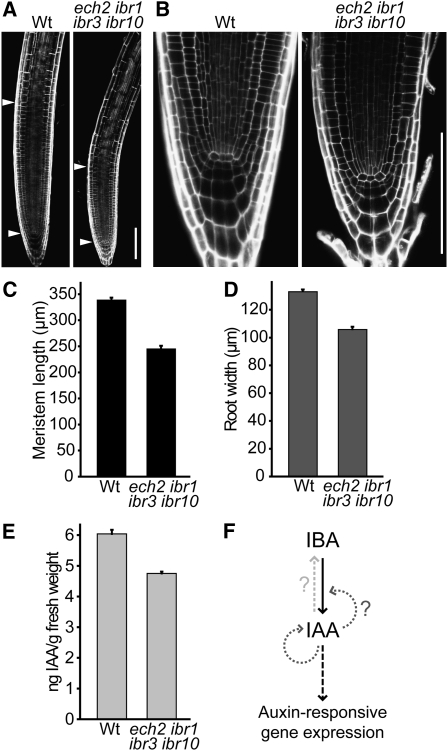
ech2 ibr1 ibr3 ibr10 Displays Meristem Defects and Decreased Auxin Levels. (A) Confocal images of propidium iodide–stained root tips from 7-d-old light-grown wild-type (Wt) and ech2-1 ibr1-2 ibr3-1 ibr10-1 seedlings. Arrowheads delineate the top and bottom of the root meristem. Bar = 100 μm. (B) Confocal images of propidium iodide–stained root tips from 7-d-old light-grown wild-type and ech2-1 ibr1-2 ibr3-1 ibr10-1 seedlings. Bar = 100 μm. (C) Mean meristem lengths (+se; n ≥ 47) of 8-d-old light-grown wild-type and ech2-1 ibr1-2 ibr3-1 ibr10-1 seedlings. (D) Mean root widths (+se; n ≥ 47) in the elongation zone of 8-d-old light-grown wild-type and ech2-1 ibr1-2 ibr3-1 ibr10-1 seedlings. (E) Mean IAA levels (+se; n ≥ 3) in 5-mm root tips from light-grown wild-type and ech2-1 ibr1-2 ibr3-1 ibr10-1 seedlings. (F) A model for the effects of IBA-to-IAA conversion on the auxin pool. IBA is converted to IAA in a process similar to peroxisomal fatty acid β-oxidation (solid black arrow). IAA also can be converted to IBA (dashed gray arrow; reviewed in Ludwig-Müller, 2000). Reduced DR5-GUS activity and decreased lateral root formation in ech2 ibr10 mutants treated with active auxins suggests that IBA-to-IAA conversion is necessary for full response to active auxins, either because auxin stimulates IBA-to-IAA conversion (positive feedback loops; dotted gray arrows) or because additional auxin is required to overcome the auxin deficit that results from blocking IBA-to-IAA conversion. Ultimately, increased auxin levels promote auxin signaling (dashed black arrow).

References

    1. Adham A.R., Zolman B.K., Millius A., Bartel B. (2005). Mutations in Arabidopsis acyl-CoA oxidase genes reveal distinct and overlapping roles in β-oxidation. Plant J. 41: 859–874 - PubMed
    1. Barkawi L.S., Tam Y.Y., Tillman J.A., Normanly J., Cohen J.D. (2010). A high-throughput method for the quantitative analysis of auxins. Nat. Protoc. 5: 1609–1618 - PubMed
    1. Barkawi L.S., Tam Y.Y., Tillman J.A., Pederson B., Calio J., Al-Amier H., Emerick M., Normanly J., Cohen J.D. (2008). A high-throughput method for the quantitative analysis of indole-3-acetic acid and other auxins from plant tissue. Anal. Biochem. 372: 177–188 - PubMed
    1. Casimiro I., Beeckman T., Graham N., Bhalerao R., Zhang H., Casero P., Sandberg G., Bennett M.J. (2003). Dissecting Arabidopsis lateral root development. Trends Plant Sci. 8: 165–171 - PubMed
    1. Cheng Y., Dai X., Zhao Y. (2006). Auxin biosynthesis by the YUCCA flavin monooxygenases controls the formation of floral organs and vascular tissues in Arabidopsis. Genes Dev. 20: 1790–1799 - PMC - PubMed

Publication types

LinkOut - more resources