Effect of magnesium ions and temperature on the sequence-dependent curvature of DNA restriction fragments
- PMID: 21406776
- PMCID: PMC3151479
- DOI: 10.1088/0953-8984/22/49/494110
Effect of magnesium ions and temperature on the sequence-dependent curvature of DNA restriction fragments
Abstract
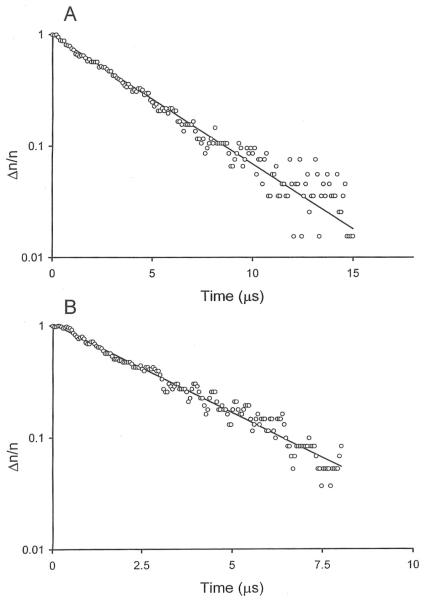
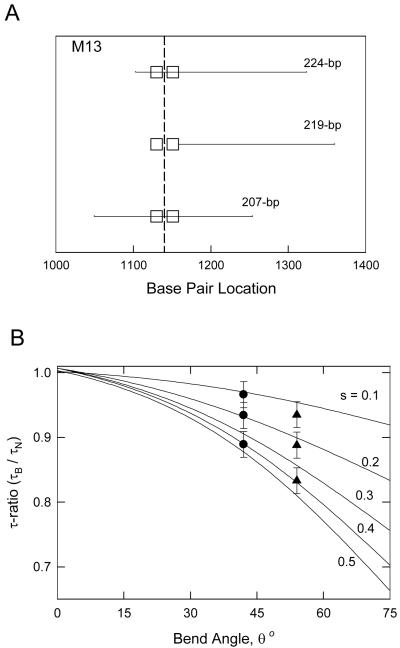
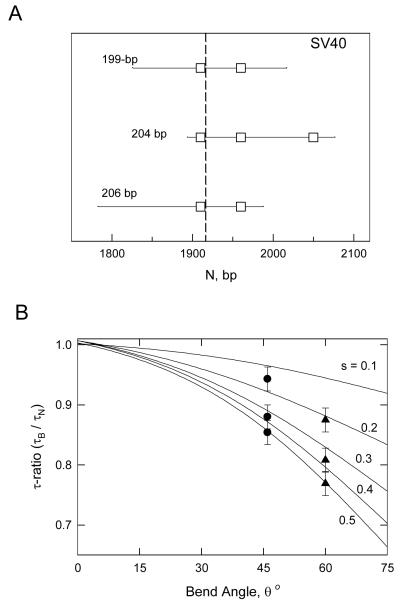
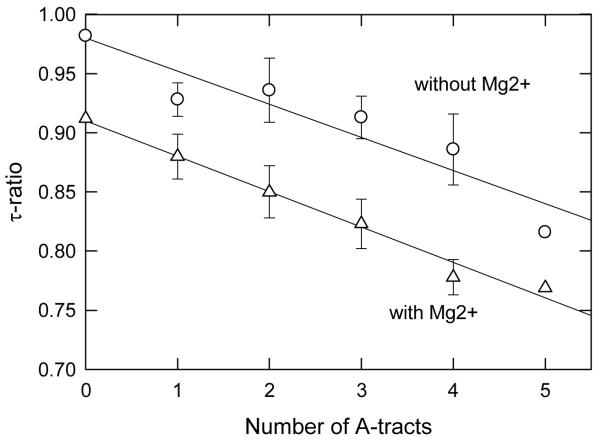
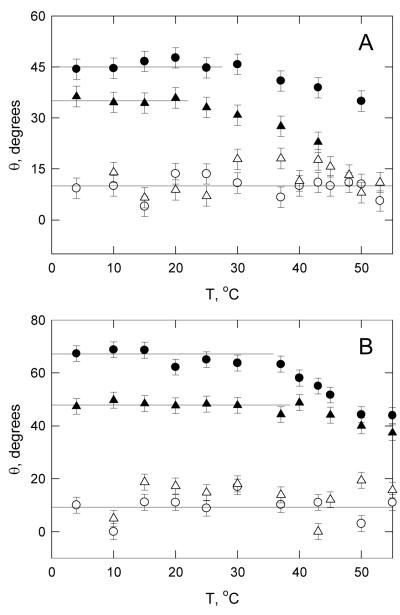
Transient electric birefringence has been used to quantify the curvature of two DNA restriction fragments, a 199-base-pair fragment taken from the origin of replication of the M13 bacteriophage and a 207-base-pair fragment taken from the VP1 gene in the SV40 minichromosome. Stable curvature in the SV40 and M13 restriction fragments is due to a series of closely spaced A tracts, runs of 4-6 contiguous adenine residues located within 40 or 60 base pair 'curvature modules' near the center of each fragment. The M13 and SV40 restriction fragments exhibit bends of ∼ 45° in solutions containing monovalent cations and ∼ 60° in solutions containing Mg(2 +) ions. The curvature is not localized at a single site but is distributed over the various A tracts in the curvature modules. Thermal denaturation studies indicate that the curvature in the M13 and SV40 restriction fragments remains constant up to 30 °C in solutions containing monovalent cations, and up to 40 °C in solutions containing Mg(2 +) ions, before beginning to decrease slowly with increasing temperature. Hence, stable curvature in these DNA restriction fragments exists at the biologically important temperature of 37 °C.
Figures

References
-
- Hagerman P. Annu. Rev. Biophys. Biophys. Chem. 1988;17:265–286. - PubMed
-
- Lu YJ, Weers B, Stellwagen NC. Biopolymers. 2002;61:261–275. - PubMed
-
- Olson WK, Zhurkin VB. Biological Structure and Dynamics. Adenine Press; Schenectady, NY: 1996. pp. 341–370.
-
- Hud NV, Plavec J. Biopolymers. 2003;69:144–159. - PubMed
-
- Haran TE, Mohanty U. Q. Rev. Biophys. 2009;42:41–81. - PubMed
Grants and funding
LinkOut - more resources
Full Text Sources