


Fluid intake and incidence of renal cell carcinoma in UK women
- PMID: 21407222
- PMCID: PMC3101943
- DOI: 10.1038/bjc.2011.90
Fluid intake and incidence of renal cell carcinoma in UK women
Abstract
Background: It has been suggested that the apparent protective effect of alcohol intake on renal cell carcinoma may be due to the diluting effect of carcinogens by a high total fluid intake. We assessed the association between intakes of total fluids and of specific beverages on the risk of renal cell carcinoma in a large prospective cohort of UK women.
Methods: Information on beverage consumption was obtained from a questionnaire sent ∼3 years after recruitment into the Million Women Study. Cox proportional hazards models were used to estimate relative risks (RRs) and 95% confidence intervals (CIs) for renal cell carcinoma associated with beverage consumption adjusted for age, region of residence, socioeconomic status, smoking, and body mass index.
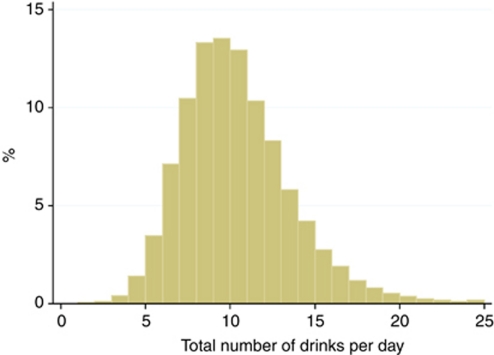
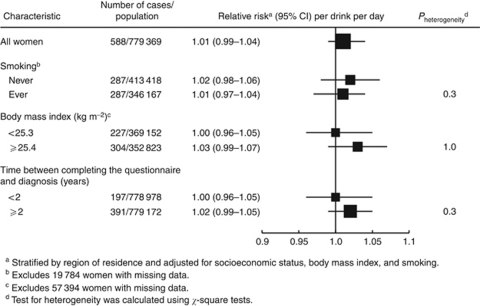
Results: After an average of 5.2 years of follow-up, 588 cases of renal cell carcinoma were identified among 779,369 women. While alcohol intake was associated with a reduced risk of renal cell carcinoma (RR for ≥ 2 vs <1 drink per day: 0.76; 95% CI: 0.61-0.96; P for trend=0.02), there was no association with total fluid intake (RR for ≥ 12 vs <7 drinks per day: 1.15; 95% CI: 0.91-1.45; P for trend=0.3) or with intakes of specific beverages.
Conclusions: The apparent protective effect of alcohol on the risk of renal cell carcinoma is unlikely to be related to a high fluid intake.
Conflict of interest statement
The authors declare no conflict of interest.
Figures
References
-
- Allen NE, Beral V, Casabonne D, Kan SW, Reeves GK, Brown A, Green J (2009) Moderate alcohol intake and cancer incidence in women. J Natl Cancer Inst 101: 296–305 - PubMed
-
- Asal NR, Risser DR, Kadamani S, Geyer JR, Lee ET, Cherng N (1988) Risk factors in renal cell carcinoma: I. Methodology, demographics, tobacco, beverage use, and obesity. Cancer Detect Prev 11: 359–377 - PubMed
-
- Benhamou S, Lenfant MH, Ory-Paoletti C, Flamant R (1993) Risk factors for renal-cell carcinoma in a French case-control study. Int J Cancer 55: 32–36 - PubMed
Publication types
MeSH terms
Substances
Grants and funding
LinkOut - more resources
Full Text Sources
Medical
