. 2011 Mar 9;6(3):e17460.
doi: 10.1371/journal.pone.0017460.

Development of social vocalizations in mice

Affiliations

Development of social vocalizations in mice

Jasmine M S Grimsley et al. PLoS One. .

Abstract

Adult mice are highly vocal animals, with both males and females vocalizing in same sex and cross sex social encounters. Mouse pups are also highly vocal, producing isolation vocalizations when they are cold or removed from the nest. This study examined patterns in the development of pup isolation vocalizations, and compared these to adult vocalizations. In three litters of CBA/CaJ mice, we recorded isolation vocalizations at ages postnatal day 5 (p5), p7, p9, p11, and p13. Adult vocalizations were obtained in a variety of social situations. Altogether, 28,384 discrete vocal signals were recorded using high-frequency-sensitive equipment and analyzed for syllable type, spectral and temporal features, and the temporal sequencing within bouts. We found that pups produced all but one of the 11 syllable types recorded from adults. The proportions of syllable types changed developmentally, but even the youngest pups produced complex syllables with frequency-time variations. When all syllable types were pooled together for analysis, changes in the peak frequency or the duration of syllables were small, although significant, from p5 through p13. However, individual syllable types showed different, large patterns of change over development, requiring analysis of each syllable type separately. Most adult syllables were substantially lower in frequency and shorter in duration. As pups aged, the complexity of vocal bouts increased, with a greater tendency to switch between syllable types. Vocal bouts from older animals, p13 and adult, had significantly more sequential structure than those from younger mice. Overall, these results demonstrate substantial changes in social vocalizations with age. Future studies are required to identify whether these changes result from developmental processes affecting the vocal tract or control of vocalization, or from vocal learning. To provide a tool for further research, we developed a MATLAB program that generates bouts of vocalizations that correspond to mice of different ages.


Conflict of interest statement

Competing Interests: The authors have declared that no competing interests exist.

Figures

Figure 1
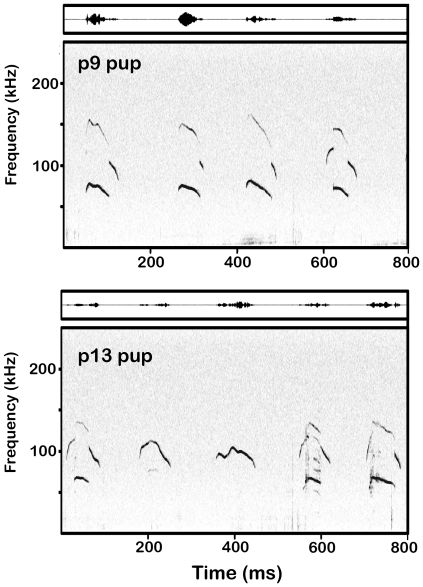
Figure 1. Spectrograms and waveforms of typical syllables recorded from CBA/CaJ pups.
All of the syllables shown from a p9 pup (top) have frequency steps and one harmonic, the sound levels of consecutive syllables varied substantially. The final two syllables shown from a p13 pup (bottom) have nonlinearities within their 2nd elements.
Figure 2
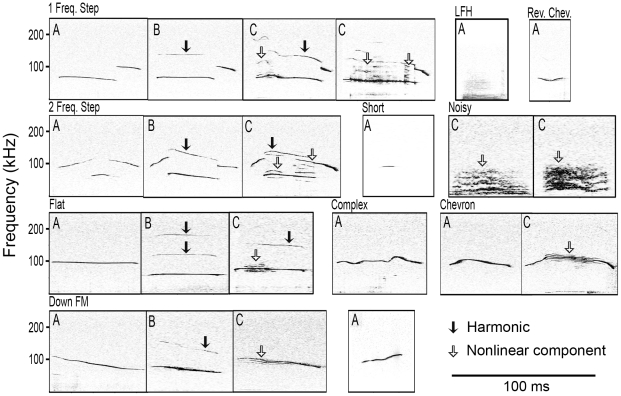
Figure 2. Spectrograms of the different syllable types produced by CBA/CaJ mice.
The majority of syllables have energy solely in the ultrasonic range (20 kHz) with the exception of the Noisy syllable and the low frequency harmonic (LFH) syllable. Note substantial energy at frequencies above 100 kHz for many syllables. Tonal syllables are marked (A); these syllables have no harmonics or nonlinearities. Harmonic sounds are marked with a (B). Nonlinear sounds are marked with a (C); these syllables have subharmonics or deterministic chaotic elements.
Figure 3
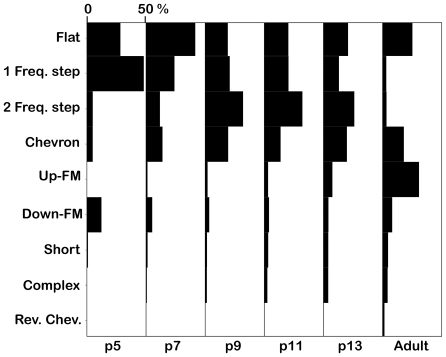
Figure 3. Changes in the proportions of syllable types across postnatal development.
Each column shows proportions of most common syllables at the specified age. The proportions of the noisy syllable are not shown as it was only produced very rarely by adult mice, representing only 0.6% (44/6936) of syllables.
Figure 4
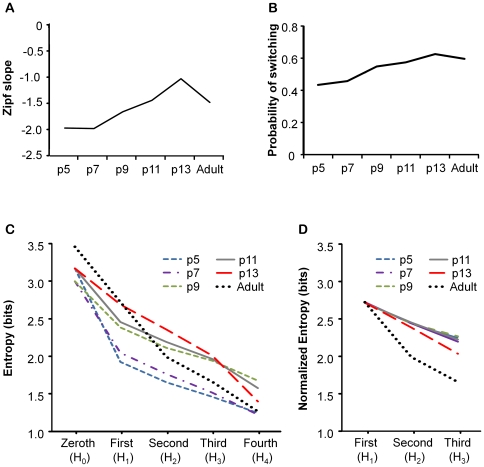
Figure 4. Change in the sequencing of syllables within bouts, across age.
(A) The Zipf slopes increase with age, showing that the repertoire became less repetitious with increasing age. (B) The probability of a switch between syllables, in consecutive calls, increased with age. (C) For mice of different age groups, entropy declines as function of structural order. The negative slope indicates a higher-order structure in the syllable sequences at each age. (D) Slopes of the first to third order entropies, normalized to the value for adults for graphical purposes only. Note that the negative slope is steeper for p13 pups than for the younger pups, indicating greater higher-order structure within song bouts. P13 animals had significantly more sequential structure than younger animals. Adults had significantly more sequential structure than pups at any age.
Figure 5
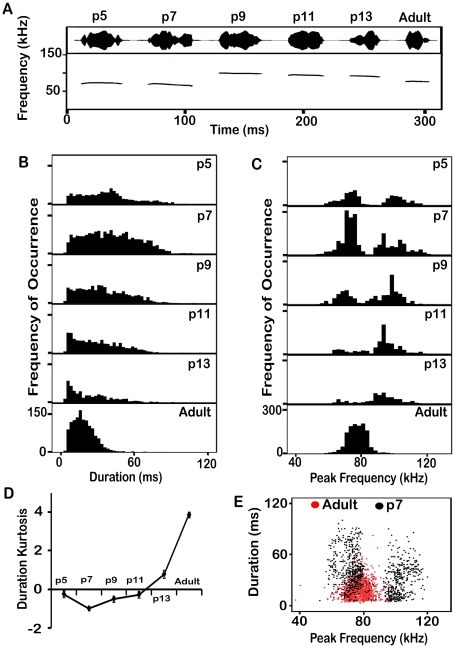
Figure 5. Analysis of the duration and frequency of flat syllables across ages.
(A) The most typical flat syllable at each age. (B) Distributions of durations of the flat syllable at each age. Older pups are progressively less likely to produce longer flat syllables. (C) Distributions of the dominant frequency of the flat syllables at each age. At p5, p7 and p9 there are two clear peaks in the distribution, but by p11 there are fewer low frequency syllables. The frequency of the higher peak gradually reduces with age. (D) The kurtosis of the duration distribution gets more positive with age, indicating a more peaked distribution of duration. Bars represent the standard error of the mean. (E) Scatter plots of duration against frequency for flat syllables from animals aged p7 and adults. Although there is some overlap, the frequencies of adult syllables fall between those of the pup syllables.
Figure 6
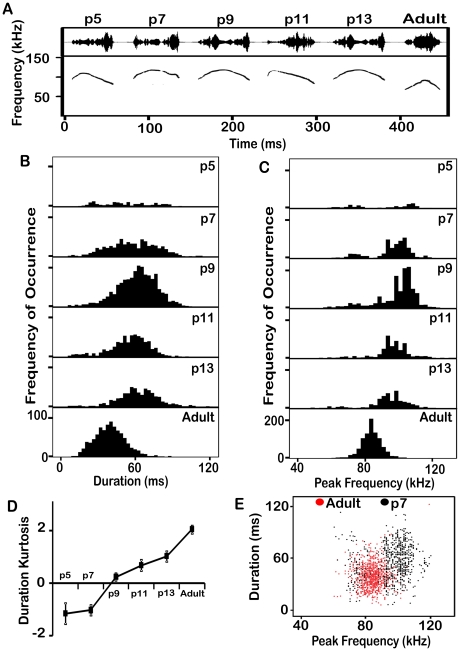
Figure 6. Analysis of the duration and frequency of chevron syllables across ages.
(A) The most typical chevron syllable at each age. Note the similarity of pup syllables. (B) Distributions of durations of the chevron syllable at each age. The mean duration changes only slightly. (D) The Kurtosis of the distribution increases with age. Bars represent the standard error of the mean. (C) Distributions of the dominant frequency of the chevron syllable at each age. At p5 and p7 there are two clear peaks in the distribution, but by p9 there are fewer low frequency syllables being produced. The frequency of the higher peak gradually reduces with age. (E) Scatter plots of duration against frequency from animals aged p7 and adults. Although there is some overlap, the spectro-temporal features of adult syllables are distinct from pup syllables.
Figure 7
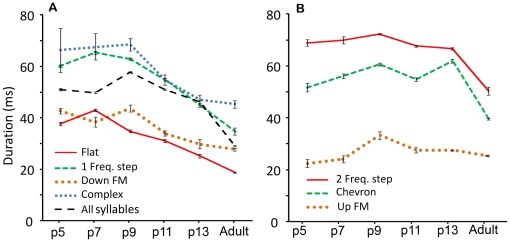
Figure 7. Developmental changes in syllable duration.
The means and standard errors of the durations are shown. (A) These syllables showed a progressive decrease in duration over development. The average durations across all syllables (dashed black line) reflect the pattern of these individual syllable types. (B) These syllables had more complex patterns of duration change across age. Age-dependent durations of the short syllable are not shown, as the criterion for classifying it was duration dependent.
Figure 8
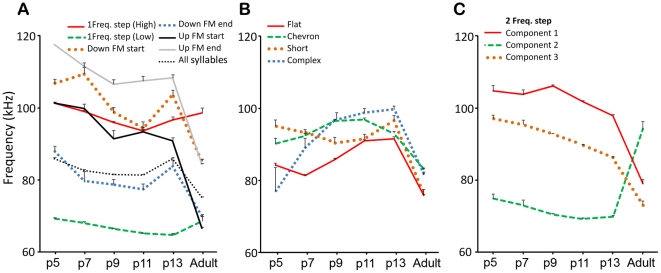
Figure 8. Changes in frequencies for each of several syllables, and for all syllables (dotted black line).
(A) Dominant frequencies declined somewhat with pup age. (B) Syllable types that showed an increase in dominant frequency with pup age. In all cases, dominant frequency declined between p13 pups and adults. (C) The dominant frequencies of the three components of the 2 freq. step syllable; the stepped pattern was reversed for adult animals.
Figure 9
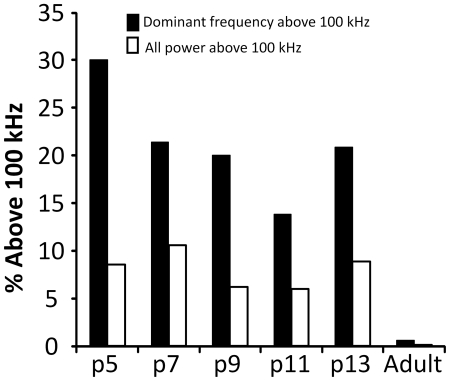
Figure 9. Syllables with dominant frequencies above 100 kHz are common in pups but not adults.
Figure 10
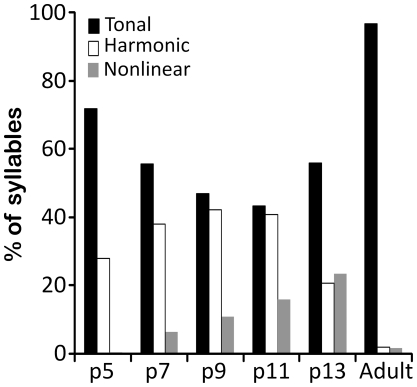
Figure 10. Harmonic and non-linear syllables are common in pups but not adults.
With increasing pup age the proportion that had nonlinearities changed significantly (X2 (5, N = 2416) = 1417, p<0.001); increasing steadily developmentally. There were also significant changes in the proportions of harmonic syllables (X2 (5, N = 7672) = 1091, p<0.001). Adult mouse syllables were almost always tonal, the proportions of tonal syllables changed significantly over development (X2 (5, N = 17915) = 1737, p<0.001).
Figure 11
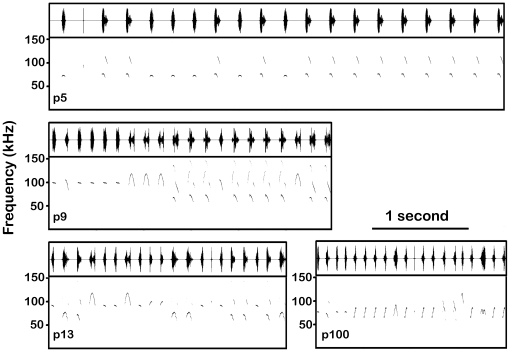
Figure 11. Spectrograms of syllable bouts generated by the Virtual Mouse Vocal Organ.
Syllable bouts correspond to mice aged p5, p9, p13 and adult.

References

    1. Panksepp JB, Jochman KA, Kim JU, Koy JJ, Wilson ED, et al. Affiliative behavior, ultrasonic communication and social reward are influenced by genetic variation in adolescent mice. PLoS One. 2007;2:e351. - PMC - PubMed
    1. Gourbal BE, Barthelemy M, Petit G, Gabrion C. Spectrographic analysis of the ultrasonic vocalisations of adult male and female BALB/c mice. Naturwissenschaften. 2004;91:381–385. - PubMed
    1. Maggio JC, Whitney G. Ultrasonic vocalizing by adult female mice (Mus musculus). J Comp Psychol. 1985;99:420–436. - PubMed
    1. Stowers L, Holy TE, Meister M, Dulac C, Koentges G. Loss of sex discrimination and male-male aggression in mice deficient for TRP2. Science. 2002;295:1493–1500. - PubMed
    1. Liu RC, Miller KD, Merzenich MM, Schreiner CE. Acoustic variability and distinguishability among mouse ultrasound vocalizations. J Acoust Soc Am. 2003;114:3412–3422. - PubMed

Publication types