


Short-term compassion training increases prosocial behavior in a newly developed prosocial game
- PMID: 21408020
- PMCID: PMC3052380
- DOI: 10.1371/journal.pone.0017798
Short-term compassion training increases prosocial behavior in a newly developed prosocial game
Abstract
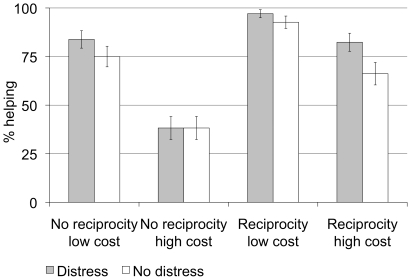
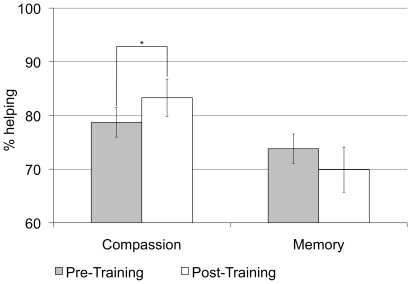
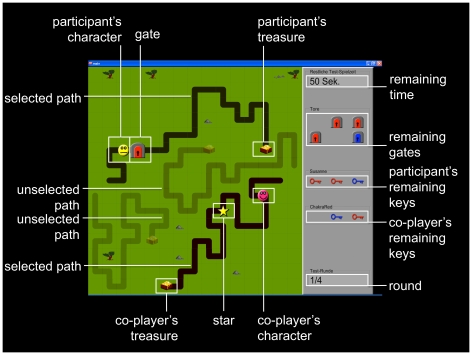
Compassion has been suggested to be a strong motivator for prosocial behavior. While research has demonstrated that compassion training has positive effects on mood and health, we do not know whether it also leads to increases in prosocial behavior. We addressed this question in two experiments. In Experiment 1, we introduce a new prosocial game, the Zurich Prosocial Game (ZPG), which allows for repeated, ecologically valid assessment of prosocial behavior and is sensitive to the influence of reciprocity, helping cost, and distress cues on helping behavior. Experiment 2 shows that helping behavior in the ZPG increased in participants who had received short-term compassion training, but not in participants who had received short-term memory training. Interindividual differences in practice duration were specifically related to changes in the amount of helping under no-reciprocity conditions. Our results provide first evidence for the positive impact of short-term compassion training on prosocial behavior towards strangers in a training-unrelated task.
Conflict of interest statement
Figures
References
-
- Baumeister RF, Vohs KD. Sage; 2007. Encyclopedia of social psychology.
-
- Singer T, Steinbeis N. Differential roles of fairness- and compassion-based motivations for cooperation, defection, and punishment. Ann NY Acad Sci. 2009;1167:41–50. - PubMed
-
- Fehr C, Sprecher S, Underwood L. Chichester: Wiley; 2009. The Science of Compassionate Love: Theory Research and Application.
-
- Davis MH. Measuring individual differences in empathy: Evidence for a multidimensional approach. J Pers Soc Psychol. 1983;44:113–126.
-
- Batson CD. “These things called empathy: eight related but distinct phenomena”. In: Decety J, Ickes W, editors. The Social Neuroscience of Empathy. Cambridge: MIT press; 2009. pp. 3–15.
MeSH terms
LinkOut - more resources
Full Text Sources
Medical
