Trypanosoma cruzi utilizes the host low density lipoprotein receptor in invasion
- PMID: 21408103
- PMCID: PMC3051337
- DOI: 10.1371/journal.pntd.0000953
Trypanosoma cruzi utilizes the host low density lipoprotein receptor in invasion
Abstract
Background: Trypanosoma cruzi, an intracellular protozoan parasite that infects humans and other mammalian hosts, is the etiologic agent in Chagas disease. This parasite can invade a wide variety of mammalian cells. The mechanism(s) by which T. cruzi invades its host cell is not completely understood. The activation of many signaling receptors during invasion has been reported; however, the exact mechanism by which parasites cross the host cell membrane barrier and trigger fusion of the parasitophorous vacuole with lysosomes is not understood.
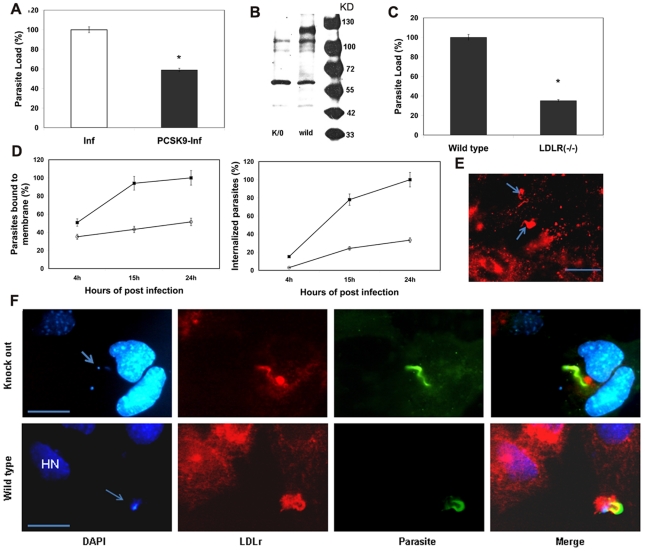
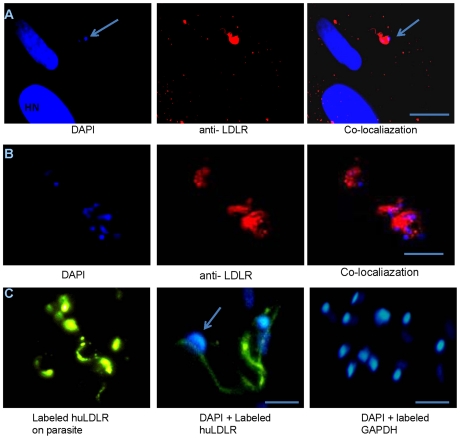
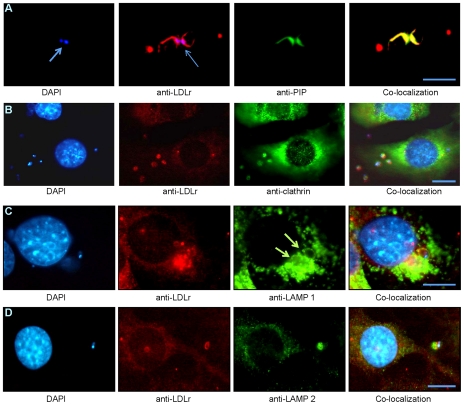
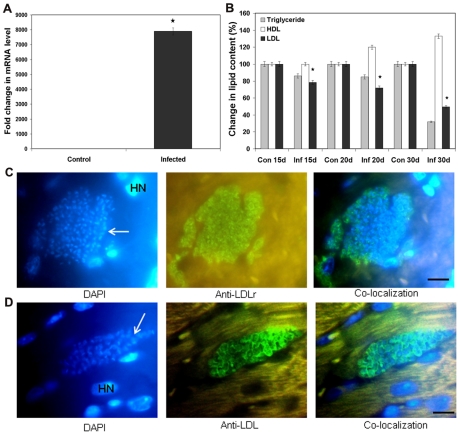
Methodology/principal findings: In order to explore the role of the Low Density Lipoprotein receptor (LDLr) in T. cruzi invasion, we evaluated LDLr parasite interactions using immunoblot and immunofluorescence (IFA) techniques. These experiments demonstrated that T. cruzi infection increases LDLr levels in infected host cells, inhibition or disruption of LDLr reduces parasite load in infected cells, T. cruzi directly binds recombinant LDLr, and LDLr-dependent T. cruzi invasion requires PIP2/3. qPCR analysis demonstrated a massive increase in LDLr mRNA (8000 fold) in the heart of T. cruzi infected mice, which is observed as early as 15 days after infection. IFA shows a co-localization of both LDL and LDLr with parasites in infected heart.
Conclusions/significance: These data highlight, for the first time, that LDLr is involved in host cell invasion by this parasite and the subsequent fusion of the parasitophorous vacuole with the host cell lysosomal compartment. The model suggested by this study unifies previous models of host cell invasion for this pathogenic protozoon. Overall, these data indicate that T. cruzi targets LDLr and its family members during invasion. Binding to LDL likely facilitates parasite entry into host cells. The observations in this report suggest that therapeutic strategies based on the interaction of T. cruzi and the LDLr pathway should be pursued as possible targets to modify the pathogenesis of disease following infection.
Conflict of interest statement
The authors have declared that no competing interests exist.
Figures

References
-
- Brown MS, Goldstein JL. A receptor-mediated pathway for cholesterol homeostasis. Science. 1986;232:34–47. - PubMed
-
- Sudhof TC, Russel DW, Goldstein JL, Brown MS. Casette of eight exons shared by genes for LDL receptor and EGF pecursor. Science. 1985;228:893–95. - PubMed
-
- Chen WJ, Goldstein L, Brown MS. NPXY, a sequence often found in cytoplasmic tails, is required for coated pit-mediated internalization of the low density lipoprotein receptor. J Biol Chem. 1990;265:3116–3123. - PubMed
Publication types
MeSH terms
Substances
Grants and funding
LinkOut - more resources
Full Text Sources