


Effects of weight loss in metabolically healthy obese subjects after laparoscopic adjustable gastric banding and hypocaloric diet
- PMID: 21408112
- PMCID: PMC3050899
- DOI: 10.1371/journal.pone.0017737
Effects of weight loss in metabolically healthy obese subjects after laparoscopic adjustable gastric banding and hypocaloric diet
Abstract
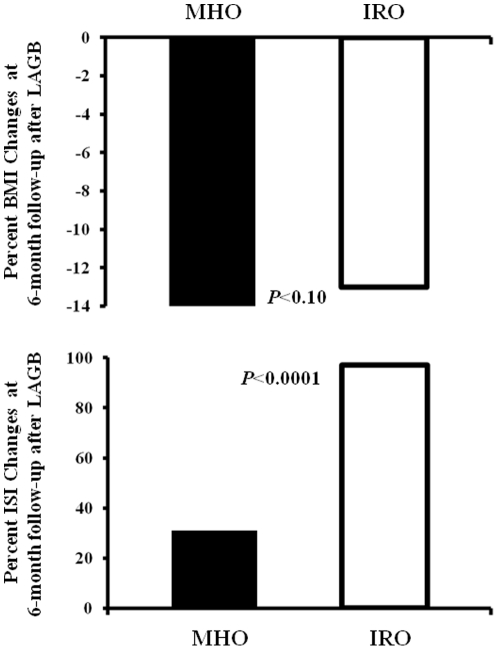
Weight loss in metabolically healthy obese (MHO) subjects may result in deterioration of cardio-metabolic risk profile. We analyzed the effects of weight loss induced by laparoscopic adjustable gastric banding (LAGB) on cardio-metabolic risk factors in MHO and insulin resistant obese (IRO) individuals. This study included 190 morbidly obese non-diabetic subjects. Obese individuals were stratified on the basis of their insulin sensitivity index (ISI), estimated from an OGTT, into MHO (ISI index in the upper quartile) and IRO (ISI in the three lower quartiles). Anthropometric and cardio-metabolic variables were measured at baseline and 6-months after LAGB. Six months after LAGB, anthropometric measures were significantly reduced in both MHO and IRO. Percent changes in body weight, BMI, and waist circumference did not differ between the two groups. Fasting glucose and insulin levels, triglycerides, AST, and ALT were significantly reduced, and HDL cholesterol significantly increased, in both MHO and IRO subjects with no differences in percent changes from baseline. Insulin sensitivity increased in both MHO and IRO group. Insulin secretion was significantly reduced in the IRO group only. However, the disposition index significantly increased in both MHO and IRO individuals with no differences in percent changes from baseline between the two groups. The change in insulin sensitivity correlated with the change in BMI (r = -0.43; P<0.0001). In conclusion, our findings reinforce the recommendation that weight loss in response to LAGB intervention should be considered an appropriate treatment option for morbidly obese individuals regardless of their metabolic status, i.e. MHO vs. IRO subjects.
Conflict of interest statement
Figures

References
-
- Wildman RP, Muntner P, Reynolds K, McGinn AP, Rajpathak S, et al. The obese without cardiometabolic risk factor clustering and the normal weight with cardiometabolic risk factor clustering: prevalence and correlates of 2 phenotypes among the US population (NHANES 1999-2004). Arch Intern Med. 2008;168:1617–1624. - PubMed
-
- Meigs JB, Wilson PW, Fox CS, Vasan RS, Nathan DM, et al. Body mass index, metabolic syndrome, and risk of type 2 diabetes or cardiovascular disease. J Clin Endocrinol Metab. 2006;91:2906–2912. - PubMed
-
- Brochu M, Tchernof A, Dionne IJ, Sites CK, Eltabbakh GH, et al. What are the physical characteristics associated with a normal metabolic profile despite a high level of obesity in postmenopausal women? J Clin Endocrinol Metab. 2001;86:1020–1025. - PubMed
