


Vegetarian dietary patterns are associated with a lower risk of metabolic syndrome: the adventist health study 2
- PMID: 21411506
- PMCID: PMC3114510
- DOI: 10.2337/dc10-1221
Vegetarian dietary patterns are associated with a lower risk of metabolic syndrome: the adventist health study 2
Abstract
Objective: The study objective was to compare dietary patterns in their relationship with metabolic risk factors (MRFs) and the metabolic syndrome (MetS).
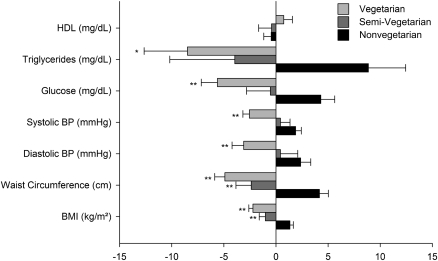
Research design and methods: Cross-sectional analysis of 773 subjects (mean age 60 years) from the Adventist Health Study 2 was performed. Dietary pattern was derived from a food frequency questionnaire and classified as vegetarian (35%), semi-vegetarian (16%), and nonvegetarian (49%). ANCOVA was used to determine associations between dietary pattern and MRFs (HDL, triglycerides, glucose, blood pressure, and waist circumference) while controlling for relevant cofactors. Logistic regression was used in calculating odds ratios (ORs) for MetS.
Results: A vegetarian dietary pattern was associated with significantly lower means for all MRFs except HDL (P for trend < 0.001 for those factors) and a lower risk of having MetS (OR 0.44, 95% CI 0.30-0.64, P < 0.001) when compared with a nonvegetarian dietary pattern.
Conclusions: A vegetarian dietary pattern is associated with a more favorable profile of MRFs and a lower risk of MetS. The relationship persists after adjusting for lifestyle and demographic factors.
Figures
References
-
- Ford ES. Risks for all-cause mortality, cardiovascular disease, and diabetes associated with the metabolic syndrome: a summary of the evidence. Diabetes Care 2005;28:1769–1778 - PubMed
-
- Djoussé L, Padilla H, Nelson TL, Gaziano JM, Mukamal KJ. Diet and metabolic syndrome. Endocr Metab Immune Disord Drug Targets 2010;10:124–137 - PubMed
-
- Chan J, Knutsen SF, Sabate J, Haddad E, Yan R, Fraser GE. Feasibility of running clinics to collect biological specimens in a nationwide cohort study—Adventist Health Study-2. Ann Epidemiol 2007;17:454–457 - PubMed
-
- Bachorik PS, Rock R, Cloey T, Treciak E, Becker D, Sigmund W. Cholesterol screening: comparative evaluation of on-site and laboratory-based measurements. Clin Chem 1990;36:255–260 - PubMed
Publication types
MeSH terms
Grants and funding
LinkOut - more resources
Full Text Sources
Medical
