Review
. 2011 Mar;2(3):135-64.
doi: 10.18632/oncotarget.240.

Ras/Raf/MEK/ERK and PI3K/PTEN/Akt/mTOR inhibitors: rationale and importance to inhibiting these pathways in human health

Affiliations
Review

Ras/Raf/MEK/ERK and PI3K/PTEN/Akt/mTOR inhibitors: rationale and importance to inhibiting these pathways in human health

William H Chappell et al. Oncotarget. 2011 Mar.

Abstract

The Ras/Raf/MEK/ERK and PI3K/PTEN/Akt/mTOR cascades are often activated by genetic alterations in upstream signaling molecules such as receptor tyrosine kinases (RTK). Integral components of these pathways, Ras, B-Raf, PI3K, and PTEN are also activated/inactivated by mutations. These pathways have profound effects on proliferative, apoptotic and differentiation pathways. Dysregulation of these pathways can contribute to chemotherapeutic drug resistance, proliferation of cancer initiating cells (CICs) and premature aging. This review will evaluate more recently described potential uses of MEK, PI3K, Akt and mTOR inhibitors in the proliferation of malignant cells, suppression of CICs, cellular senescence and prevention of aging. Ras/Raf/MEK/ERK and Ras/PI3K/PTEN/Akt/mTOR pathways play key roles in the regulation of normal and malignant cell growth. Inhibitors targeting these pathways have many potential uses from suppression of cancer, proliferative diseases as well as aging.


Figures
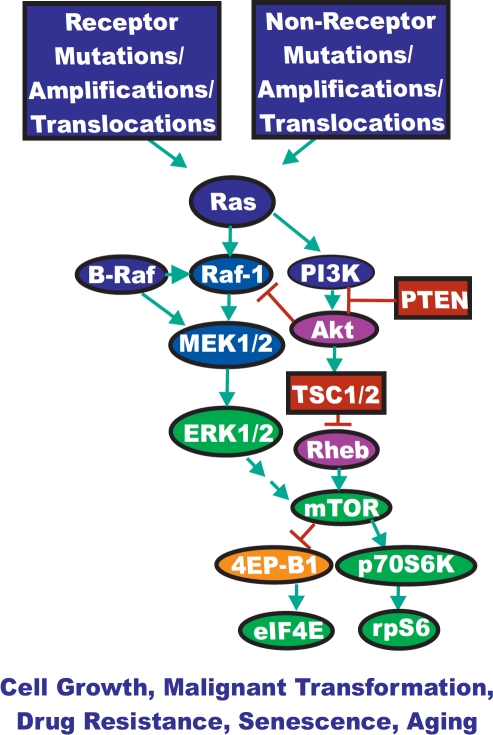
Figure 1
Figure 1. Dysregulated Expression of Upstream Receptors and Kinases Can Result in Activation of the Ras/Raf/MEK/ERK and Ras/PI3K/PTEN/Akt/mTOR Pathway
Sometimes dysregulated expression of growth factor receptors occurs by increased expression, genetic translocations or genomic amplifications which can lead to activation of the Ras/Raf/MEK/ERK and Ras/PI3K/PTEN/Akt/mTOR pathways. Alternatively chromosomal translocations can occur in non-receptor kinases and other genes which result in activation of these pathways. Genes in the Ras/Raf/MEK/ERK and Ras/PI3K/PTEN/Akt/mTOR pathways that have activating mutations detected in human cancer and proliferative diseases are indicated in blue ovals. Genes overexpressed in certain cancers are indicated in purple ovals. Tumor suppressor genes mutated in human cancer are indicated in red rectangles. Other key genes are indicated in green ovals. Genes inactivated by the Ras/PI3K/PTEN/Akt/mTOR pathway are indicated in orange ovals. Green arrows indicate activating events in pathways. Blocked red arrows indicating inactivating events in pathway.
Figure 2
Figure 2. Rationale for Targeting Both the Ras/Raf/MEK/ERK and Ras/PI3K/PTEN/Akt/mTOR Pathways for Suppressing Cancer Growth
A: The Ras/Raf/MEK/ERK and Ras/PI3K/PTEN/Akt/mTOR pathways are both activated by upstream receptor ligation and frequently co-regulate many downstream targets in parallel. Thus for effective elimination of many cancers or prevention of aging, it may be necessary to target both signaling pathways. Activation of these pathways could also result in increased transcription of many genes that promote cellular growth and malignant transformation. B. Inhibition of mTOR can result in the induction of autophagy, which is a very important mechanism of cell death, especially in solid tumors. C. As described previously, both the Ras/Raf/MEK/ERK and Ras/PI3K/PTEN/Akt/mTOR pathways regulate the activity of apoptotic proteins by post-translational mechanisms. Targeting this pathway may also contribute to the induction of apoptosis. Signaling molecules promoting phosphorylation events are indicated in green. Stimulatory signaling events are indicted in green lines with a green arrow before the target of the phophorylation. Small molecule inhibitors are indicated in red. Inhibitory phosphorylation events are indicated in red lines with a block on the end before the target of the inhibition. Inhibitory signaling or proapoptotic molecules or inactivated molecules are indicated in yellow. A growth factor and a growth factor receptor are indicated in purple. Active transcription factors are indicated in purple diamonds. Inactivated transcription factors are indicated in yellow diamonds.
Figure 3
Figure 3. Conceptual Overview of Targeting the Ras/Raf/MEK/ERK and Ras/PI3K/PTEN/Akt/mTOR Pathways to Suppress Malignant Growth
The Ras/Raf/MEK/ERK and Ras/PI3K/PTEN/Akt/mTOR pathways can interact at many different levels. In this diagram, we have focused on how they interact to regulate mTOR, p70S6K and protein synthesis and autophagy. Targeting both of these pathways may be an effective means to regulate cell growth. Signaling molecules promoting phosphorylation events are indicated in green. Stimulatory signaling events are indicted in green lines with a green arrow before the target of the phosphorylation. Small molecule inhibitors are indicated in red. Inhibitory phosphorylation events are indicated in red lines with a block on the end before the target of the inhibition. More tentative inhibitory phosphorylation events are indicated in dotted red lines with a block on the end before the target of the inhibition. Inhibitory signaling or proapoptotic molecules or inactivated molecules are indicated in yellow. A growth factor and a growth factor receptor are indicated in purple. Active transcription factors are indicated in purple diamonds. Inactivated transcription factors are indicated in yellow diamonds.
Figure 4
Figure 4. Targeting Ras/Raf/MEK/ERK and Ras/PI3K/PTEN/Akt/mTOR Pathways May Prevent Drug Resistance and Reemergence of Cancer Initiating Cells
Chemotherapeutic drugs such as Doxorubicin and Docetaxel may also induce the Raf/MEK/ERK pathway which may contribute to emergence of drug resistant clones. The Raf/MEK/ERK pathway may regulate downstream transcription factors such as GATA-1 which control the transcription of genes such as XRCC1 and ERCC1 which are involved in DNA repair and their aberrant expression may contribute to drug resistance. Treatment of drug resistant cells with MEK inhibitors, or combined treatments consisting of a chemotherapeutic drug and a MEK inhibitor, may be an effective approach to prevent drug resistance. Treatment of certain cancer initiating cells with Akt or mTOR inhibitors may prevent their reemergence. Various components of the Ras/PI3K/PTEN/Akt/mTOR pathway are implicated in drug resistance. Changes in Akt expression may occur to mutations at PI3K or PTEN. Furthermore, altered expression of microRNAs may be involved in decreasing PTEN expression which results in drug resistance. The roles of these various genetic changes in cancer initiating cells are beginning to become apparent. Chemotherapeutic drugs are indicated in irregular black elipses. Treatment of certain cancer initiating cells with Akt or mTOR inhibitors may prevent their reemergence. Signaling molecules promoting phosphorylation events are indicated in green. Stimulatory signaling events are indicted in green lines with a green arrow before the target of the phosphorylation. Small molecule inhibitors are indicated in red. Inhibitory phosphorylation events are indicated in red lines with a block on the end before the target of the inhibition. More tentative inhibitory phosphorylation events are indicated in dotted red lines with a block on the end before the target of the inhibition. Inhibitory signaling or proapoptotic molecules or inactivated molecules are indicated in yellow. A growth factor and a growth factor receptor are indicated in purple. Active transcription factors are indicated in purple diamonds. Inactivated transcription factors are indicated in yellow diamonds.

References

    1. Steelman LS, Abrams SL, Whelan J, Bertrand FE, Ludwig DE, Basecke J, Libra M, Stivala F, Milella M, Tafuri A, Lunghi P, Bonati A, et al. Contributions of the Raf/MEK/ERK, PI3K/PTEN/Akt/mTOR and JAK/STAT pathways to leukemia. Leukemia. 2008;22:686–707. - PubMed
    1. McCubrey JA, Steelman LS, Abrams SL, Bertrand FE, Ludwig DE, Basecke J, Libra M, Stivala F, Milella M, Tafuri A, Lunghi P, Bonati A, et al. Targeting Survival Cascades Induced by Activation of Raf/Raf/MEK/ERK, PI3K/PTEN/Akt/mTOR and Jak/STAT pathways for effective leukemia therapy. Leukemia. 2008;22:708–22. - PubMed
    1. McCubrey JA, Milella M, Tafuri A, Martelli AM, Lunghi P, Bonati A, Cervello M, Lee JT, Steelman LS. Targeting the Raf/MEK/ERK pathway with small-molecule inhibitors. Current Opinion in Investigational Drugs. 2008;9:614–30. - PubMed
    1. McCubrey JA, Steelman LS, Chappell WH, Abrams SL, Wong EW, Chang F, Lehmann B, Terrian DM, Milella M, Tafuri A, Stivala F, Libra M, et al. Roles of the Raf/MEK/ERK pathway in cell growth, malignant transformation and drug resistance. Biochem Biophys Acta. 2007;773:1263–84. - PMC - PubMed
    1. Solit DB, Garraway LA, Pratilas CA, Sawai A, Getz G, Basso A, Ye Q, Lobo JM, She Y, Osman I, Golub TR, Sebolt-Leopold J, et al. BRAF mutation predicts sensitivity to MEK inhibition. Nature. 2006;439:358–62. - PMC - PubMed

Publication types

MeSH terms
