


Behavioral choice between conflicting alternatives is regulated by a receptor guanylyl cyclase, GCY-28, and a receptor tyrosine kinase, SCD-2, in AIA interneurons of Caenorhabditis elegans
- PMID: 21414922
- PMCID: PMC6623760
- DOI: 10.1523/JNEUROSCI.4691-10.2011
Behavioral choice between conflicting alternatives is regulated by a receptor guanylyl cyclase, GCY-28, and a receptor tyrosine kinase, SCD-2, in AIA interneurons of Caenorhabditis elegans
Abstract
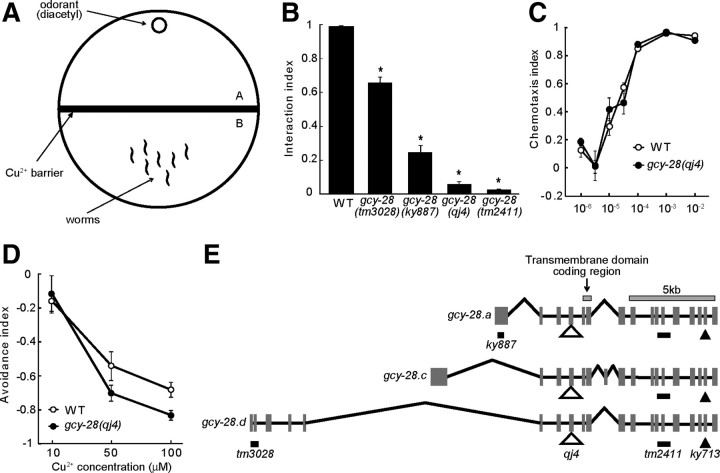
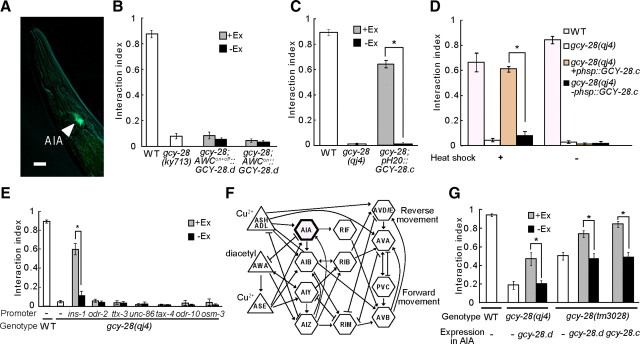
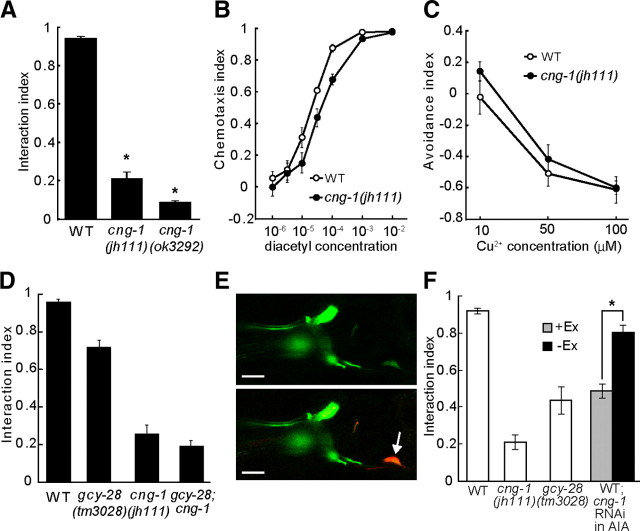
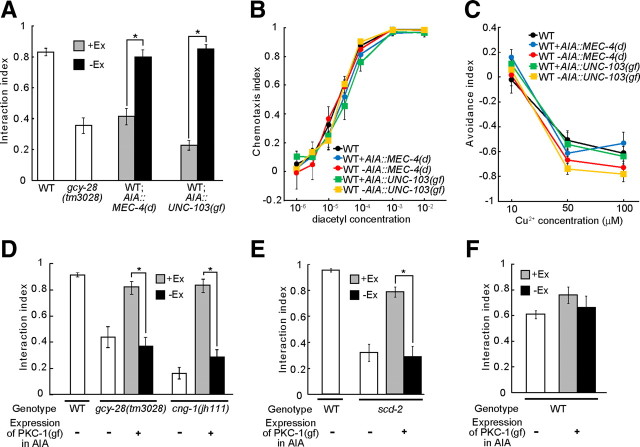
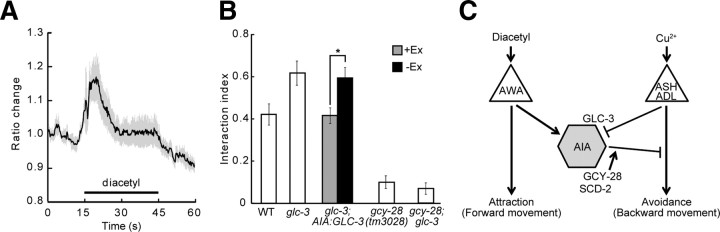
Animals facing conflicting sensory cues make a behavioral choice between competing alternatives through integration of the sensory cues. Here, we performed a genetic screen to identify genes important for the sensory integration of two conflicting cues, the attractive odorant diacetyl and the aversive stimulus Cu(2+), and found that the membrane-bound guanylyl cyclase GCY-28 and the receptor tyrosine kinase SCD-2 regulate the behavioral choice between these alternatives in Caenorhabditis elegans. The gcy-28 mutants and scd-2 mutants show an abnormal bias in the behavioral choice between the cues, although their responses to each individual cue are similar to those in wild-type animals. Mutants in a gene encoding a cyclic nucleotide gated ion channel, cng-1, also exhibit the defect in sensory integration. Molecular genetic analyses suggested that GCY-28 and SCD-2 regulate sensory integration in AIA interneurons, where the conflicting sensory cues may converge. Genetic ablation or hyperpolarization of AIA interneurons showed nearly the same phenotype as gcy-28 or scd-2 mutants in the sensory integration, although this did not affect the sensory response to each individual cue. In gcy-28 or scd-2 mutants, activation of AIA interneurons is sufficient to restore normal sensory integration. These results suggest that the activity of AIA interneurons regulates the behavioral choice between the alternatives. We propose that GCY-28 and SCD-2 regulate sensory integration by modulating the activity of AIA interneurons.
Figures

References
-
- Abdelalim EM, Masuda C, Tooyama I. Expression of natriuretic peptide-activated guanylate cyclases by cholinergic and dopaminergic amacrine cells of the rat retina. Peptides. 2008;29:622–628. - PubMed
-
- Amet LE, Lauri SE, Hienola A, Croll SD, Lu Y, Levorse JM, Prabhakaran B, Taira T, Rauvala H, Vogt TF. Enhanced hippocampal long-term potentiation in mice lacking heparin-binding growth-associated molecule. Mol Cell Neurosci. 2001;17:1014–1024. - PubMed
-
- Bargmann CI, Hartwieg E, Horvitz HR. Odorant-selective genes and neurons mediate olfaction in C. elegans. Cell. 1993;74:515–527. - PubMed
-
- Baude EJ, Arora VK, Yu S, Garbers DL, Wedel BJ. The cloning of a Caenorhabditis elegans guanylyl cyclase and the construction of a ligand-sensitive mammalian/nematode chimeric receptor. J Biol Chem. 1997;272:16035–16039. - PubMed
-
- Bessereau JL, Wright A, Williams DC, Schuske K, Davis MW, Jorgensen EM. Mobilization of a Drosophila transposon in the Caenorhabditis elegans germ line. Nature. 2001;413:70–74. - PubMed
Publication types
MeSH terms
Substances
Grants and funding
LinkOut - more resources
Full Text Sources
Other Literature Sources
Molecular Biology Databases
Research Materials
