


Co-occupancy by multiple cardiac transcription factors identifies transcriptional enhancers active in heart
- PMID: 21415370
- PMCID: PMC3078411
- DOI: 10.1073/pnas.1016959108
Co-occupancy by multiple cardiac transcription factors identifies transcriptional enhancers active in heart
Abstract
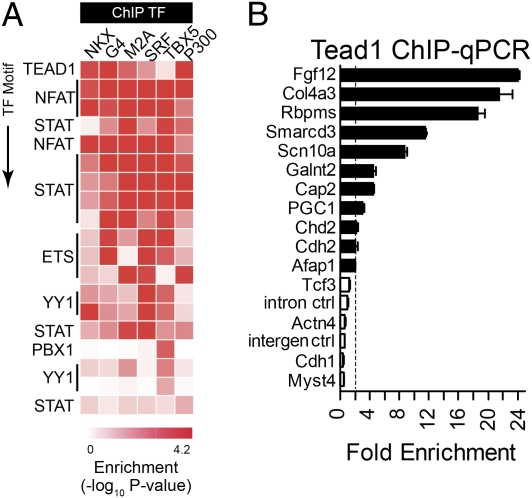
Identification of genomic regions that control tissue-specific gene expression is currently problematic. ChIP and high-throughput sequencing (ChIP-seq) of enhancer-associated proteins such as p300 identifies some but not all enhancers active in a tissue. Here we show that co-occupancy of a chromatin region by multiple transcription factors (TFs) identifies a distinct set of enhancers. GATA-binding protein 4 (GATA4), NK2 transcription factor-related, locus 5 (NKX2-5), T-box 5 (TBX5), serum response factor (SRF), and myocyte-enhancer factor 2A (MEF2A), here referred to as "cardiac TFs," have been hypothesized to collaborate to direct cardiac gene expression. Using a modified ChIP-seq procedure, we defined chromatin occupancy by these TFs and p300 genome wide and provided unbiased support for this hypothesis. We used this principle to show that co-occupancy of a chromatin region by multiple TFs can be used to identify cardiac enhancers. Of 13 such regions tested in transient transgenic embryos, seven (54%) drove cardiac gene expression. Among these regions were three cardiac-specific enhancers of Gata4, Srf, and swItch/sucrose nonfermentable-related, matrix-associated, actin-dependent regulator of chromatin, subfamily d, member 3 (Smarcd3), an epigenetic regulator of cardiac gene expression. Multiple cardiac TFs and p300-bound regions were associated with cardiac-enriched genes and with functional annotations related to heart development. Importantly, the large majority (1,375/1,715) of loci bound by multiple cardiac TFs did not overlap loci bound by p300. Our data identify thousands of prospective cardiac regulatory sequences and indicate that multiple TF co-occupancy of a genomic region identifies developmentally relevant enhancers that are largely distinct from p300-associated enhancers.
Conflict of interest statement
The authors declare no conflict of interest.
Figures



References
-
- Heintzman ND, et al. Distinct and predictive chromatin signatures of transcriptional promoters and enhancers in the human genome. Nat Genet. 2007;39:311–318. - PubMed
-
- Naya FJ, et al. Mitochondrial deficiency and cardiac sudden death in mice lacking the MEF2A transcription factor. Nat Med. 2002;8:1303–1309. - PubMed
Publication types
MeSH terms
Substances
Associated data
- Actions
Grants and funding
LinkOut - more resources
Full Text Sources
Other Literature Sources
Molecular Biology Databases
Research Materials
Miscellaneous
