


Inhibition of virulence potential of Vibrio cholerae by natural compounds
- PMID: 21415500
- PMCID: PMC3089057
Inhibition of virulence potential of Vibrio cholerae by natural compounds
Abstract
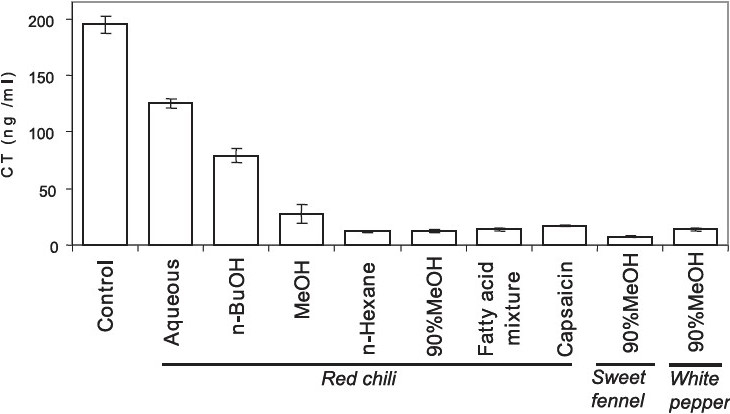
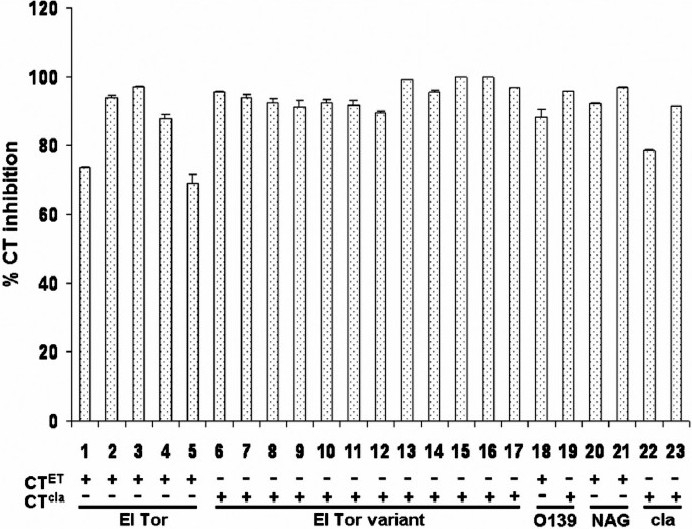
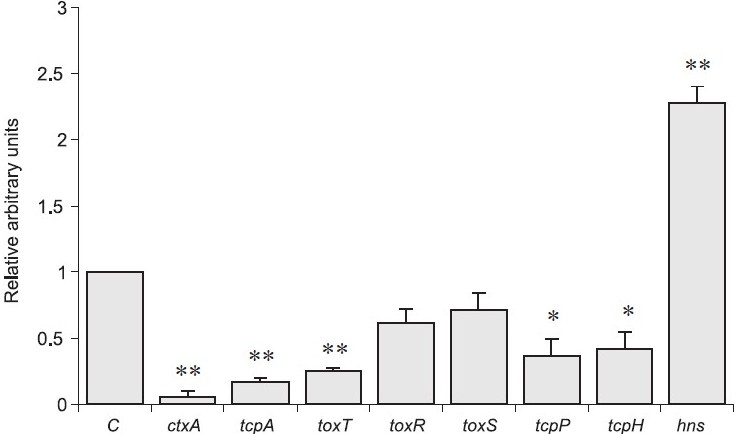
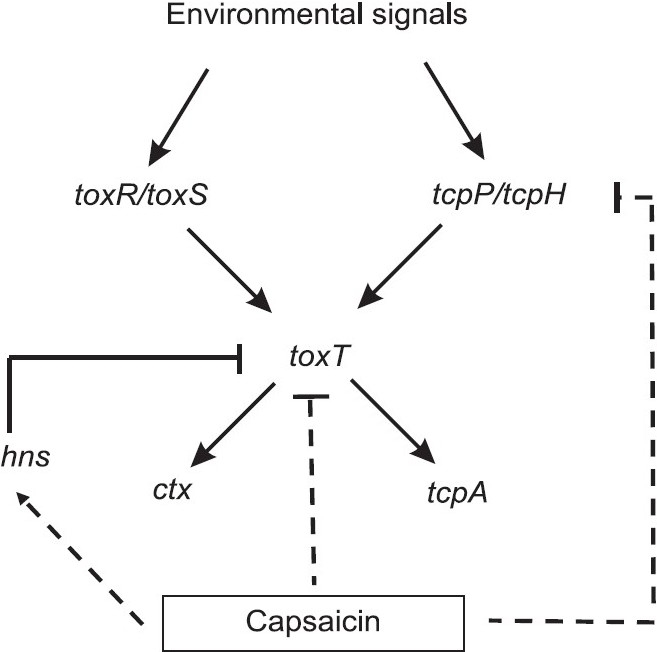
The rise in multi-drug resistant Vibrio cholerae strains is a big problem in treatment of patients suffering from severe cholera. Only a few studies have evaluated the potential of natural compounds against V. cholerae. Extracts from plants like 'neem', 'guazuma', 'daio', apple, hop, green tea and elephant garlic have been shown to inhibit bacterial growth or the secreted cholera toxin (CT). However, inhibiting bacterial growth like common antimicrobial agents may also impose selective pressure facilitating development of resistant strains. A natural compound that can inhibit virulence in V. cholerae is an alternative choice for remedy. Recently, some common spices were examined to check their inhibitory capacity against virulence expression of V. cholerae. Among them methanol extracts of red chili, sweet fennel and white pepper could substantially inhibit CT production. Fractionation of red chili methanol extracts indicated a hydrophobic nature of the inhibitory compound(s), and the n-hexane and 90 per cent methanol fractions could inhibit >90 per cent of CT production. Purification and further fractionation revealed that capsaicin is one of the major components among these red chili fractions. Indeed, capsaicin inhibited the production of CT in various V. cholerae strains regardless of serogroups and biotypes. The quantitative reverse transcription real-time PCR assay revealed that capsaicin dramatically reduced the expression of major virulence-related genes such as ctxA, tcpA and toxT but enhanced the expression of hns gene that transcribes a global prokaryotic gene regulator (H-NS). This indicates that the repression of CT production by capsaicin or red chili might be due to the repression of virulence genes transcription by H-NS. Regular intake of spices like red chili might be a good approach to fight against devastating cholera.
Figures
References
-
- Sack DA, Sack RB, Nair GB, Siddique AK. Cholera. Lancet. 2004;363:23–33. - PubMed
-
- Ramamurthy T, Yamasaki S, Takeda Y, Nair GB. Vibrio cholerae O139 Bengal: Odyssey of a fortuitous variant. Microbes Infect. 2003;5:329–44. - PubMed
-
- Raychoudhuri A, Mukhopadhyay AK, Ramamurthy T, Nandy RK, Takeda Y, Nair GB. Biotyping of Vibrio cholerae O1: Time to redefine the scheme. Indian J Med Res. 2008;128:695–8. - PubMed
-
- Chatterjee S, Ghosh K, Roychoudhuri A, Chowdhury G, Bhattacharya MK, Mukhopadhyay AK, et al. Incidence, virulence factors and clonality among clinical strains of non-O1, non-O139 Vibrio cholerae isolates from hospitalized diarrheal patients in Kolkata, India. J Clin Microbiol. 2009;47:1087–95. - PMC - PubMed
-
- Waldar MK, Mekalanos JJ. Lysogenic conversion by a filamentous phage encoding cholera toxin. Science. 2006;272:1910–4. - PubMed
Publication types
MeSH terms
Substances
LinkOut - more resources
Full Text Sources
Medical
Miscellaneous