. 2011 Apr 29;44(7):1264-70.
doi: 10.1016/j.jbiomech.2011.02.014. Epub 2011 Mar 21.

Muscle redundancy does not imply robustness to muscle dysfunction

Affiliations

Muscle redundancy does not imply robustness to muscle dysfunction

Jason J Kutch et al. J Biomech. .

Abstract

It is well-known that muscle redundancy grants the CNS numerous options to perform a task. Does muscle redundancy, however, allow sufficient robustness to compensate for loss or dysfunction of even a single muscle? Are all muscles equally redundant? We combined experimental and computational approaches to establish the limits of motor robustness for static force production. In computer-controlled cadaveric index fingers, we find that only a small subset (<5%) of feasible forces is robust to loss of any one muscle. Importantly, the loss of certain muscles compromises force production significantly more than others. Further computational modeling of a multi-joint, multi-muscle leg demonstrates that this severe lack of robustness generalizes to whole limbs. These results provide a biomechanical basis to begin to explain why redundant motor systems can be vulnerable to even mild neuromuscular pathology.


Conflict of interest statement

Conflict of interest statement

We the authors have no real or perceived financial and personal relationships with other people or organizations that could inappropriately influence (bias) our work. Examples of potential conflicts of interest include employment, consultancies, stock ownership, honoraria, paid expert testimony, patent applications/registrations, and grants or other funding.

Figures
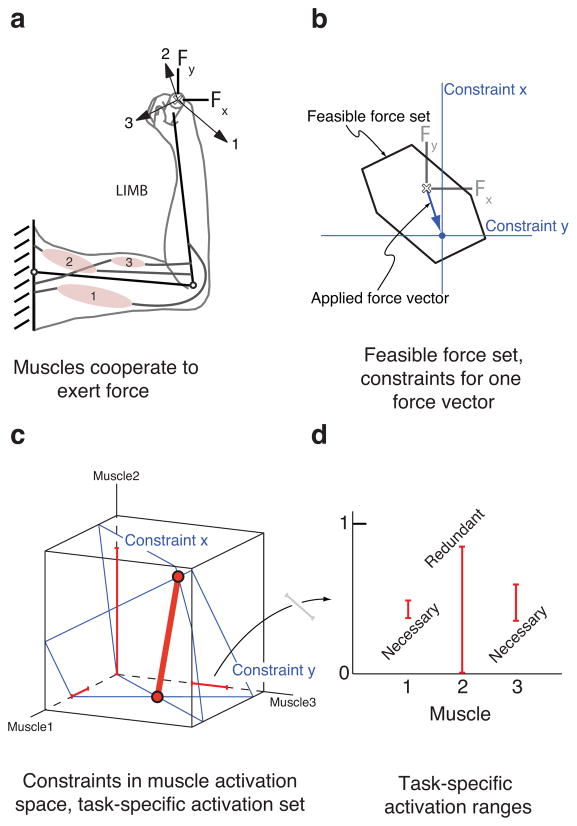
Figure 1
Figure 1
Three muscle “schematic model” conceptually illustrates the necessity of muscles. a. Muscles can be functionally visualized as force vectors at the endpoint. b. A region of force space, the feasible force set, is achievable given this musculature. A particular target force vector can be decomposed into a target x-force and a target y-force. c. The valid coordination patterns for the x and y targets can also be viewed in muscle activation space as planes; the portion of the intersection of these two planes that is inside the unit cube is the task-specific activation set. Any point on the task-specific activation set will generate the same target force vector. d. The task-specific activation set can be projected onto the muscle coordinate axes, revealing the minimum and maximum activation in each muscle for the given applied force vector. The task-specific activation ranges can be constructed for each muscle, and reveal which muscles are necessary and which are redundant for a given target force vector.
Figure 2
Figure 2
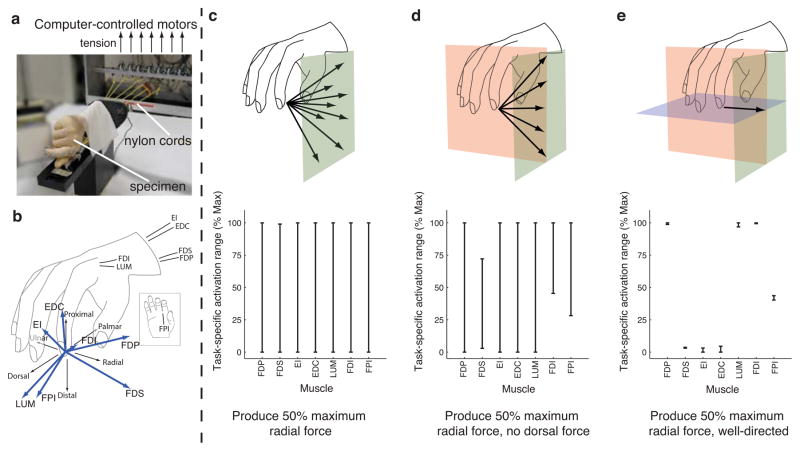
Muscle necessity depends on the nature of the task constraints. a. Experimental setup. Computer controlled motors produce specified amounts of tension to the tendons of all seven index finger muscles in a cadaver hand specimen, generating finger movement and/or fingertip force. b. The approximate anatomical location of these tendons is shown, along with the fingertip force vector produced by applying 1 N of tension to each tendon individually. c. The necessity of index finger muscles for a precision pinch task (approximating the index finger in “key pinch”) was analyzed for one representative specimen in the posture shown. When the task required 50% of the maximum possible radial force, no muscle was necessary as any could have zero activation for this task. d. However, when the task required the same amount of radial force but with zero dorsal force (more stringent task), the FDS, FDI and FPI became necessary. The CNS would not be able to adapt and find a coordination pattern satisfying these constraints if any of these three muscles were lost. e. The task constraints are particularly stringent when the same amount of radial force is required to be well-directed (zero dorsal and distal force). The FDP, FDS, LUM, FDI, and FPI are all necessary to achieve this task. Interestingly, the EI, EDC, and FDS muscles must be nearly inactive, suggesting that the CNS would not be able to adapt and achieve the task if either of these muscles was hyperactive.
Figure 3
Figure 3
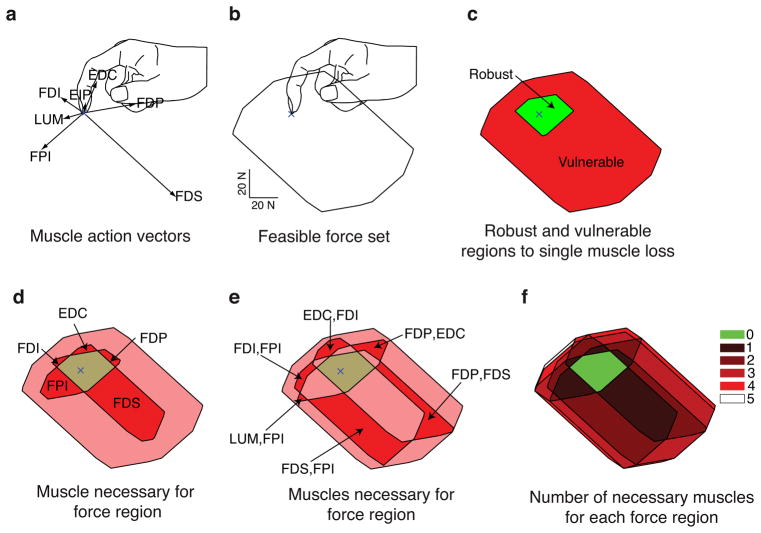
Muscles were necessary for most sub-maximal forces: one example specimen and posture. a. The action vectors of the 7 index finger muscles in the posture shown. b. The feasible force set, showing that the index finger is strongest in combinations of distal (downward) and palmar (rightward) force. c. The feasible force set decomposed into two regions: no particular muscle is necessary in the robust region, while particular muscles are required for all forces in the vulnerable region. d. The particular muscle vulnerabilities can be mapped out for single muscles. e. Regions that are vulnerable to dysfunction in either of a pair of muscles can also be mapped out. f. The number of muscles to which a region is vulnerable generally increases with increasing force magnitude.
Figure 4
Figure 4
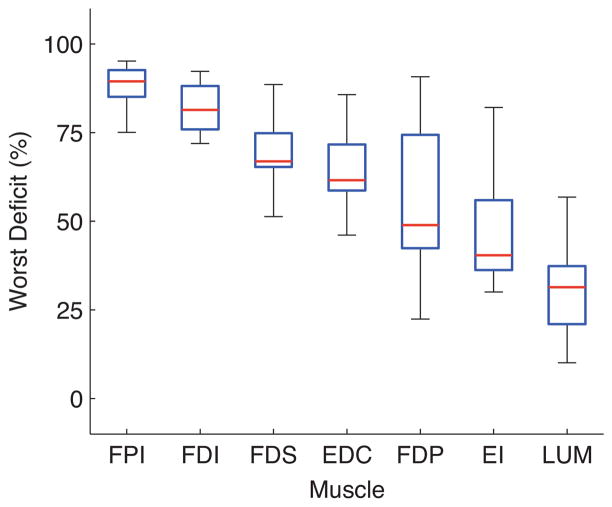
The worst deficit (WD) metric rank orders muscles by necessity. The 3D fingertip force production deficit that would be incurred by the loss of each index finger muscle. Red lines show median, blue boxes show 25th and 75th percentiles, and the whiskers show the remainder of the data points. While muscles such as the FPI and FDI are clearly more necessary on average than muscles such as the EI and LUM, a specimen and posture could be found for every muscle for which WD value for that muscle was large.
Figure 5
Figure 5
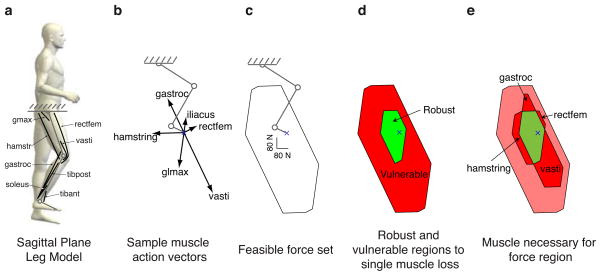
The ability of the leg to produce forces is also vulnerable to muscle loss. a. The leg model that we analyzed had 14 muscle groups, only 8 of which are shown for clarity. b. These muscles could also be visualized as action vectors in endpoint force space. Each muscle has an action vector, but only the dominant action vectors are shown for clarity. c. These action vectors generate a feasible force set, showing that the leg is particularly strong in generating downward force. d. The robust and vulnerable regions of the feasible force set were calculated: the robust region occupies 14% of the feasible force set area for this model. e. Similar to the human finger, the leg model predicts that certain regions of the feasible force set will be vulnerable to the loss of only one muscle. Regions also exist for the leg model in which only two muscles are necessary, etc., but are not shown for clarity.

References

    1. Agee J, Relton McCarroll H, Hollister A. The anatomy of the flexor digitorum superficialis relevant to tendon transfers. The Journal of Hand Surgery: Journal of the British Society for Surgery of the Hand. 1991;16(1):68–69. - PubMed
    1. Arnold EM, Ward SR, Lieber RL, Delp SL. A model of the lower limb for analysis of human movement. Annals of Biomedical Engineering. 2010:1–11. - PMC - PubMed
    1. Avis D, Fukuda K. A pivoting algorithm for convex hulls and vertex enumeration of arrangements and polyhedra. Discrete & Computational Geometry. 1992;8(3):295–313.
    1. Bernstein NA. The co-ordination and regulation of movements. Pergamon Press; Oxford: 1967.
    1. Buchanan TS, Almdale DPJ, Lewis JL, Rymer WZ. Characteristics of synergic relations during isometric contractions of human elbow muscles. Journal of Neurophysiology. 1986;56(5):1225–1241. - PubMed

Publication types