


Compliance with national guidelines for physical activity in U.S. preschoolers: measurement and interpretation
- PMID: 21422082
- PMCID: PMC3387888
- DOI: 10.1542/peds.2010-2021
Compliance with national guidelines for physical activity in U.S. preschoolers: measurement and interpretation
Abstract
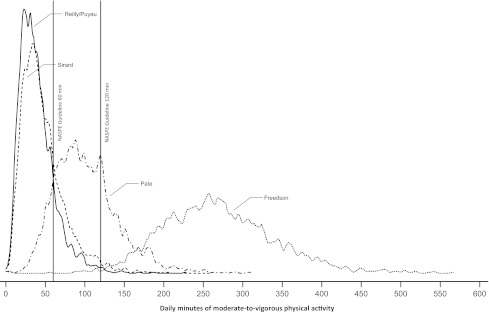
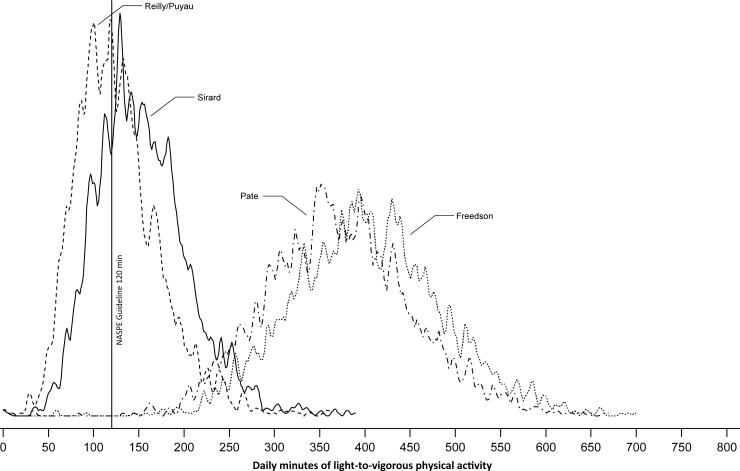
Objective: The National Association for Sport and Physical Education (NASPE) guidelines for preschoolers recommend 120 minutes of physical activity daily. Two issues, however, create a situation whereby substantial variation in estimated prevalence rates of (in)active preschoolers are reported. First, NASPE guidelines have been interpreted in multiple ways. Second, objective monitoring via accelerometry is the most widely accepted measure of preschoolers' physical activity, yet multiple cut points provide vastly different estimates of physical activity. This study aimed to estimate the prevalence of preschoolers meeting NASPE guidelines and illustrate the differences among rates, given guideline interpretations, and cut points.
Patients and methods: Three- to 5-year-old children (n = 397) wore ActiGraph accelerometers for an average of 5.9 days. NASPE guidelines were expressed in 3 ways: 120 minutes daily of light-to-vigorous physical activity; 120 minutes daily of moderate-to-vigorous physical activity; and 60 minutes daily of moderate-to-vigorous physical activity. Estimates of 120 minutes daily of light-to-vigorous physical activity, 120 minutes daily of moderate-to-vigorous physical activity, and 60 minutes daily of moderate-to-vigorous physical activity were calculated on the basis of 4 common accelerometer cut points for preschoolers: Pate, Reilly and Puyau, Sirard, and Freedson.
Results: Prevalence rates varied considerably, with estimates ranging from 13.5% to 99.5%, 0.0% to 95.7%, and 0.5% to 99.5% for 120 minutes daily of light-to-vigorous physical activity, 120 minutes daily of moderate-to-vigorous physical activity, and 60 minutes daily of moderate-to-vigorous physical activity, respectively.
Conclusions: The variation in NASPE guidelines, coupled with different accelerometer cut points, results in disparate estimates of (in)active preschoolers. This limits the ability to estimate population prevalence levels of physical activity that can be used to guide public health policy. Development of new guidelines should focus on an explicit delineation of physical activity and attempt to standardize the measurement of preschoolers' physical activity.
Figures
References
-
- Institute of Medicine Preventing Childhood Obesity: Health in the Balance: Committee on Prevention of Obesity in Children and Youth. Washington, DC: National Academic Press; 2004
-
- Burdette HL, Whitaker RC. Resurrecting free play in young children: looking beyond fitness and fatness to attention, affiliation, and affect. Arch Pediatr Adolesc Med. 2005;159(1):46–50 - PubMed
-
- Ginsburg KR. The importance of play in promoting healthy child development and maintaining strong parent-child bonds. Pediatrics. 2007;119(1):182–191 - PubMed
-
- National Association for Sport and Physical Education Active Start: A Statement of Physical Activity Guidelines for Children from Birth to Age 5, 2nd Edition Sewickley, PA: American Alliance for Health, Physical Education, Recreation, and Dance; 2009
-
- Tucker P. The physical activity levels of preschool-aged children: a systematic review. Early Child Res Q. 2008;23(4):547–558
