


Physicians report barriers to deliver best practice care for asplenic patients: a cross-sectional survey
- PMID: 21423748
- PMCID: PMC3053367
- DOI: 10.1371/journal.pone.0017302
Physicians report barriers to deliver best practice care for asplenic patients: a cross-sectional survey
Abstract
Background: Current management of asplenic patients is not in compliance with best practice standards, such as defined by the British Committee for Standards in Haematology. To improve quality of care, factors inhibiting best practice care delivery need to be identified first. With this study, we aimed to identify and quantify physicians' barriers to adhere to best practice management of asplenic patients in The Netherlands.
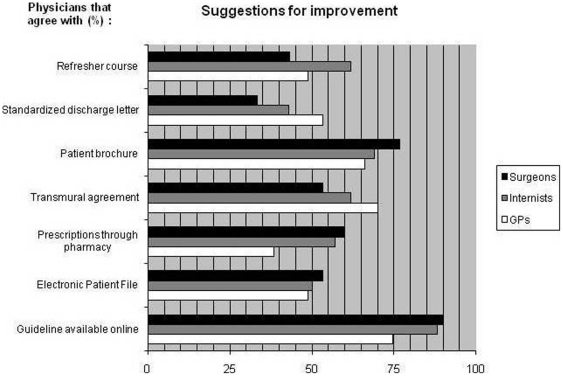
Methods and principal findings: A cross-sectional survey, preceded by multiple focus group discussions, was performed among Dutch physicians responsible for prevention of infections in asplenic patients, including specialists (of Internal medicine and Surgery) and general practitioners (GPs). Forty seven GPs and seventy three hospital specialists returned the questionnaire, yielding response rates of 47% and 36.5% respectively. Physicians reported several barriers to deliver best practice. For both GPs and specialists, the most frequently listed barriers were: poor patient knowledge (>80% of hospital specialists and GPs) and lack of clarity about which physician is responsible for the management of asplenic patients (50% of Internists, 46% of Surgeons, 55% of GPs). Both GPs and hospital specialists expressed to experience a lack of mutual trust: specialists were uncertain whether the GP would follow their advice given on patient discharge (33-59%), whereas half of GPs was not convinced that specialists' discharge letters contained the correct recommendations. Almost all physicians (>90%) indicated that availability of a national guideline would improve adherence to best practice, especially if accessible online.
Conclusion: This study showed that, in accordance with reports on international performance, care delivery for asplenic patients in The Netherlands is suboptimal. We identified and quantified perceived barriers by physicians that prevent adherence to post-splenectomy guidelines for the first time. Better transmural collaboration and better informed patients are likely to improve the quality of care of the asplenic patient population. A national, online-available guideline is urgently required.
Conflict of interest statement
Figures
References
-
- Holdsworth RJ, Irving AD, Cuschieri A. Postsplenectomy sepsis and its mortality rate: actual versus perceived risks. Br J Surg. 1991;78:1031–8. - PubMed
-
- Styrt B. Infection associated with asplenia: risks, mechanisms, and prevention. Am J Med. 1990;88:33N–42N. - PubMed
-
- Gaston MH, Verter JI, Woods G, Pegelow C, Kelleher J, et al. Prophylaxis with oral penicillin in children with sickle cell anemia. A randomized trial. N Engl J Med. 1986;%19;314:1593–1599. - PubMed
-
- Halasa NB, Shankar SM, Talbot TR, Arbogast PG, Mitchel EF, et al. Incidence of invasive pneumococcal disease among individuals with sickle cell disease before and after the introduction of the pneumococcal conjugate vaccine. Clin Infect Dis. 2007;44:1428–1433. - PubMed
-
- Mourtzoukou EG, Pappas G, Peppas G, Falagas ME. Vaccination of asplenic or hyposplenic adults. Br J Surg. 2008;95:273–280. - PubMed
Publication types
MeSH terms
LinkOut - more resources
Full Text Sources
