


Epithelial cell stretching and luminal acidification lead to a retarded development of stria vascularis and deafness in mice lacking pendrin
- PMID: 21423764
- PMCID: PMC3056798
- DOI: 10.1371/journal.pone.0017949
Epithelial cell stretching and luminal acidification lead to a retarded development of stria vascularis and deafness in mice lacking pendrin
Abstract
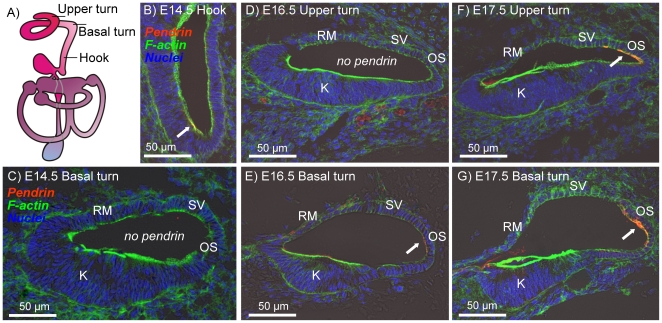
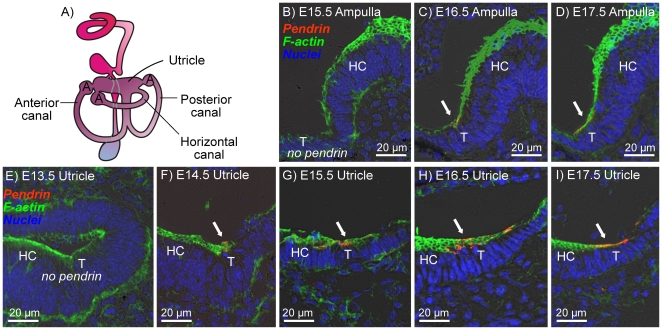
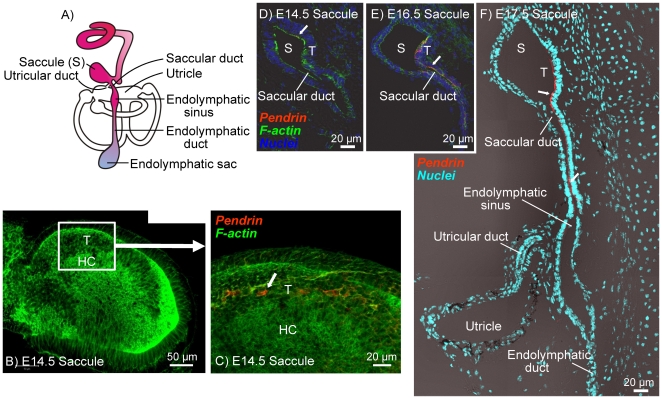
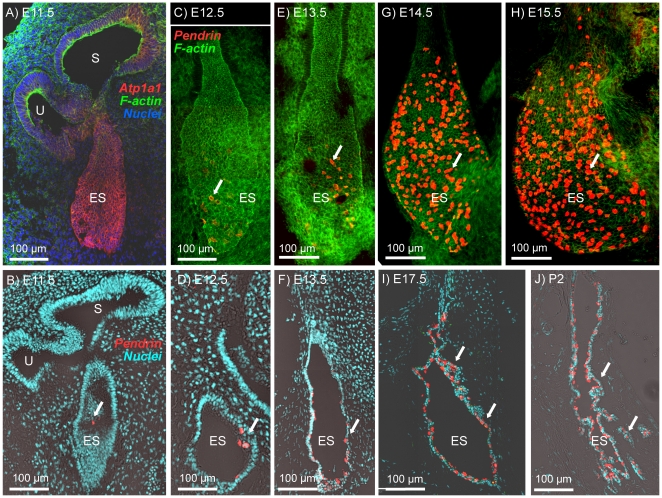
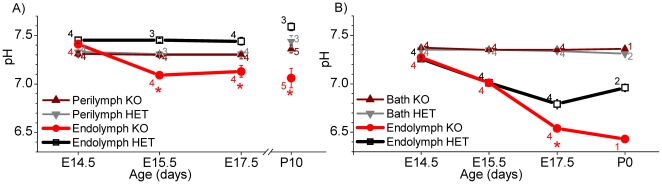
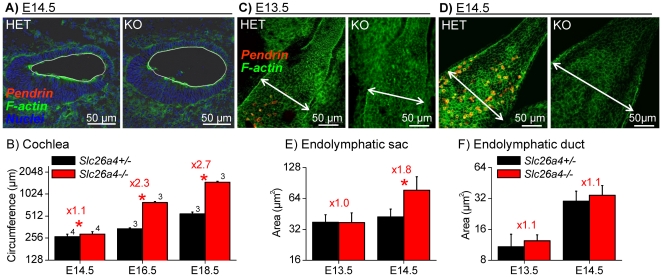
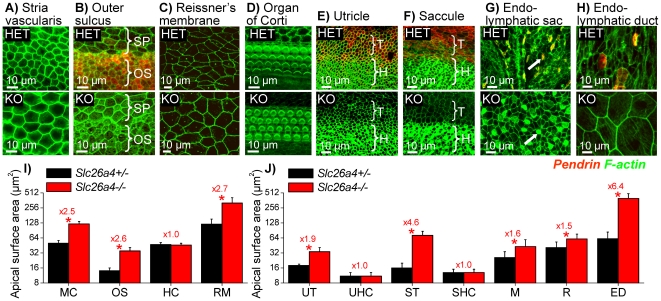
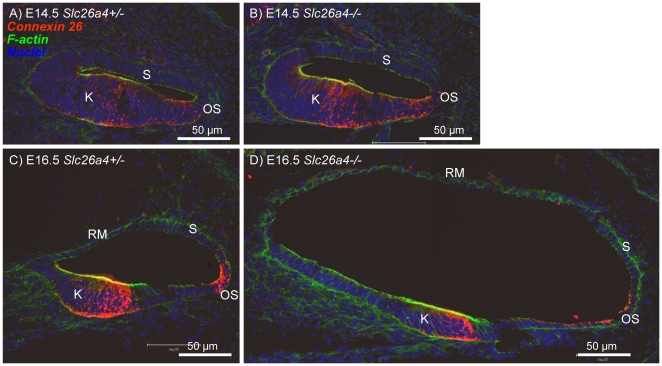
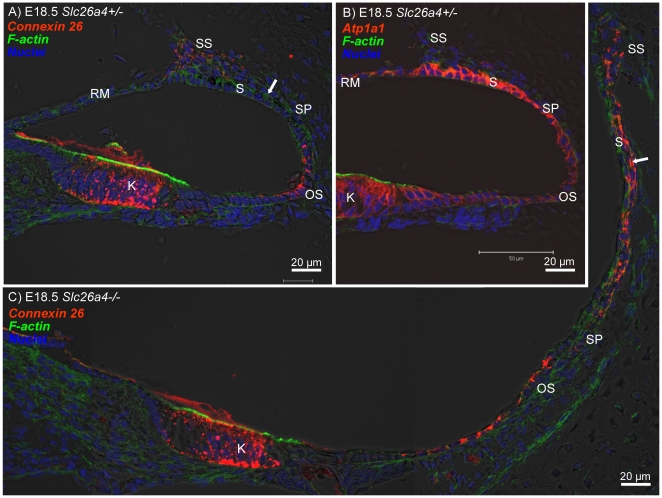
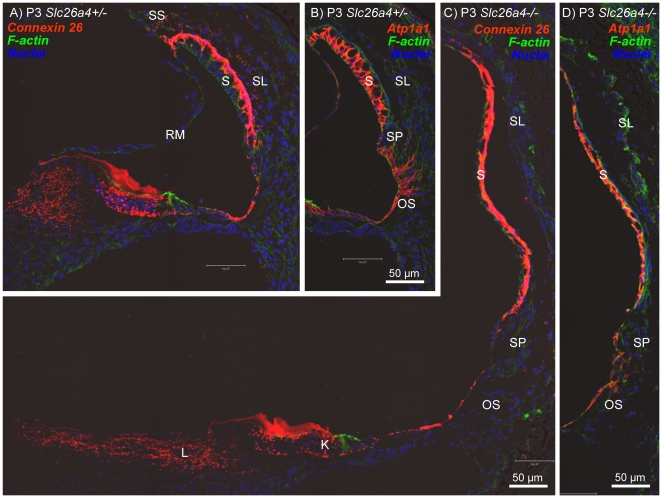
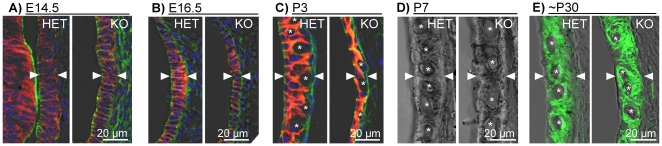
Loss-of-function mutations of SLC26A4/pendrin are among the most prevalent causes of deafness. Deafness and vestibular dysfunction in the corresponding mouse model, Slc26a4(-/-), are associated with an enlargement and acidification of the membranous labyrinth. Here we relate the onset of expression of the HCO(3) (-) transporter pendrin to the luminal pH and to enlargement-associated epithelial cell stretching. We determined expression with immunocytochemistry, cell stretching by digital morphometry and pH with double-barreled ion-selective electrodes. Pendrin was first expressed in the endolymphatic sac at embryonic day (E) 11.5, in the cochlear hook-region at E13.5, in the utricle and saccule at E14.5, in ampullae at E16.5, and in the upper turn of the cochlea at E17.5. Epithelial cell stretching in Slc26a4(-/-) mice began at E14.5. pH changes occurred first in the cochlea at E15.5 and in the endolymphatic sac at E17.5. At postnatal day 2, stria vascularis, outer sulcus and Reissner's membrane epithelial cells, and utricular and saccular transitional cells were stretched, whereas sensory cells in the cochlea, utricle and saccule did not differ between Slc26a4(+/-) and Slc26a4(-/-) mice. Structural development of stria vascularis, including vascularization, was retarded in Slc26a4(-/-) mice. In conclusion, the data demonstrate that the enlargement and stretching of non-sensory epithelial cells precedes luminal acidification in the cochlea and the endolymphatic sac. Stretching and luminal acidification may alter cell-to-cell communication and lead to the observed retarded development of stria vascularis, which may be an important step on the path to deafness in Slc26a4(-/-) mice, and possibly in humans, lacking functional pendrin expression.
Conflict of interest statement
Figures
References
-
- Fraser GR. Association of congenital deafness with goitre (Pendred's syndrome) a study of 207 families. Ann Hum Genet. 1965;28:201–249. - PubMed
-
- Reardon W, Coffey R, Phelps PD, Luxon LM, Stephens D, et al. Pendred syndrome–100 years of underascertainment? QJM. 1997;90:443–447. - PubMed
-
- Albert S, Blons H, Jonard L, Feldmann D, Chauvin P, et al. SLC26A4 gene is frequently involved in nonsyndromic hearing impairment with enlarged vestibular aqueduct in Caucasian populations. Eur J Hum Genet. 2006;14:773–779. - PubMed
Publication types
MeSH terms
Substances
Grants and funding
LinkOut - more resources
Full Text Sources
Medical
Molecular Biology Databases
