Review
. 2011 May;43(2):307-16.
doi: 10.3109/03602532.2011.552909. Epub 2011 Mar 22.

S-glutathionyl-(chloro)hydroquinone reductases: a new class of glutathione transferases functioning as oxidoreductases

Affiliations
Review

S-glutathionyl-(chloro)hydroquinone reductases: a new class of glutathione transferases functioning as oxidoreductases

Sara M Belchik et al. Drug Metab Rev. 2011 May.

Abstract

Glutathione transferases (GSTs) are best known for transferring glutathione (GSH) to hydrophobic organic compounds, making the conjugates more soluble. However, the omega-class GSTs of animals and the lambda-class GSTs and dehydroascorbate reductases (DHARs) of plants have little or no activity for GSH transfer. Instead, they catalyze GSH-dependent oxidoreductions. The lambda-class GSTs reduce disulfide bonds, the DHARs reduce the disulfide bonds and dehydroascorbate, and the omega-class GSTs can reduce more substrates, including disulfide bonds, dehydroascorbate, and dimethylarsinate. Glutathionyl-(chloro)hydroquinone reductases (GS-HQRs) are the newest class of GSTs that mainly catalyze oxidoreductions. Besides the activities of the other three classes, GS-HQRs also reduce GS-hydroquinones, including GS-trichloro-p-hydroquinone, GS-dichloro-p-hydroquinone, GS-2-hydroxy-p-hydroquinone, and GS-p-hydroquinone. They are conserved and widely distributed in bacteria, fungi, protozoa, and plants, but not in animals. The four classes are phylogenetically more related to each other than to other GSTs, and they share a Cys-Pro motif at the GSH-binding site. Hydroquinones are metabolic intermediates of certain aromatic compounds. They can be auto-oxidized by O(2) to benzoquinones, which spontaneously react with GSH to form GS-hydroquinones via Michael's addition. GS-HQRs are expected to channel GS-hydroquinones, formed spontaneously or enzymatically, back to hydroquinones. When the released hydroquinones are intermediates of metabolic pathways, GS-HQRs play a maintenance role for the pathways. Further, the common presence of GS-HQRs in plants, green algae, cyanobacteria, and halobacteria suggest a beneficial role in the light-using organisms.


Figures

Figure 1
Figure 1
PCP metabolic pathway in S. chlorophenolicum ATCC 39723. PCP is converted to II (tetrachloro-p-benzoquinone), TeCH (tetrachloro-p-hydroquinone), TriCH (trichloro-p-hydroquinone), DiCH (2,6-dichloro-p-hydroquinone), VI (2-chloromaleylacetate), maleylacetate, and 3-oxoadipate. PcpB, PCP 4-monooxygenase; PcpD, quinone reductase; PcpC, TeCH reductive dehalogenase; PcpC-ox, oxidatively damaged PcpC; PcpF, GS-HQR; PcpA, DiCH 1,2-dioxygenase; PcpE, (chloro)maleylacetate reductase.
Figure 2
Figure 2
Inferred phylogenetic relationship among GSTs with a Cys residue at the N-terminus of α1-helix. The tree was constructed using the neighbor-joining method with pairwise deletion. The numbers on the branches are bootstrap values (percentage of 1,000 runs), indicating the frequency of grouping in the cluster. The distance correlates to the number of amino acids substituted per site. The GSTs and corresponding NCBI protein accession numbers are as follows: EcYqjG, NP_417573; ReYqjG, YP_295669; ECM4, NP_013002; PcpF, AAM96671; AtECM4a, NP_199315; HsGSTOI, NP_004823; HsGSTO2; NP_899062; ZmGSTL, CAA41447; OzGSTL, AAF70831; AtGSTLl, AL162973; TaGSTL, CAA76758; AtDHARI, AAF98403; SoDHAR, AAG24945; LigG, BAA77216.1; RaGSTZ (of Ralstonia sp. U2), 2JL4_A; HsGSTZI, AAB96392.1; AtGSTZI, AAO60039; PcpC, AAM96673; LinD, BAA14011; BphK, YP_556402; SpGSTB, 1F2ED; PmGSTB, 2PMTA; EcGSTB, 1A0F_A.
Figure 3
Figure 3
Alignment of peptide sequences around α1-helix of the GSTs from Figure 2. The whole peptide sequences are aligned by ClustalW, and the alignment around α1-helix is presented here to show the location of the Cys reside at the beginning of the helix and GSTs with the Cys-Pro motif (A) and those without (B). Accession numbers are given in the legend for Figure 2.
Figure 4
Figure 4
A proposed reaction between PcpF-Cys53 thiolate and GS-TriCH. (A) The Cys53 thiolate attacks the sulfur atom of GS-TriCH to generate GS-PcpF (PcpF-Cys53-S-SG) and release TriCH. (B) GS-PcpF is reduced by GSH or other small thiols to regenerate PcpF-Cys-S.
Figure 5
Figure 5
PcpF catalyzes GS-TriCH reduction via a ping-pong mechanism. The reaction mechanism is deduced from kinetic analysis (Xun et al., 2010). Small thiols can replace GSH in the second half of the reaction.
Figure 6
Figure 6
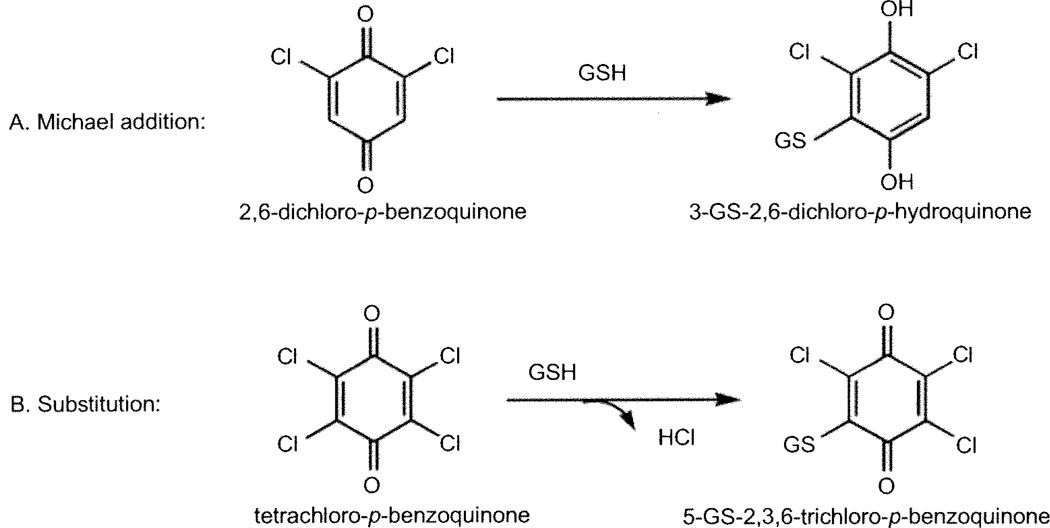
Spontaneous formation of GS-hydroquinones. (A) Michael’s addition results in GS-hydroquinones. (B) Substitution produces GS-benzoquinones, which can be reduced to GS-hydroquinones.
Figure 7
Figure 7
GS-hydroquinone substrates of GS-HQRs. GS-TriCH and GS-DiCH have been reported as substrates (Huang et al., 2008; Xun et al., 2010), and the other two have not been reported (Lam and Xun, unpublished data).

References

    1. Allocati N, Federici L, Masulli M, Di Ilio C. Glutathione transferases in bacteria. FEBS J. 2009;276:58–75. - PubMed
    1. Allocati N, Federici L, Masulli M, Favaloro B, Di Ilio C. Cysteine 10 is critical for the activity of Ochrobactrum anthropi glutathione transferase and its mutation to alanine causes the preferential binding of glutathione to the H-site. Proteins. 2008;71:16–23. - PubMed
    1. Anandarajah K, Kiefer PMJ, Donohoe BS, Copley SD. Recruitment of a double bond isomerase to serve as a reductive dehalogenase during biodegradation of pentachlorophenol. Biochemistry. 2000;39:5303–5311. - PubMed
    1. Barreto L, Garcerá A, Jansson K, Sunnerhagen P, Herrero E. A peroxisomal glutathione transferase of Saccharomyces cerevisiae is functionally related to sulfur amino acid metabolism. Eukaryot Cell. 2006;5:1748–1759. - PMC - PubMed
    1. Board PG, Anders MW. Glutathione transferase omega-1 catalyzes the reduction of S-(phenacyl)glutathiones to acetophenones. Chem Res Toxicol. 2007;20:149–154. - PMC - PubMed

Publication types

LinkOut - more resources