Use of fibrates in the United States and Canada
- PMID: 21427374
- PMCID: PMC3332101
- DOI: 10.1001/jama.2011.353
Use of fibrates in the United States and Canada
Abstract
Context: Interest in the role of fibrates intensified after the publication of the negative results from the Action to Control Cardiovascular Risk in Diabetes (ACCORD) trial, which assessed therapy with fenofibrate plus statins. The evidence for clinical benefit in outcomes with the use of fibrates is heavily weighted on the use of the older fibrates such as gemfibrozil and clofibrate.
Objectives: To examine trends in the current use of fibrates and to examine the relationship between differences in the availability and use of brand-name vs generic formulations of fenofibrate and the economic implications in the United States compared with Canada.
Design, setting, and patients: Population-level, observational cohort study using IMS Health data from the United States and Canada of patients prescribed fibrates between January 2002 and December 2009.
Main outcome measures: Fibrate prescriptions dispensed and expenditures.
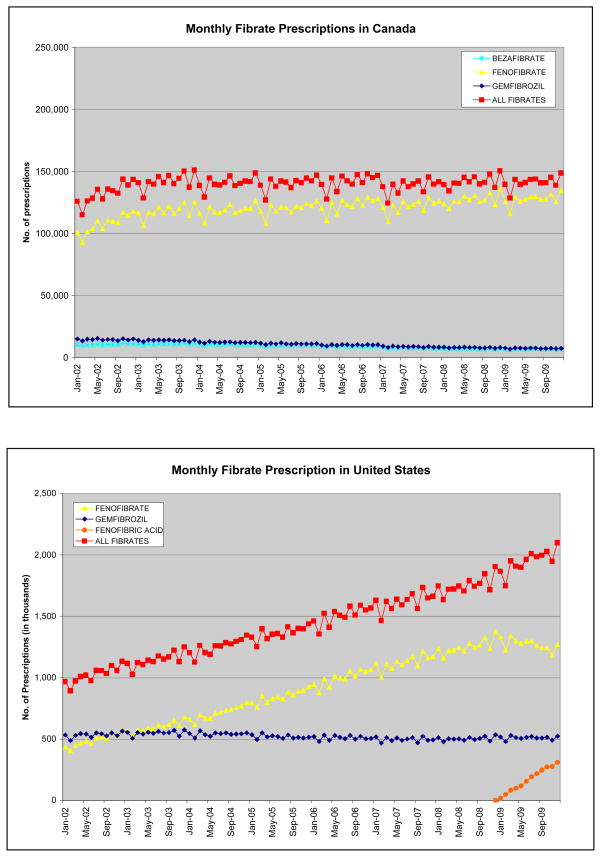
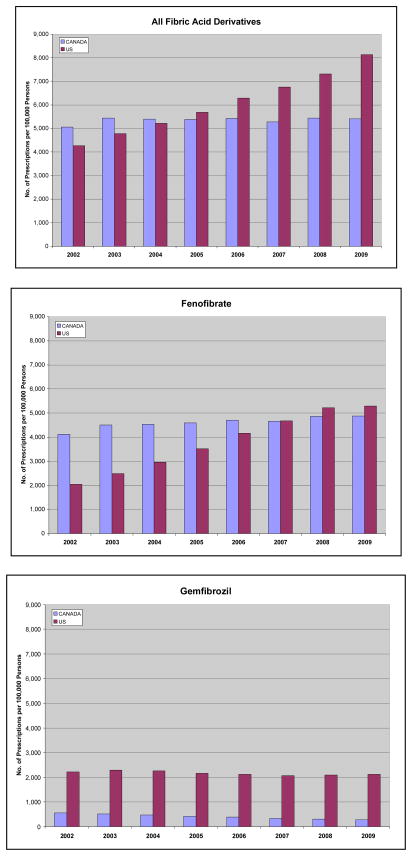
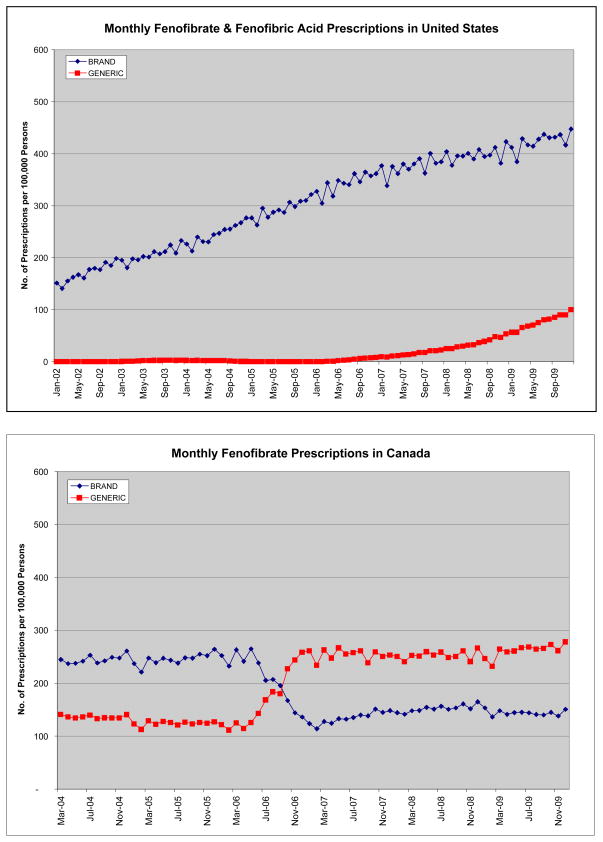
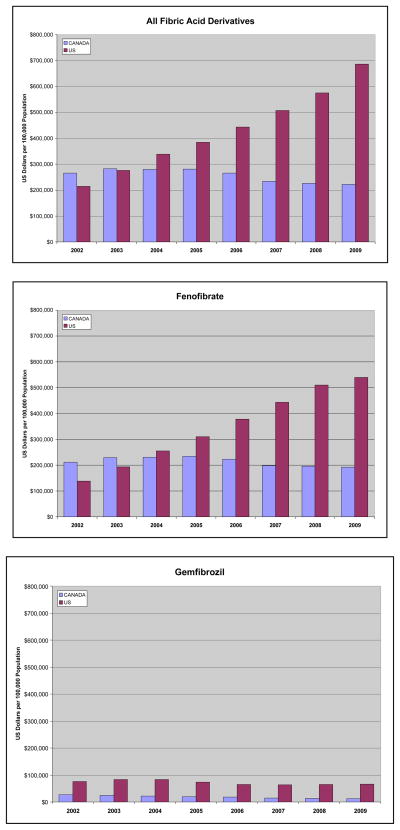
Results: In the United States, fibrate prescriptions dispensed increased from 336 prescriptions/100,000 population in January 2002 to 730 prescriptions/100,000 population in December 2009, an increase of 117.1% (95% confidence interval [CI], 116.0%-117.9%), whereas in Canada, fibrate prescriptions increased from 402 prescriptions/100,000 population in January 2002 to 474 prescriptions/100,000 population in December 2009, an increase of 18.1% (95% CI, 17.9%-18.3%) (P <.001). In the United States, fenofibrate prescriptions dispensed increased from 150 prescriptions/100,000 population in January 2002 to 440 prescriptions/100,000 population in December 2009, an increase of 159.3% (95% CI, 157.7%-161.0%), comprising 47.9% of total fibrate prescriptions in 2002 and 65.2% in 2009. In Canada, fenofibrate prescriptions increased from 321 prescriptions/100,000 population in January 2002 to 429 prescriptions/100,000 population in December 2009. The annual ratio of generic to brand-name fenofibrate use in the United States ranged from 0:1 to 0.09:1 between 2002 and 2008, while the ratio in Canada steadily increased from 0.51:1 to 1.89:1 between 2005 and 2008. In the United States, crude fenofibrate expenditures increased from $11,535/100,000 population/month in 2002 to $44,975/100,000 population/month in 2009, while the rates in Canada declined from $17,695/100,000 population/month in 2002 to $16,112/100,000 population/month in 2009. Fibrate expenditures per 100,000 population were 3-fold higher in 2009 in the United States compared with Canada.
Conclusion: During the past decade, prescriptions for fibrates (particularly fenofibrate) increased in the United States, while prescriptions for fibrates in Canada remained stable.
Figures
Comment in
-
Fibrate use in the United States and Canada.JAMA. 2011 Jul 13;306(2):157-8; author reply 158-9. doi: 10.1001/jama.2011.946. JAMA. 2011. PMID: 21750289 No abstract available.
-
Fibrate use in the United States and Canada.JAMA. 2011 Jul 13;306(2):157; author reply 158-9. doi: 10.1001/jama.2011.945. JAMA. 2011. PMID: 21750290 No abstract available.
References
-
- Brody H. Medicine’s ethical responsibility for health care reform – the top five list. N Engl J Med. 2010;362:283–5. - PubMed
-
- Redberg RF. Less is more. Arch Intern Med. 2010;170:584. - PubMed
-
- Keech A, Simes RJ, Barter P, et al. Effects of long-term fenofibrate therapy on cardiovascular events in 9795 people with type 2 diabetes mellitus (the FIELD study): randomised controlled trial. Lancet. 2005;366:1849–1861. [Erratum, Lancet 2006;368:1415, 1420.] - PubMed
Publication types
MeSH terms
Substances
Grants and funding
LinkOut - more resources
Full Text Sources
Medical
Miscellaneous