


Deconstructing craving: dissociable cortical control of cue reactivity in nicotine addiction
- PMID: 21429478
- PMCID: PMC3090477
- DOI: 10.1016/j.biopsych.2011.01.023
Deconstructing craving: dissociable cortical control of cue reactivity in nicotine addiction
Abstract
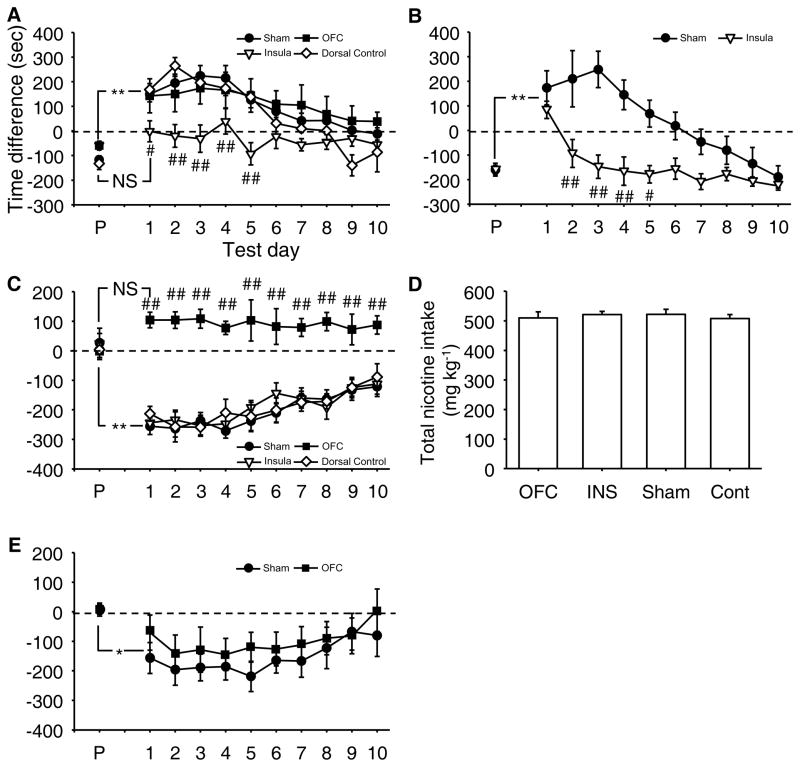
Background: Cue reactivity, the ability of cues associated with addictive substances to induce seeking and withdrawal, is a major contributor to addiction. Although human imaging studies show that cigarette-associated cues simultaneously activate the insula and the orbitofrontal cortex and evoke craving, how these activities functionally contribute to distinct elements of cue reactivity remains unclear. Moreover, it remains unclear whether the simultaneous activation of these cortical regions reflects coordinated functional connectivity or parallel processing.
Methods: We selectively lesioned the insula or orbitofrontal cortex with the excitotoxin ibotenic acid in mice, and their approach to nicotine-associated cues (n = 6-13/group) and avoidance of withdrawal-associated cues (n = 5-12/group) were separately examined in place conditioning paradigms. We additionally tested the role of these two cortical structures in approach to food-associated cues (n = 6-7/group) and avoidance of lithium chloride-associated cues (n = 6-7/group).
Results: Our data show a double dissociation in which excitotoxic lesions of the insula and orbitofrontal cortex selectively disrupted nicotine-induced cue approach and withdrawal-induced cue avoidance, respectively. These effects were not entirely generalized to approach to food-associated cues or avoidance of lithium chloride-associated cues.
Conclusions: Our data provide functional evidence that cue reactivity seen in addiction includes unique neuroanatomically dissociable elements and suggest that the simultaneous activation of these two cortical regions in response to smoking-related cues does not necessarily indicate functional connectivity.
Copyright © 2011 Society of Biological Psychiatry. Published by Elsevier Inc. All rights reserved.
Figures


References
-
- Niaura RS, Rohsenow DJ, Binkoff JA, Monti PM, Pedraza M, Abrams DB. Relevance of cue reactivity to understanding alcohol and smoking relapse. J Abnorm Psychol. 1988;97:133–152. - PubMed
-
- Childress AR, Hole AV, Ehrman RN, Robbins SJ, McLellan AT, O'Brien CP. Cue reactivity and cue reactivity interventions in drug dependence. NIDA Res Monogr. 1993;137:73–95. - PubMed
-
- Carter BL, Tiffany ST. Meta-analysis of cue-reactivity in addiction research. Addiction. 1999;94:327–340. - PubMed
-
- Caggiula AR, Donny EC, Chaudhri N, Perkins KA, Evans-Martin FF, Sved AF. Importance of nonpharmacological factors in nicotine self-administration. Physiol Behav. 2002;77:683–687. - PubMed
-
- Shiffman S, Paty JA, Gnys M, Kassel JA, Hickcox M. First lapses to smoking: within-subjects analysis of real-time reports. J Consult Clin Psychol. 1996;64:366–379. - PubMed
Publication types
MeSH terms
Substances
Grants and funding
LinkOut - more resources
Full Text Sources
