


doi: 10.3389/fnbeh.2011.00010.
eCollection 2011.
Gait Modulation in C. Elegans: It's Not a Choice, It's a Reflex!
Affiliations
- PMID: 21430792
- PMCID: PMC3053488
- DOI: 10.3389/fnbeh.2011.00010
Item in Clipboard
Gait Modulation in C. Elegans: It's Not a Choice, It's a Reflex!
Front Behav Neurosci.
.
No abstract available
Figures
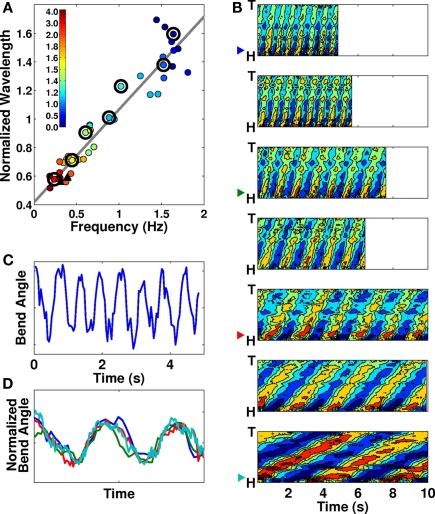
(A) Frequency–wavelength relation across a range of gelatin concentrations (filled circles) and agar surfaces (black triangles). Colors represent gelatin concentrations (%) as indicated. The best linear fit to the data is superimposed. Adapted from Figure 1B in Berri et al. (2009). Large black circles indicate which contour plots are shown in (B). (B) Seven contour plots of bending angle (represented by color, with dark red corresponding to extreme dorsal bending and dark blue to extreme ventral bending) over time (horizontal) and along the body (vertical), selected to show the range of observed forward locomotion behaviors, from “swimming” in liquid buffer solution (top) to “crawling” in relatively stiff gelatin (bottom; see methods in Berri et al., for additional details). Note the linear propagation along the entire body without changes in wave speed. (C) Trace of bending angle versus time for a point near the head of a worm in buffer solution [same data as top plot in (B)]. Note that the worm does not dwell in the maximally bent positions (peaks and troughs of the curve). (D) Bending angle traces as in (C), taken from the 1st, 3rd, 5th, and 7th panels of (B; see color-coded arrow heads) and normalized by undulation period and amplitude. Note the similarity of the waveforms.
Comment on
-
Shared Strategies for Behavioral Switching: Understanding How Locomotor Patterns are Turned on and Off.Front Behav Neurosci. 2010 Jul 30;4:49. doi: 10.3389/fnbeh.2010.00049. eCollection 2010. Front Behav Neurosci. 2010. PMID: 20721315 Free PMC article.
References
-
- Vidal-Gadea A., Topper S., Young L., Pierce-Shimomura J. T. (2009). Neural Mechanisms for Switching Locomotory Patterns in C. elegans. Neuroscience 366:17 Calabrese Ronald: Faculty of 1000 Biology, 11 November, 2009. Conference 2009 October 16–21. Available at: http://f1000biology.com/article/id/1182956/evaluation
Grants and funding
LinkOut - more resources
Full Text Sources
