


HIV and chronic methamphetamine dependence affect cerebral blood flow
- PMID: 21431471
- PMCID: PMC3251315
- DOI: 10.1007/s11481-011-9270-y
HIV and chronic methamphetamine dependence affect cerebral blood flow
Abstract
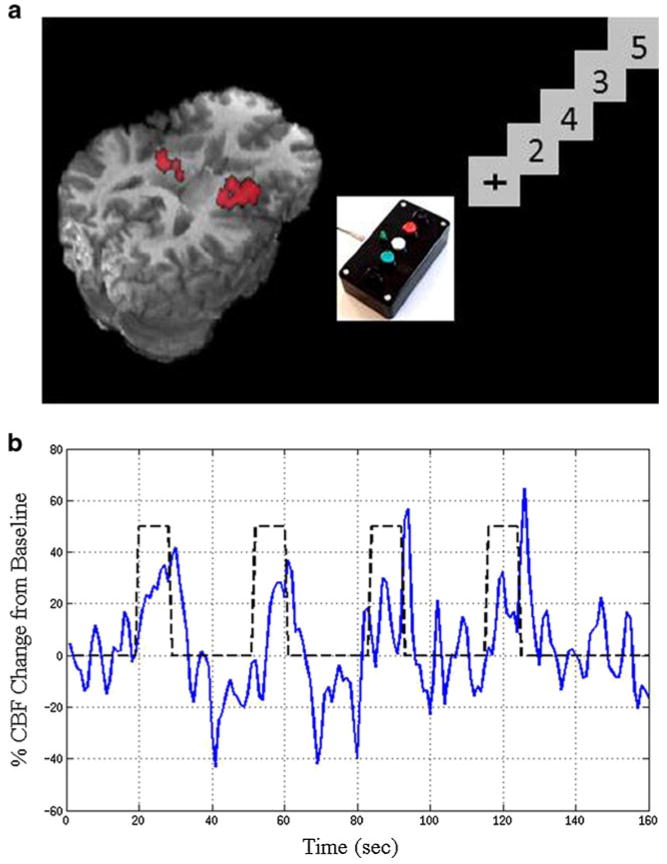
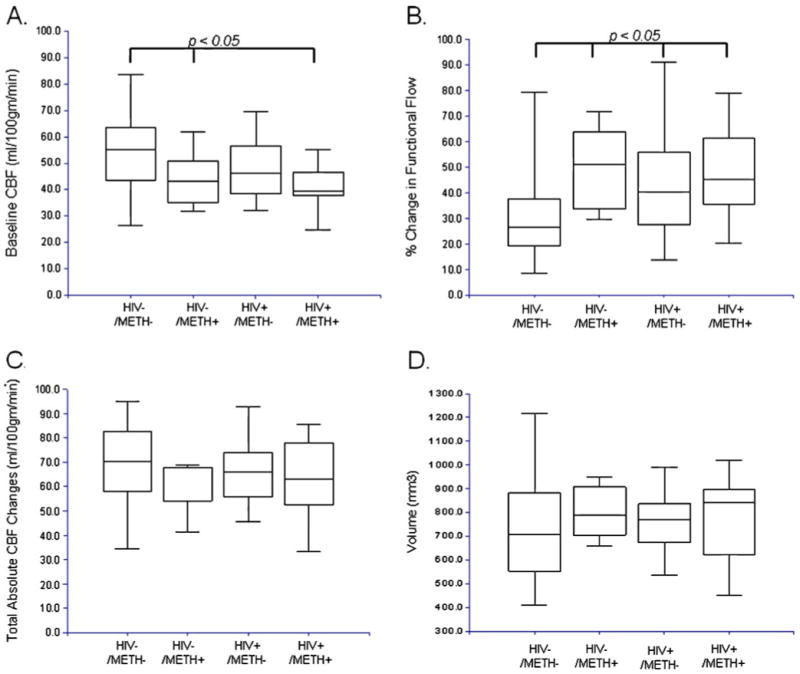
Human immunodeficiency virus (HIV) and methamphetamine (METH) dependence are independently associated with neuronal dysfunction. The coupling between cerebral blood flow (CBF) and neuronal activity is the basis of many task-based functional neuroimaging techniques. We examined the interaction between HIV infection and a previous history of METH dependence on CBF within the lenticular nuclei (LN). Twenty-four HIV-/METH-, eight HIV-/METH+, 24 HIV+/METH-, and 15 HIV+/METH+ participants performed a finger tapping paradigm. A multiple regression analysis of covariance assessed associations and two-way interactions between CBF and HIV serostatus and/or previous history of METH dependence. HIV+ individuals had a trend towards a lower baseline CBF (-10%, p = 0.07) and greater CBF changes for the functional task (+32%, p = 0.01) than HIV- subjects. Individuals with a previous history of METH dependence had a lower baseline CBF (-16%, p = 0.007) and greater CBF changes for a functional task (+33%, p = 0.02). However, no interaction existed between HIV serostatus and previous history of METH dependence for either baseline CBF (p = 0.53) or CBF changes for a functional task (p = 0.10). In addition, CBF and volume in the LN were not correlated. A possible additive relationship could exist between HIV infection and a history of METH dependence on CBF with a previous history of METH dependence having a larger contribution. Abnormalities in CBF could serve as a surrogate measure for assessing the chronic effects of HIV and previous METH dependence on brain function.
Conflict of interest statement
Figures
Similar articles
-
Impact of methamphetamine on regional metabolism and cerebral blood flow after traumatic brain injury.Neurocrit Care. 2013 Oct;19(2):183-91. doi: 10.1007/s12028-013-9871-9. Neurocrit Care. 2013. PMID: 23836426 Free PMC article.
-
Functional interactions of HIV-infection and methamphetamine dependence during motor programming.Psychiatry Res. 2012 Apr 30;202(1):46-52. doi: 10.1016/j.pscychresns.2012.03.006. Epub 2012 May 17. Psychiatry Res. 2012. PMID: 22608157 Free PMC article.
-
Prior Methamphetamine Use Disorder History Does Not Impair Interoceptive Processing of Soft Touch in HIV Infection.Viruses. 2021 Dec 10;13(12):2476. doi: 10.3390/v13122476. Viruses. 2021. PMID: 34960745 Free PMC article.
-
Synergistic Impairment of the Neurovascular Unit by HIV-1 Infection and Methamphetamine Use: Implications for HIV-1-Associated Neurocognitive Disorders.Viruses. 2021 Sep 21;13(9):1883. doi: 10.3390/v13091883. Viruses. 2021. PMID: 34578464 Free PMC article. Review.
-
Interactions of HIV and methamphetamine: cellular and molecular mechanisms of toxicity potentiation.Neurotox Res. 2007 Oct;12(3):181-204. doi: 10.1007/BF03033915. Neurotox Res. 2007. PMID: 17967742 Review.
Cited by
-
An Update of the Review of Neuropsychological Consequences of HIV and Substance Abuse: A Literature Review and Implications for Treatment and Future Research.Curr Drug Abuse Rev. 2015;8(1):50-71. doi: 10.2174/1874473708666150309124820. Curr Drug Abuse Rev. 2015. PMID: 25751583 Free PMC article. Review.
-
Effects of HIV Infection, methamphetamine dependence and age on cortical thickness, area and volume.Neuroimage Clin. 2018;20:1044-1052. doi: 10.1016/j.nicl.2018.09.034. Epub 2018 Oct 7. Neuroimage Clin. 2018. PMID: 30342393 Free PMC article.
-
Reduction in cerebral oxygen metabolism in subcortical regions may be a biomarker of cognitive decline in people living with human immunodeficiency virus.Eur J Neurol. 2022 Apr;29(4):1062-1074. doi: 10.1111/ene.15196. Epub 2021 Dec 10. Eur J Neurol. 2022. PMID: 34821434 Free PMC article.
-
Neuropsychological, Neurovirological and Neuroimmune Aspects of Abnormal GABAergic Transmission in HIV Infection.J Neuroimmune Pharmacol. 2016 Jun;11(2):279-93. doi: 10.1007/s11481-016-9652-2. Epub 2016 Jan 30. J Neuroimmune Pharmacol. 2016. PMID: 26829944 Free PMC article.
-
Variability of physiological brain perfusion in healthy subjects - A systematic review of modifiers. Considerations for multi-center ASL studies.J Cereb Blood Flow Metab. 2018 Sep;38(9):1418-1437. doi: 10.1177/0271678X17702156. Epub 2017 Apr 10. J Cereb Blood Flow Metab. 2018. PMID: 28393659 Free PMC article.
References
-
- Allison JD, Meador KJ, Loring DW, Figueroa RE, Wright JC. Functional MRI cerebral activation and deactivation during finger movement. Neurology. 2000;54:135–142. - PubMed
-
- Ances BM, Ellis RJ. Dementia and neurocognitive disorders due to HIV-1 infection. Semin Neurol. 2007;27:86–92. - PubMed
-
- Ances BM, Roc AC, Wang J, Korczykowski M, Okawa J, Stern J, Kim J, Wolf R, Lawler K, Kolson DL, Detre JA. Caudate blood flow and volume are reduced in HIV+ neurocognitively impaired patients. Neurology. 2006;66:862–866. - PubMed
Publication types
MeSH terms
Substances
Grants and funding
- P50 DA026306/DA/NIDA NIH HHS/United States
- NS-36722/NS/NINDS NIH HHS/United States
- 1R01NR012657/NR/NINR NIH HHS/United States
- P50 DA26306/DA/NIDA NIH HHS/United States
- R01 NS042069/NS/NINDS NIH HHS/United States
- K23 MH081786/MH/NIMH NIH HHS/United States
- AI47033/AI/NIAID NIH HHS/United States
- R01 NR012657/NR/NINR NIH HHS/United States
- NS-42069/NS/NINDS NIH HHS/United States
- P01 DA12065/DA/NIDA NIH HHS/United States
- N01 MH022005/MH/NIMH NIH HHS/United States
- R01 AI047033/AI/NIAID NIH HHS/United States
- R01 NS036722/NS/NINDS NIH HHS/United States
- 1K23MH081786/MH/NIMH NIH HHS/United States
- P30 MH62512/MH/NIMH NIH HHS/United States
- P30 MH062512/MH/NIMH NIH HHS/United States
- P01 DA012065/DA/NIDA NIH HHS/United States
LinkOut - more resources
Full Text Sources
Medical
