


Bile acid metabolism and the pathogenesis of type 2 diabetes
- PMID: 21431855
- PMCID: PMC3338411
- DOI: 10.1007/s11892-011-0187-x
Bile acid metabolism and the pathogenesis of type 2 diabetes
Abstract
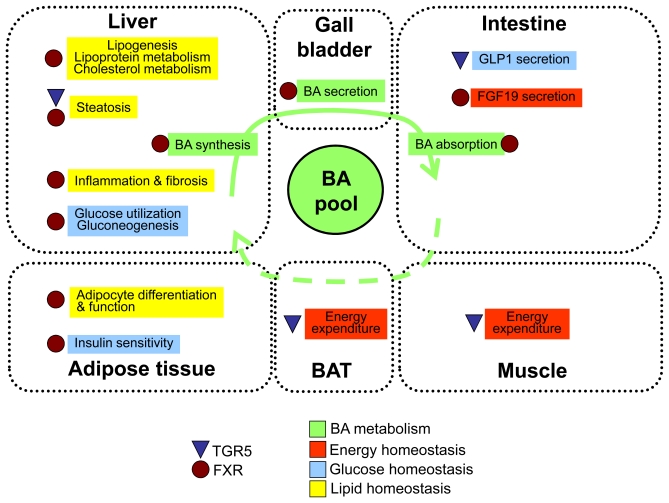
Type 2 diabetes (T2D) is a growing health problem worldwide, but the currently available strategies for therapy and prevention are insufficient. Recent observations indicate that bile acid homeostasis is altered in T2D. Bile acids are metabolic regulators that act as signaling molecules through receptor-dependent and -independent pathways. The most prominent signaling molecules mediating bile acid signaling are the nuclear receptor farnesoid X receptor (FXR) and the membrane receptor TGR5. Both are implicated in the regulation of lipid, glucose, and energy metabolism. Dysregulation of these pathways might contribute to the development of T2D and associated complications. Interestingly, data from studies with bile acids or bile acid sequestrants indicate that the manipulation of bile acid homeostasis might be an attractive approach for T2D therapy. In this review, we summarize the mechanisms of bile acid-mediated metabolic control that might be relevant in the pathogenesis of T2D.
Conflict of interest statement
The authors disclose no conflict of interest.
Figures
References
-
- IDF Diabetes Atlas. [Accessed January 2011]. Available at http://www.diabetesatlas.org/
-
- Lefebvre P, Cariou B, Lien F, et al. Role of bile acids and bile acid receptors in metabolic regulation. Physiol Rev. 2009;89:147–191. - PubMed
-
- Thomas C, Pellicciari R, Pruzanski M, et al. Targeting bile-acid signalling for metabolic diseases. Nat Rev Drug Discov. 2008;7:678–693. - PubMed
-
- Russell DW. The enzymes, regulation, and genetics of bile acid synthesis. Annu Rev Biochem. 2003;72:137–174. - PubMed
-
- Bennion LJ, Grundy SM. Effects of diabetes mellitus on cholesterol metabolism in man. N Engl J Med. 1977;296:1365–1371. - PubMed
Publication types
MeSH terms
Substances
LinkOut - more resources
Full Text Sources
Other Literature Sources
Medical
