Comparative Study
. 2011 Sep;25(6):1014-28.
doi: 10.1080/02699931.2010.542999. Epub 2011 May 24.

Negative emotional outcomes impair older adults' reversal learning

Affiliations
Comparative Study

Negative emotional outcomes impair older adults' reversal learning

Kaoru Nashiro et al. Cogn Emot. 2011 Sep.

Abstract

In a typical reversal-learning experiment, one learns stimulus-outcome contingencies that then switch without warning. For instance, participants might have to repeatedly choose between two faces, one of which yields points whereas the other does not, with a reversal at some point in which face yields points. The current study examined age differences in the effects of outcome type on reversal learning. In the first experiment, the participants' task was either to select the person who would be in a better mood or to select the person who would yield more points. Reversals in which face was the correct option occurred several times. Older adults did worse in blocks in which the correct response was to select the person who would not be angry than in blocks in which the correct response was to select the person who would smile. Younger adults did not show a difference by emotional valence. In the second study, the negative condition was switched to have the same format as the positive condition (to select who will be angry). Again, older adults did worse with negative than positive outcomes, whereas younger adults did not show a difference by emotional valence. A third experiment replicated the lack of valence effects in younger adults with a harder probabilistic reversal-learning task. In the first two experiments, older adults performed about as well as younger adults in the positive conditions but performed worse in the negative conditions. These findings suggest that negative emotional outcomes selectively impair older adults' reversal learning.


Figures
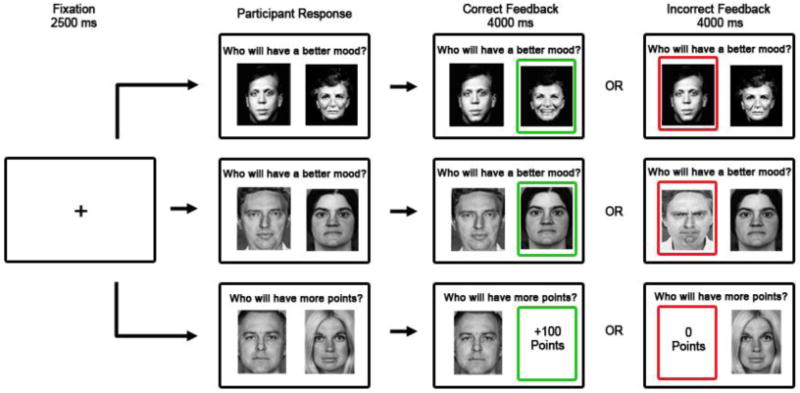
Figure 1
Figure 1. Procedure of Experiment 1
The positive (top), negative (middle) or non-emotion conditions (bottom) were assigned to the subject in a random order. The trial began with a fixation cross presented for 2500 ms, and two people with neutral face expressions were presented to the subject. The subject had to select one of the people by pressing a key, and feedback was presented for 4000 ms. In the positive condition, the correct person smiled, and the incorrect person remained neutral. In the negative condition, the correct person remained neutral, and the incorrect person showed an angry expression. In the non-emotion condition, the correct person showed 100 points, and the incorrect person showed 0 points. Across conditions, the task for the subject was to keep track of the correct face because it switched mid-game (after five consecutive correct trials, which was unknown to the subject).
Figure 2
Figure 2. Procedure of Experiment 2
The positive (top), negative (middle) or non-emotion conditions (bottom) were assigned to the subject in a random order. The trial began with a fixation cross presented for 3000 ms, and two people with neutral face expressions were presented to the subject. The subject had to select one of the people by pressing a key, and feedback was presented for 3000 ms. In the positive condition, the correct person smiled, and the incorrect person remained neutral. In the negative condition, the correct person showed an angry expression, and incorrect person remained neutral. In the non-emotion condition, the correct person wore eyeglasses, and the incorrect person remained neutral. Across conditions, the task for the subject was to keep track of the correct face because it switched mid-game (after between five and seven consecutive correct trials, which was unknown to the subject).

References

    1. Brainard DH. The Psychophysics Toolbox. Spatial Vision. 1997;10(4):443–446. - PubMed
    1. Charles S, Mather M, Carstensen LL. Aging and emotional memory: The forgettable nature of negative images for older adults. Journal of Experimental Psychology: General. 2003;132:310–324. doi: 10.1037/0096-3445.132.2.310. - DOI - PubMed
    1. Comblain C, D'Argembeau A, Van der Linden M, Aldenhoff L. The effect of aging on the recollection of emotional and neutral pictures. Memory. 2004;12:673–684. doi: 10.1080/09658210344000477. - DOI - PubMed
    1. Denburg NL, Buchanan TW, Tranel D, Adolphs R. Evidence for preserved emotional memory in normal older adults. Emotion. 2003;3:239–253. doi: 10.1037/1528-3542.3.3.239. - DOI - PubMed
    1. Denburg NL, Recknor EC, Bechara A, Tranel D. Psychophysiological anticipation of positive outcomes promotes advantageous decision-making in normal older persons. International Journal of Psychophysiology. 2006;61:19–25. doi: 10.1016/j.ijpsycho.2005.10.021. - DOI - PubMed

Publication types

LinkOut - more resources
