


Deliberate real-time mood regulation in adulthood: the importance of age, fixation and attentional functioning
- PMID: 21432641
- PMCID: PMC3168583
- DOI: 10.1080/02699931.2010.541668
Deliberate real-time mood regulation in adulthood: the importance of age, fixation and attentional functioning
Abstract
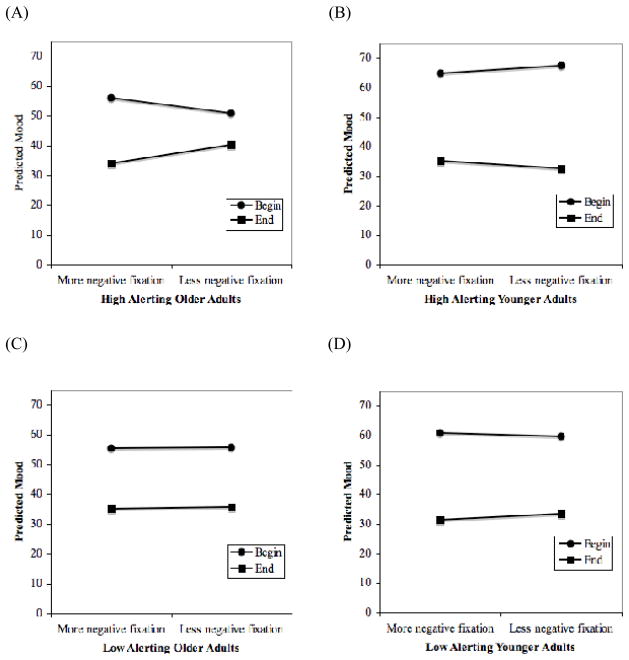
While previous research has linked executive attention to emotion regulation, the current study investigated the role of attentional alerting (i.e., efficient use of external warning cues) on younger (N=39) and older (N=44) adults' use of gaze to regulate their mood in real time. Participants viewed highly arousing unpleasant images while reporting their mood and were instructed to deliberately manage how they felt and to minimise the effect of those stimuli on their mood. Fixations toward the most negative areas of the images were recorded with eye tracking. We examined whether looking less at the most negative regions, compared to each individual's own tendency, was a beneficial mood regulatory strategy and how it interacted with age and alerting ability. High alerting older adults, who rely more on external cues to guide their attention, experienced a smaller decline in mood over time by activating a less-negative-looking approach (compared to their own average tendency), effectively looking away from the most negative areas of the images. More negative gaze patterns predicted better mood for younger adults, though this effect decreased over time. Alerting did not moderate gaze-mood links in younger adults. Successful mood regulation may thus depend on particular combinations of age, fixation, and attention.
Figures
References
-
- Carstensen LL, Isaacowitz DM, Charles ST. Taking time seriously: A theory of socioemotional selectivity. American Psychologist. 1999;54:165–181. - PubMed
-
- Carstensen LL, Mikels JA. At the intersection of emotion and cognition: aging and the positivity effect. Current Directions in Psychological Science. 2005;14:117–121.
-
- Carstensen LL, Mikels JA, Mather M. Aging and the Intersection of Cognition, Motivation, and Emotion. In: Birren JE, Schaire KW, editors. Handbook of the Psychology of Aging. 6. Amsterdam: Elsevier; 2006. pp. 343–362.
Publication types
MeSH terms
Grants and funding
LinkOut - more resources
Full Text Sources
