A 3'-untranslated region KRAS variant and triple-negative breast cancer: a case-control and genetic analysis
- PMID: 21435948
- PMCID: PMC3488438
- DOI: 10.1016/S1470-2045(11)70044-4
A 3'-untranslated region KRAS variant and triple-negative breast cancer: a case-control and genetic analysis
Erratum in
- Lancet Oncol. 2011 Jun;12(6):522
Abstract
Background: We previously identified a functional variant in a let-7 microRNA (miRNA) complementary site in the 3'-untranslated region of the KRAS oncogene (rs61764370) which is associated with cancer. We aimed to investigate the association of this KRAS variant with breast cancer and tumour biology.
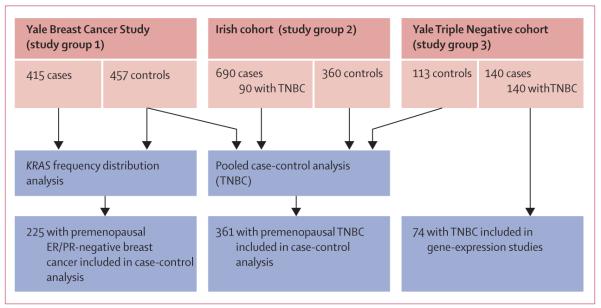
Methods: We assessed frequency distributions of the KRAS variant in 415 patients with histologically confirmed breast cancer and 457 controls from Connecticut, USA (study group 1) and association of this variant with breast-cancer subtypes in 690 Irish women with known oestrogen receptor (ER), progesterone receptor (PR), and HER2 statuses, and 360 controls (study group 2). We pooled data for study groups 1 and 2 with a cohort of 140 women with triple-negative breast cancer and 113 controls to assess the association of the KRAS variant with triple-negative breast cancer risk, and genome-wide mRNA and specific miRNA expression in patients with triple-negative breast cancer.
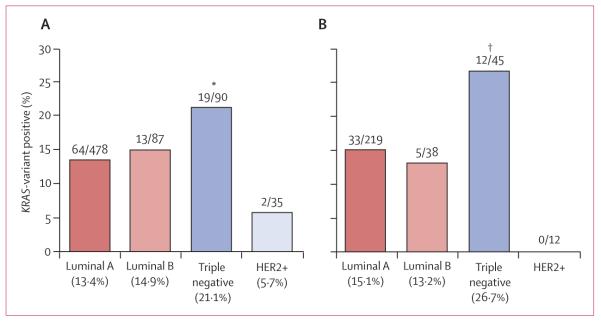
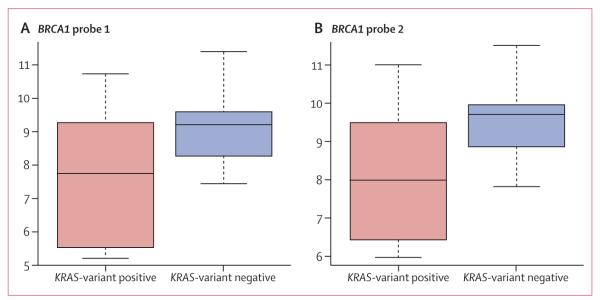
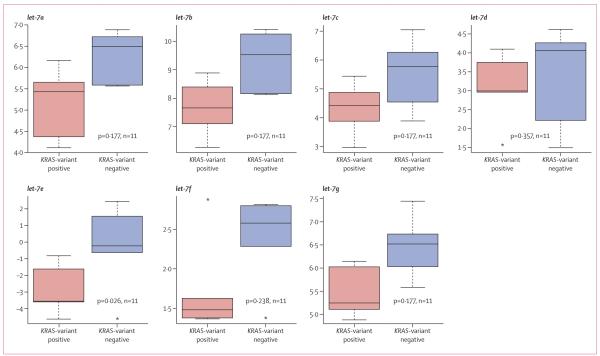
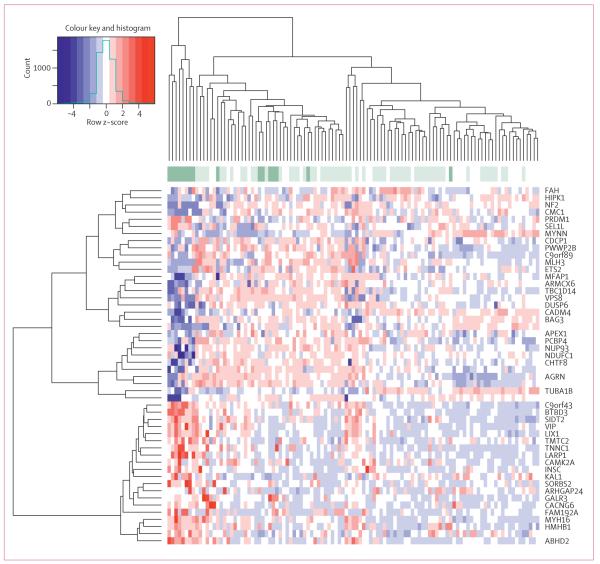
Findings: Although frequency distributions of the KRAS variant in study group 1 did not differ between all genotyped individuals, eight (33%) of 24 premenopausal women with ER/PR-negative cancer had the KRAS variant, compared with 27 (13%) of 201 premenopausal controls (p=0.015). In study group 2, the KRAS variant was significantly enriched in women with triple-negative breast cancer (19 [21%] of 90 cases) compared with 64 (13%) of 478 for luminal A, 13 (15%) of 87 for luminal B, and two (6%) of 35 for HER2-positive subgroups (p=0.044). Multivariate analysis in the pooled study groups showed that the KRAS variant was associated with triple-negative breast cancer in premenopausal women (odds ratio 2.307, 95% CI 1.261-4.219, p=0.0067). Gene-expression analysis of triple-negative breast-cancer tumours suggested that KRAS-variant positive tumours have significantly altered gene expression, and are enriched for the luminal progenitor and BRCA1 deficiency signatures. miRNA analysis suggested reduced levels of let-7 miRNA species in KRAS-variant tumours.
Interpretation: The KRAS variant might be a genetic marker for development of triple-negative breast cancer in premenopausal women, and altered gene and miRNA expression signatures should enable molecular and biological stratification of patients with this subgroup of breast cancer.
Funding: US National Institutes of Health.
Copyright © 2011 Elsevier Ltd. All rights reserved.
Figures
Comment in
-
KRAS 3'-UTR variants and stratification of breast-cancer risk.Lancet Oncol. 2011 Apr;12(4):318-9. doi: 10.1016/S1470-2045(11)70065-1. Epub 2011 Mar 22. Lancet Oncol. 2011. PMID: 21435949 No abstract available.
-
Association between KRAS rs61764370 and triple-negative breast cancer--a false positive?Lancet Oncol. 2011 Aug;12(8):723-4; author reply 724. doi: 10.1016/S1470-2045(11)70156-5. Lancet Oncol. 2011. PMID: 21807336 No abstract available.
References
-
- Haffty BG, Yang Q, Reiss M, et al. Locoregional relapse and distant metastasis in conservatively managed triple-negative early-stage breast cancer. J Clin Oncol. 2006;24:5652–57. - PubMed
-
- Rakha EA, Ellis IO. Triple-negative/basal-like breast cancer: review. Pathology. 2009;41:40–47. - PubMed
-
- Lim E, Vaillant F, Wu D, et al. Aberrant luminal progenitors as the candidate target population for basal tumor development in BRCA1 mutation carriers. Nat Med. 2009;15:907–13. - PubMed
Publication types
MeSH terms
Substances
Grants and funding
LinkOut - more resources
Full Text Sources
Other Literature Sources
Medical
Research Materials
Miscellaneous