Minireview: Alternative activation pathways for the androgen receptor in prostate cancer
- PMID: 21436259
- PMCID: PMC3100605
- DOI: 10.1210/me.2010-0469
Minireview: Alternative activation pathways for the androgen receptor in prostate cancer
Abstract
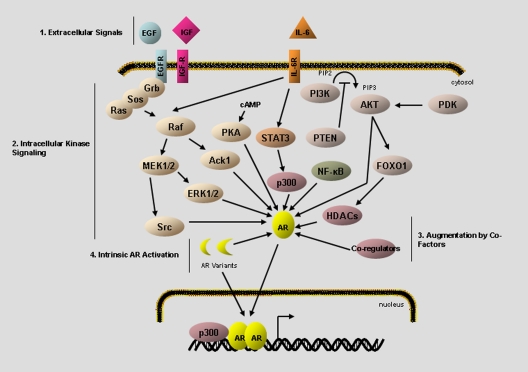
Advanced prostate tumors, which are androgen dependent, are often initially treated in the clinic with hormone ablation therapy, either through surgical castration or administration of small-molecule antiandrogens. Most tumors respond favorably to these treatments, exhibiting regression of the tumor, amelioration of symptoms, and a decrease of prostate-specific antigen in patient sera. However, with time, the majority of tumors recur in a more aggressive, castration-resistant (CR) phenotype. Currently, no effective treatment exists for this stage of the cancer, and patients ultimately succumb to metastatic disease. The androgen receptor (AR), which is a member of the nuclear hormone receptor superfamily of proteins, is the transcription factor that is responsible for mediating the effects of androgens upon target tissues, and it has been demonstrated to play a central role in the development and progression of prostate cancer. Despite CR tumor cells being able to continue to grow after hormonal therapy in which testosterone and dihydrotestosterone are markedly reduced, they still require the expression and activity of the AR. The AR can become transactivated in this low-androgen environment through a number of different mechanisms, including amplification and mutation of the receptor, cross talk with other signaling pathways, and altered regulation by coregulatory proteins. This review will summarize the most current data regarding non-ligand-mediated activation of the AR in prostate cancer cells. Developing work in this field aims to more clearly elucidate the signals that drive AR activity independently of androgens in CR disease so that better therapeutic targets can be developed for patients with this stage of highly aggressive prostate carcinoma.
Figures
References
-
- Jemal A, Siegel R, Xu J, Ward E. 2010. Cancer Statistics, 2010. CA Cancer J Clin 60:277–300 - PubMed
-
- Geller J. 1995. Prolonging survival in metastatic prostate cancer: the case for adrenal androgens: overview and summary of therapeutic controversies in prostatic cancer. J Clin Endocrinol Metab 80:1074–1078 - PubMed
-
- Mohler JL. 2008. Castration-recurrent prostate cancer is not androgen-independent. Adv Exp Med Biol 617:223–234 - PubMed
-
- Lamont KR, Tindall DJ. 2010. Androgen regulation of gene expression. Adv Cancer Res 107:137–162 - PubMed
-
- Debes JD, Tindall DJ. 2002. The role of androgens and the androgen receptor in prostate cancer. Cancer Lett 187:1–7 - PubMed
Publication types
MeSH terms
Substances
Grants and funding
LinkOut - more resources
Full Text Sources
Other Literature Sources
Medical
Research Materials