


Reactive oxygen species (ROS) from NADPH and xanthine oxidase modulate the cutaneous local heating response in healthy humans
- PMID: 21436462
- PMCID: PMC3137526
- DOI: 10.1152/japplphysiol.01448.2010
Reactive oxygen species (ROS) from NADPH and xanthine oxidase modulate the cutaneous local heating response in healthy humans
Abstract
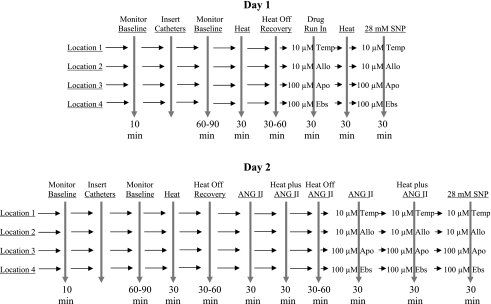
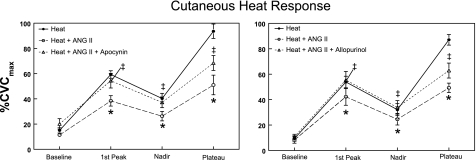
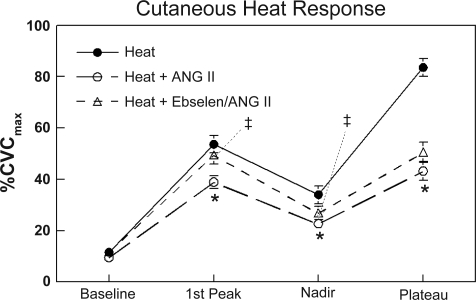
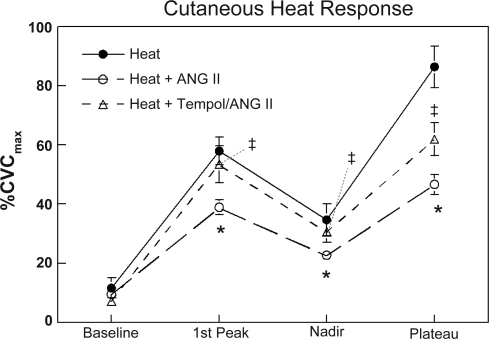
Local cutaneous heating produces vasodilation that is largely nitric oxide (NO) dependent. We showed that angiotensin II (ANG II) attenuates this by an ANG II receptor, type 1 (AT1R)-dependent mechanism that is reversible with the antioxidant ascorbate, indicating oxidative stress. Reactive oxygen species (ROS) produced by ANG II employ NADPH and xanthine oxidase pathways. To determine whether these mechanisms pertain to skin, we measured cutaneous local heating with 10 μM ANG II, using apocynin to inhibit NADPH oxidase and allopurinol to inhibit xanthine oxidase. We also inhibited superoxide with tempol, and H(2)O(2) with ebselen. We heated the skin of the calf in 8 healthy volunteers (24.5-29.9 yr old) to 42°C and measured local blood flow to assess the percentage of maximum cutaneous vascular conductance. We remeasured while perfusing allopurinol, apocynin, ebselen, and tempol through individual microdialysis catheters. This was then repeated with ANG II combined with antioxidant drugs. tempol and apocynin alone had no effect on the heat response. Allopurinol enhanced the entire response (125% of heat alone), while ebselen suppressed the heat plateau (76% of heat alone). ANG II alone caused significant attenuation of the entire heat response (52%). When added to ANG II, Allopurinol partially reversed the ANG II attenuation. Heat with ebselen and ANG II were similar to heat and ANG II; ebselen only partially reversed the ANG II attenuation. Apocynin and tempol each partially reversed the attenuation caused by ANG II. This suggests that ROS, produced by ANG II via NADPH and xanthine oxidase pathways, modulates the response of skin to the application of heat, and thus contributes to the control of local cutaneous blood flow.
Figures
Comment in
-
Cutaneous thermal hyperemia: more than skin deep.J Appl Physiol (1985). 2011 Jul;111(1):5-7. doi: 10.1152/japplphysiol.00544.2011. Epub 2011 May 5. J Appl Physiol (1985). 2011. PMID: 21551016 No abstract available.
References
-
- Anderson C, Andersson T, Wardell K. Changes in skin circulation after insertion of a microdialysis probe visualized by laser Doppler perfusion imaging. J Invest Dermatol 102: 807–811, 1994 - PubMed
-
- Beckman JS. Oxidative damage and tyrosine nitration from peroxynitrite. Chem Res Toxicol 9: 836–844, 1996 - PubMed
-
- Brain SD, Williams TJ. Substance P regulates the vasodilator activity of calcitonin gene-related peptide. Nature 335: 73–75, 1988 - PubMed
-
- Chan SH, Hsu KS, Huang CC, Wang LL, Ou CC, Chan JY. NADPH oxidase-derived superoxide anion mediates angiotensin II-induced pressor effect via activation of p38 mitogen-activated protein kinase in the rostral ventrolateral medulla. Circ Res 97: 772–780, 2005 - PubMed
Publication types
MeSH terms
Substances
Grants and funding
LinkOut - more resources
Full Text Sources
Miscellaneous
