


Prevalence of vitamin D deficiency in patients with acute myocardial infarction
- PMID: 21439530
- PMCID: PMC4320644
- DOI: 10.1016/j.amjcard.2011.01.048
Prevalence of vitamin D deficiency in patients with acute myocardial infarction
Abstract
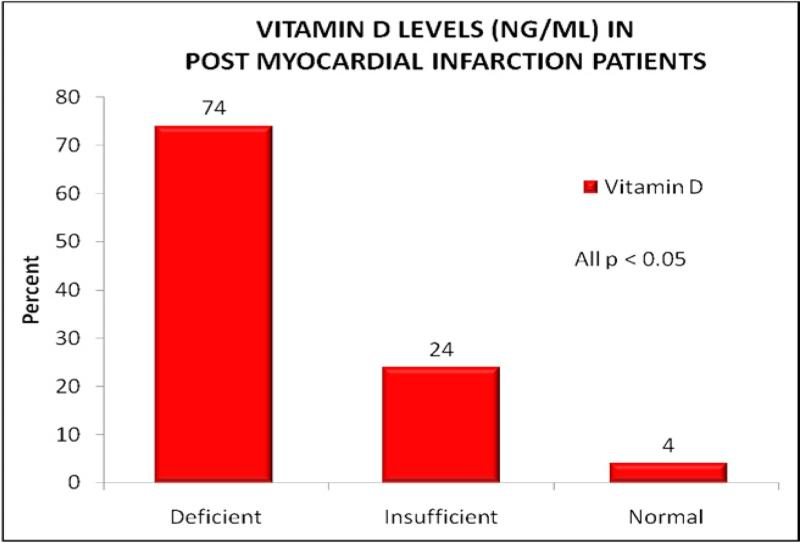
Deficiency in 25-hydroxyvitamin D (25[OH]D) is a treatable condition that has been associated with coronary artery disease and many of its risk factors. A practical time to assess for 25(OH)D deficiency, and to initiate treatment, is at the time of an acute myocardial infarction. The prevalence of 25(OH)D deficiency and the characteristics associated with it in patients with acute myocardial infarction are unknown. In this study, 25(OH)D was assessed in 239 subjects enrolled in a 20-hospital prospective myocardial infarction registry. Patients enrolled from June 1 to December 31, 2008, had serum samples sent to a centralized laboratory for analysis using the DiaSorin 25(OH)D assay. Normal 25(OH)D levels are ≥30 ng/ml, and patients with levels <30 and >20 ng/ml were classified as insufficient and those with levels ≤20 ng/ml as deficient. Vitamin D levels and other baseline characteristics were analyzed with the linear or Mantel-Haenszel trend test. Of the 239 enrolled patients, 179 (75%) were 25(OH)D deficient and 50 (21%) were insufficient, for a total of 96% of patients with abnormally low 25(OH)D levels. No significant heterogeneity was observed among age or gender subgroups, but 25(OH)D deficiency was more commonly seen in non-Caucasian patients and those with lower social support, no insurance, diabetes, and lower activity levels. Higher parathyroid hormone levels (45.3 vs 32.7 pg/ml, p = 0.029) and body mass indexes (31.2 vs 29.0 kg/m(2), p = 0.025) were also observed in 25(OH)D-deficient subjects. In conclusion, vitamin D deficiency is present in almost all patients with acute myocardial infarction in a multicenter United States cohort.
Copyright © 2011 Elsevier Inc. All rights reserved.
Figures
References
-
- Zittermann A. Vitamin D and disease prevention with special reference to cardiovascular disease. Prog Biophys Mol Biol. 2006;92:39–48. - PubMed
-
- Holick MF. Vitamin D deficiency. N Engl J Med. 2007;357:266–281. - PubMed
-
- Lee JH, O'Keefe JH, Bell D, Hensrud DD, Holick MF. Vitamin D deficiency an important, common, and easily treatable cardiovascular risk factor? J Am Coll Cardiol. 2008;52:1949–1956. - PubMed
-
- Martins D, Wolf M, Pan D, Zadshir A, Tareen N, Thadhani R, Felsenfeld A, Levine B, Mehrotra R, Norris K. Prevalence of cardiovascular risk factors and the serum levels of 25-hydroxyvitamin D in the United States: data from the Third National Health and Nutrition Examination Survey. Arch Intern Med. 2007;167:1159–1165. - PubMed
Publication types
MeSH terms
Grants and funding
LinkOut - more resources
Full Text Sources
Medical
