Mechanisms limiting body growth in mammals
- PMID: 21441345
- PMCID: PMC3365796
- DOI: 10.1210/er.2011-0001
Mechanisms limiting body growth in mammals
Abstract
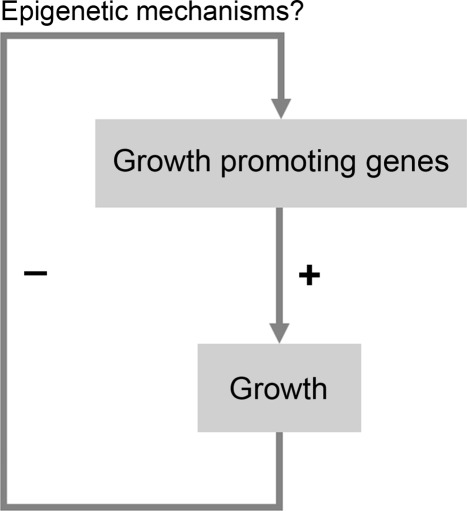
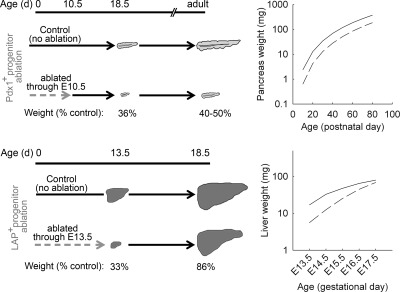
Recent studies have begun to provide insight into a long-standing mystery in biology-why body growth in animals is rapid in early life but then progressively slows, thus imposing a limit on adult body size. This growth deceleration in mammals is caused by potent suppression of cell proliferation in multiple tissues and is driven primarily by local, rather than systemic, mechanisms. Recent evidence suggests that this progressive decline in proliferation results from a genetic program that occurs in multiple organs and involves the down-regulation of a large set of growth-promoting genes. This program does not appear to be driven simply by time, but rather depends on growth itself, suggesting that the limit on adult body size is imposed by a negative feedback loop. Different organs appear to use different types of information to precisely target their adult size. For example, skeletal and cardiac muscle growth are negatively regulated by myostatin, the concentration of which depends on muscle mass itself. Liver growth appears to be modulated by bile acid flux, a parameter that reflects organ function. In pancreas, organ size appears to be limited by the initial number of progenitor cells, suggesting a mechanism based on cell-cycle counting. Further elucidation of the fundamental mechanisms suppressing juvenile growth is likely to yield important insights into the pathophysiology of childhood growth disorders and of the unrestrained growth of cancer. In addition, improved understanding of these growth-suppressing mechanisms may someday allow their therapeutic suspension in adult tissues to facilitate tissue regeneration.
Figures
References
-
- Kennedy D, Norman C. 2005. What don't we know? Science 309:75. - PubMed
-
- Tanner JM, Davies PS. 1985. Clinical longitudinal standards for height and height velocity for North American children. J Pediatr 107:317–329 - PubMed
-
- Goedbloed JF. 1972. The embryonic and postnatal growth of rat and mouse. I. The embryonic and early postnatal growth of the whole embryo. A model with exponential growth and sudden changes in growth rate. Acta Anat (Basel) 82:305–306 - PubMed
-
- Luecke RH, Wosilait WD, Young JF. 1999. Mathematical modeling of human embryonic and fetal growth rates. Growth Dev Aging 63:49–59 - PubMed