. 2011 Nov;21(11):2471-81.
doi: 10.1093/cercor/bhr017. Epub 2011 Mar 25.

Reduced functional connectivity during working memory in Turner syndrome

Affiliations

Reduced functional connectivity during working memory in Turner syndrome

Signe Bray et al. Cereb Cortex. 2011 Nov.

Abstract

Turner syndrome (TS) is a genetic disorder affecting females, resulting from the complete or partial absence of an X chromosome. The cognitive profile of TS shows relative strengths in the verbal domain and weaknesses in the procedural domain, including working memory. Neuroimaging studies have identified differences in the morphology of the parietal lobes, and white matter pathways linking frontal and parietal regions, as well as abnormal activation in dorsal frontal and parietal regions. Taken together these findings suggest that abnormal functional connectivity between frontal and parietal regions may be related to working memory impairments in TS, a hypothesis we tested in the present study. We scanned TS and typically developing participants with functional magnetic resonance imaging while they performed visuospatial and phonological working memory tasks. We generated a seed region in parietal cortex based on structural differences in TS and found that functional connectivity with dorsal frontal regions was reduced during working memory in TS. Finally, we found that connectivity was correlated with task performance in TS. These findings suggest that structural brain abnormalities in TS affect not only regional activity but also the functional interactions between regions and that this has important consequences for behavior.


Figures
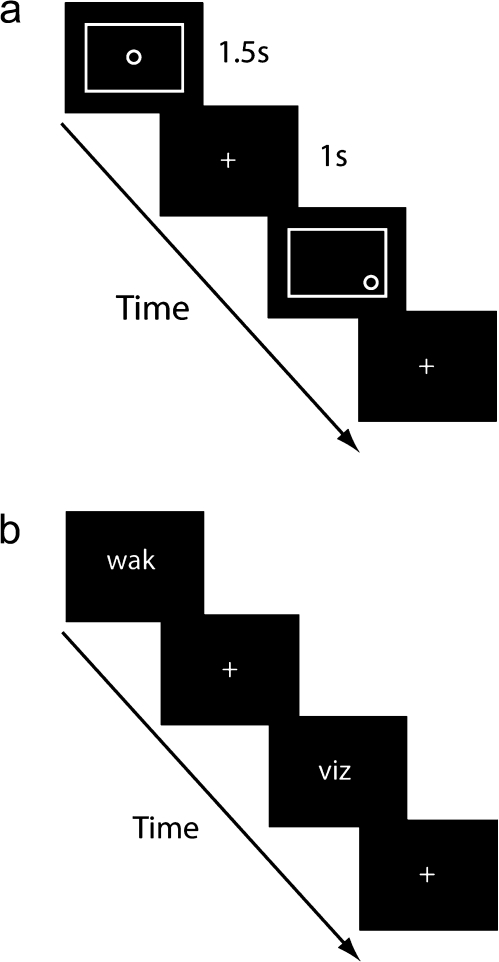
Figure 1.
Figure 1.
Task. Subjects performed visuospatial (a) and phonological (b) working memory tasks in the scanner. Both tasks consisted of rest (R), 1-back (1B), 2-back (2B), and match-control (C) blocks, in the following order (R-1B-C-1B-C-1B-C-R-2B-C-2B-C-2B-C-R). Each block consisted of 14 trials, approximately 25% of which were targets. Subjects responded according to the block, which was cued by an instruction screen presented for 2 s at the start of each block. (a) During the visuospatial working memory task, on each trial subjects saw the stimulus (a white circle inside a white rectangle, on a black background) for 1.5 s, followed by a fixation cross for 1 s. The participants pressed the button if the cue was in the center (C), same position as the previous trial (1B), or same position as 2 trials previously (2B). (b) During the phonological working memory task, on each trial participants saw a 3-letter nonword syllable at the center of the screen for 1.5 s, followed by a fixation cross for 1 s. During the match-control block, 2 syllables were presented, one above the other. The participants pressed the button if the 2 syllables rhymed (C), rhymed with the syllable shown on the previous trial (1B), or rhymed with the syllable shown 2 trials previously (2B).
Figure 2.
Figure 2.
Group differences in structure and working memory activation. (a) VBM results showing volumetric reductions in TS relative to TDs bilaterally along the IPS (Table 3). (b) Regions more engaged in the TD group relative to the TS group during working memory tasks included the right SMG (lower panel; whole-brain corrected), and left MFG, and right SFG (upper panel; corrected for small volume). (c) Regions of significant volumetric reductions (red) and working memory activation reductions (yellow) in TS relative to TDs overlaid on a canonical structural image. Statistical images thresholded at P < 0.001 uncorrected for display purposes.
Figure 3.
Figure 3.
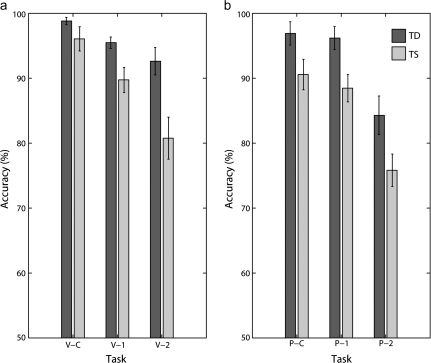
Accuracy. (a) Accuracy during the visuospatial task, for control (V-C), 1-back (V-1B), and 2-back (V-2B) conditions. (b) Accuracy during the phonological task, for control (P-C), 1-back (P-1B), and 2-back (P-2B) conditions.
Figure 4.
Figure 4.
PPI analysis. (a) Group differences in interactions with the rIPS seed region, during working memory tasks across both modalities. The TD group showed significantly greater connectivity in the right IPL (whole-brain corrected), and in left MFG, and left IPL (corrected for small volume). (b) Group differences in interactions with the rIPS seed region, during the visuospatial working memory task. The TD > TS contrast showed a significant difference in right IPL at our whole-brain corrected threshold, and in left MFG, left SFG, right MFG, and right SFG (corrected for small volume). Statistical images thresholded at P < 0.001 uncorrected for display purposes.
Figure 5.
Figure 5.
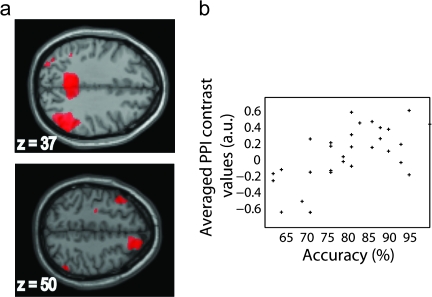
Example mask and averaged contrast values. (a) Masks were generated from clusters showing a significant correlation with accuracy at P < 0.05 with a minimum extent of 15 voxels. Shown are slices from the mask generated for the PPI 2B-C contrast. (b) Averaged contrast values extracted from the mask shown in a, plotted against 2-back accuracy.

References

    1. Ashburner J. A fast diffeomorphic image registration algorithm. Neuroimage. 2007;38:95–113. - PubMed
    1. Ashburner J, Friston KJ. Unified segmentation. Neuroimage. 2005;26:839–851. - PubMed
    1. Bender BG, Linden MG, Robinson A. Neuropsychological impairment in 42 adolescents with sex chromosome abnormalities. Am J Med Genet. 1993;48:169–173. - PubMed
    1. Bondy CA Turner Syndrome Study Group. Care of girls and women with Turner syndrome: a guideline of the Turner Syndrome Study Group. J Clin Endocrinol Metab. 2007;92:10–25. - PubMed
    1. Brett M, Anton J, Valabregue R, Poline J. Presented at the 8th International Conference on Functional Mapping of the Human Brain; 2002 June 2--6. Sendai (Japan): 2002. Region of interest analysis using an SPM toolbox [abstract]

Publication types