. 2011 May;60(5):1424-34.
doi: 10.2337/db10-1106. Epub 2011 Mar 25.

Central leptin signaling is required to normalize myocardial fatty acid oxidation rates in caloric-restricted ob/ob mice

Affiliations

Central leptin signaling is required to normalize myocardial fatty acid oxidation rates in caloric-restricted ob/ob mice

Crystal Sloan et al. Diabetes. 2011 May.

Abstract

Objective: ob/ob and db/db mice manifest myocardial hypertrophy, insulin resistance, altered substrate utilization, mitochondrial dysfunction, and lipid accumulation. This study was designed to determine the contribution of central and peripheral leptin signaling to myocardial metabolism and function in ob/ob and db/db mice in the absence of diabetes and morbid obesity.

Research design and methods: Male ob/ob mice (aged 4 weeks) were caloric restricted by pairfeeding to a leptin-treated ob/ob group. In addition to determining glucose tolerance and circulating lipid concentrations, myocardial substrate metabolism and mitochondrial function were determined in saponin-permeabilized cardiac fibers. Second, experiments were performed to determine whether leptin treatment by intraperitoneal injection or intracerebroventricular infusion could normalize myocardial palmitate oxidation in caloric-restricted ob/ob mouse hearts.

Results: Despite normalizing body weight and glucose tolerance, fat mass and circulating lipid levels remained increased in caloric-restricted ob/ob animals. Palmitate oxidation remained elevated in caloric-restricted ob/ob hearts and was normalized by intraperitoneal or intracerebroventricular leptin. Intraperitoneal and intracerebroventricular treatment also normalized circulating free fatty acid levels, myocardial fatty acid oxidation gene expression, and myocardial insulin sensitivity.

Conclusions: These data suggest that impaired hypothalamic leptin signaling is sufficient to increase myocardial fatty acid oxidation by increasing delivery of free fatty acid substrates and peroxisome proliferator-activated receptor-α ligands to the heart.


Figures
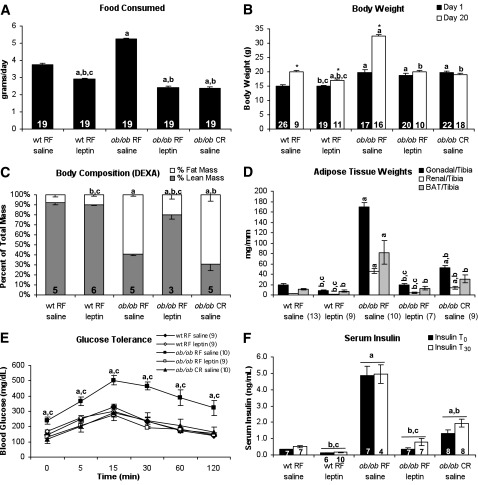
FIG. 1.
FIG. 1.
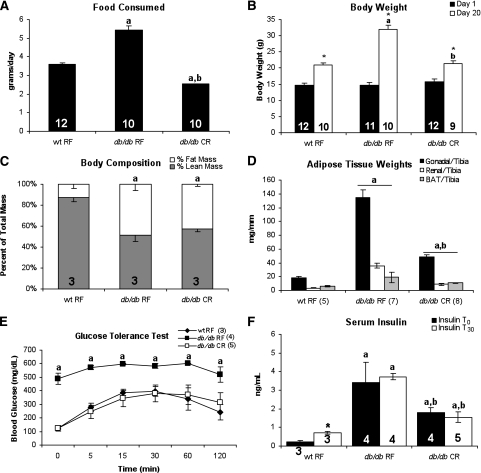
Altered body composition but normal glucose tolerance in caloric-restricted (CR) ob/ob mice. Average daily food intake (A), body weight (B), body composition (C), and adipose tissue weight (D) of ob/ob mice are shown. E: GTT performed on mice during 3rd week of treatment after 6 h of fasting. F: Serum insulin levels collected before and 30 min after glucose injection. Numbers of animals are shown in each figure. RF, random fed. aP < 0.05 vs. wt RF saline; bP < 0.05 vs. ob/ob RF saline; cP < 0.05 vs. ob/ob CR saline; *P < 0.05 vs. basal conditions of same treatment group. DEXA, dual-energy X-ray absorptiometry; RF, random fed; wt, wild type.
FIG. 2.
FIG. 2.
Altered body composition but normal glucose tolerance in caloric-restricted db/db mice. Average daily food intake (A), body weight (B), body composition (C), and adipose tissue weight (D) of db/db mice are shown. E: GTT performed on mice during 3rd week of treatment after 6 h of fasting. F: Serum insulin levels collected before and 30 min after glucose injection. Numbers of animals are shown in each figure. aP < 0.05 vs. wt RF; bP < 0.05 vs. db/db RF; *P < 0.05 vs. basal conditions of same treatment group. RF, random fed; wt, wild type.
FIG. 3.
FIG. 3.
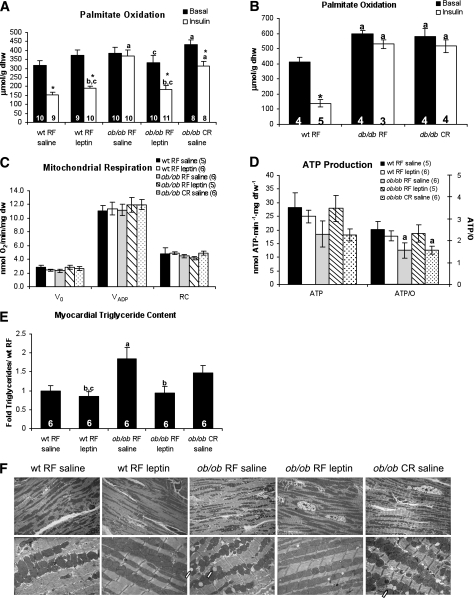
Increased triglyceride content and mitochondrial uncoupling accompany elevated myocardial palmitate oxidation in caloric-restricted mouse hearts. Myocardial palmitate oxidation as measured by isolated working heart perfusion in ob/ob (A) and db/db mice (B). C: Mitochondrial respirations from saponin-permeabilized fibers isolated from ob/ob hearts. V0, basal respiration; VADP, maximal ADP-stimulated respiration; Voligo, oxygen consumption in the presence of oligomycin; RC, respiratory control ratio (VADP/Voligo). D: ATP production rate and ATP/state 3 respirations (ATP/O ratio) for saponin-permeabilized fibers. E: Myocardial triglyceride content. F: Transmission electron microscopy of myocardial tissue from inner left ventricle. Magnification ×2,000 (top row) and ×8,000 (bottom row). Arrows indicate lipid droplets. aP < 0.05 vs. wt RF saline; bP < 0.05 vs. ob/ob RF or db/db RF; cP < 0.05 vs. ob/ob CR saline; *P < 0.05 vs. basal conditions of same treatment group. dfw, dry fiber weight; dhw, dry heart weight; dw, dry weight; RF, random fed; wt, wild type.
FIG. 4.
FIG. 4.
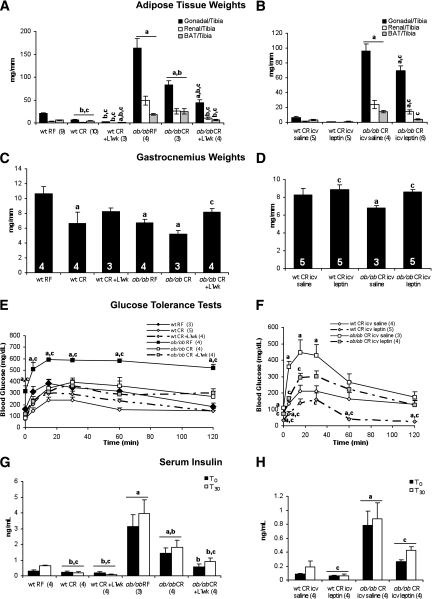
Intraperitoneal and intracerebroventricular leptin are sufficient to alter body composition and serum insulin levels. Adipose tissue and gastrocnemius muscle weights in mice treated with intraperitoneal (A, C) or intracerebroventricular (B, D) leptin for 1 week are shown. GTTs (E, F) and serum insulin levels (G, H) before and 30 min after glucose injection are shown. Numbers of animals are indicated in each figure. For intraperitoneal leptin study, aP < 0.05 vs. wt RF; bP < 0.05 vs. ob/ob RF; cP < 0.05 vs. ob/ob CR. For intracerebroventricular leptin study, aP < 0.05 vs. wt CR intracerebroventricular saline; cP < 0.05 vs. ob/ob CR intracerebroventricular saline. icv, intracerebroventricular; L 1 wk, 1 week of leptin treatment; RF, random fed; wt, wild type.
FIG. 5.
FIG. 5.
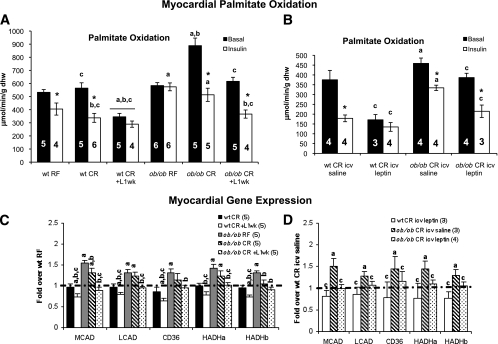
Intraperitoneal and intracerebroventricular leptin are sufficient to normalize basal and insulin-stimulated palmitate oxidation in caloric-restricted ob/ob hearts. Basal and insulin-stimulated palmitate oxidation after 1 week of intraperitoneal (A) or intracerebroventricular leptin (B). C and D: qPCR analysis from noninsulin-stimulated perfused hearts. WT RF values are normalized to 1 and shown as the dashed line. MCAD, medium chain acyl CoA dehydrogenase; LCAD, long chain acyl CoA dehydrogenase; CD36, CD36 antigen; HADHa, hydroxyacyl-CoA dehydrogenase α-subunit; HADHb, hydroxyacyl-CoA dehydrogenase β-subunit. For intraperitoneal leptin study, aP < 0.05 vs. wt RF; bP < 0.05 vs. ob/ob RF; cP < 0.05 vs. ob/ob CR; *P < 0.05 vs. noninsulin-stimulated hearts from the same treatment group. For intracerebroventricular leptin study, aP < 0.05 vs. wt CR intracerebroventricular saline; cP < 0.05 vs. ob/ob CR intracerebroventricular saline; *P < 0.05 vs. noninsulin-stimulated hearts from the same treatment group. CR, caloric restriction; dhw, dry heart weight; icv, intracerebroventricular; L 1 wk, 1 week of leptin treatment; RF, random fed; wt, wild type.

References

    1. Haynes WG. Role of leptin in obesity-related hypertension. Exp Physiol 2005;90:683–688 - PubMed
    1. Atkinson LL, Fischer MA, Lopaschuk GD. Leptin activates cardiac fatty acid oxidation independent of changes in the AMP-activated protein kinase-acetyl-CoA carboxylase-malonyl-CoA axis. J Biol Chem 2002;277:29424–29430 - PubMed
    1. Barouch LA, Berkowitz DE, Harrison RW, O’Donnell CP, Hare JM. Disruption of leptin signaling contributes to cardiac hypertrophy independently of body weight in mice. Circulation 2003;108:754–759 - PubMed
    1. Mazumder PK, O’Neill BT, Roberts MW, et al. Impaired cardiac efficiency and increased fatty acid oxidation in insulin-resistant ob/ob mouse hearts. Diabetes 2004;53:2366–2374 - PubMed
    1. Nickola MW, Wold LE, Colligan PB, Wang GJ, Samson WK, Ren J. Leptin attenuates cardiac contraction in rat ventricular myocytes. Role of NO. Hypertension 2000;36:501–505 - PubMed

Publication types

MeSH terms