. 2011 Jun;193(11):2726-34.
doi: 10.1128/JB.00787-10. Epub 2011 Mar 25.

Prophage-stimulated toxin production in Clostridium difficile NAP1/027 lysogens

Affiliations

Prophage-stimulated toxin production in Clostridium difficile NAP1/027 lysogens

Ognjen Sekulovic et al. J Bacteriol. 2011 Jun.

Abstract

TcdA and TcdB exotoxins are the main virulence factors of Clostridium difficile, one of the most deadly nosocomial pathogens. Recent data suggest that prophages can influence the regulation of toxin expression. Here we present the characterization of ϕCD38-2, a pac-type temperate Siphoviridae phage that stimulates toxin expression when introduced as a prophage into C. difficile. Host range analysis showed that ϕCD38-2 was able to infect 99/207 isolates of C. difficile representing 11 different PCR ribotypes. Of 89 isolates corresponding to the NAP1/027 hypervirulent strain, which recently caused several outbreaks in North America and Europe, 79 (89%) were sensitive to ϕCD38-2. The complete double-stranded DNA (dsDNA) genome was determined, and a putative function could be assigned to 24 of the 55 open reading frames. No toxins or virulence factors could be identified based on bioinformatics analyses. Our data also suggest that ϕCD38-2 replicates as a circular plasmid in C. difficile lysogens. Upon introduction of ϕCD38-2 into a NAP1/027 representative isolate, up to 1.6- and 2.1-fold more TcdA and TcdB, respectively, were detected by immunodot blotting in culture supernatants of the lysogen than in the wild-type strain. In addition, real-time quantitative reverse transcriptase PCR (qRT-PCR) analyses showed that the mRNA levels of all five pathogenicity locus (PaLoc) genes were higher in the CD274 lysogen. Our study provides the first genomic sequence of a new pac-type Siphoviridae phage family member infecting C. difficile and brings further evidence supporting the role of prophages in toxin production in this important nosocomial pathogen.


Figures
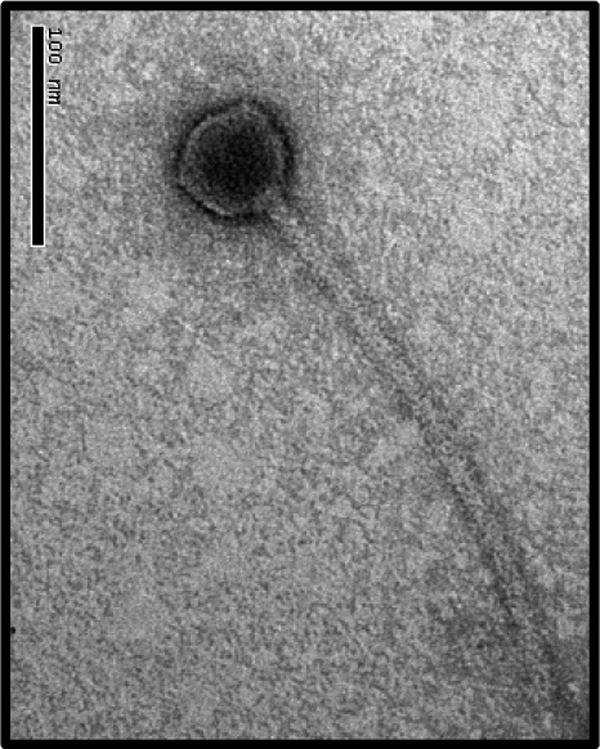
Fig. 1.
Fig. 1.
TEM picture of φCD38-2 negatively stained with 2% uranyl acetate. Bar, 100 nm.
Fig. 2.
Fig. 2.
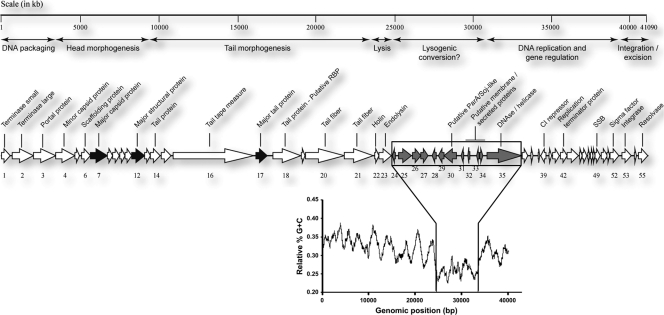
Genetic organization of the complete φCD38-2 genome (41,090 bp). Predicted ORFs and their orientations are represented by arrows. Functional assignments are indicated above the ORFs, along with functional modules that were inferred based on gene annotation and whole genomic organization. Thick black arrows correspond to proteins identified by LC–MS-MS. The relative G+C content, calculated on a 10-base window along the whole φCD38-2 genome, is shown below the map to highlight a region of possible horizontal gene transfer (gray arrows). RBP, receptor-binding protein; SSB, single-strand binding protein.
Fig. 3.
Fig. 3.
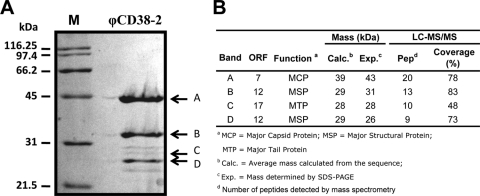
Analysis of φCD38-2 structural proteins. (A) Coomassie brilliant blue staining of a 12% SDS-polyacrylamide gel, showing φCD38-2 structural proteins, along with a protein molecular mass marker (lane M). Arrows and letters on the right correspond to protein bands identified by LC–MS-MS analysis, which are further characterized in panel B.
Fig. 4.
Fig. 4.
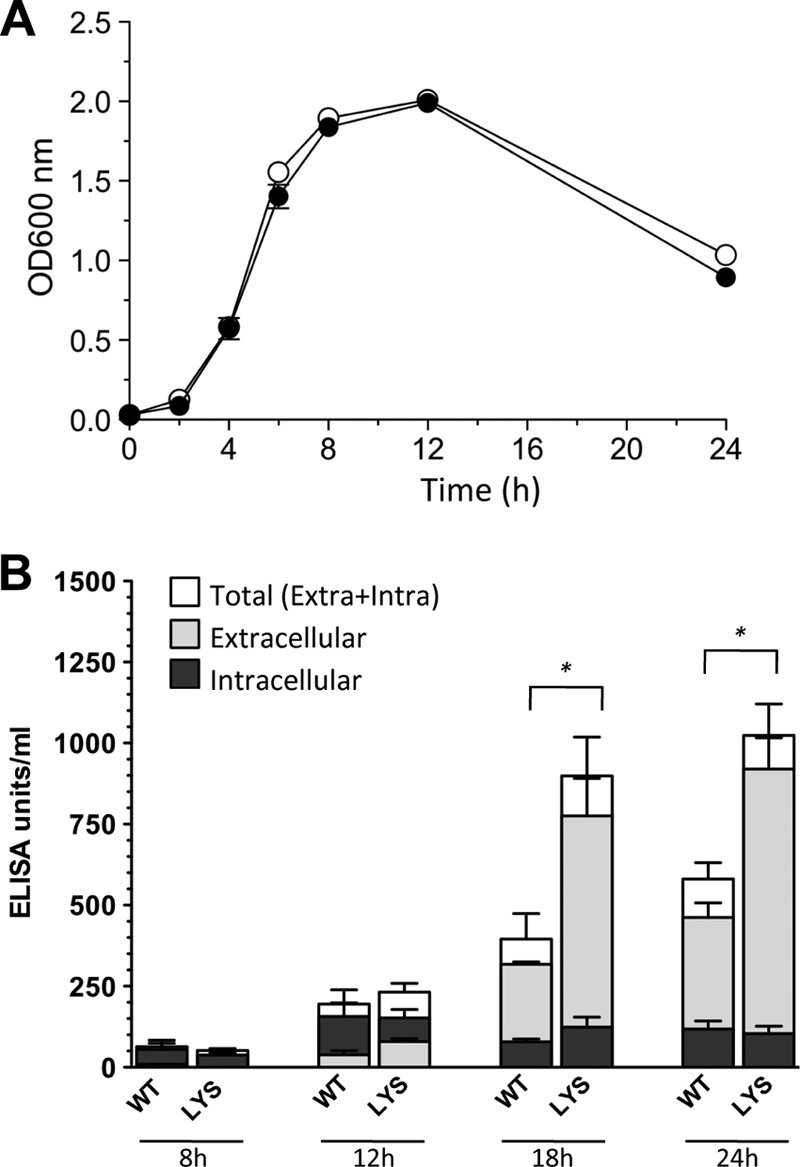
Growth and toxin production of wild-type CD274 and the CD274/φCD38-2 lysogen. (A) Growth of the wild type (white circles) and the lysogen (black circles) in TY broth was monitored by measuring the optical density at 600 nm over 24 h. (B) The relative amounts of TcdA and TcdB toxins were determined by a toxin A/B ELISA. Data represent the means ± standard deviations from three independent biological replicates. Extracellular, intracellular, and total (extracellular plus intracellular) toxin levels of the wild type (WT) and the lysogen (LYS) were compared by a Student t test. Significant differences (*, P < 0.05) were observed for total and extracellular, but not for intracellular, toxins.
Fig. 5.
Fig. 5.
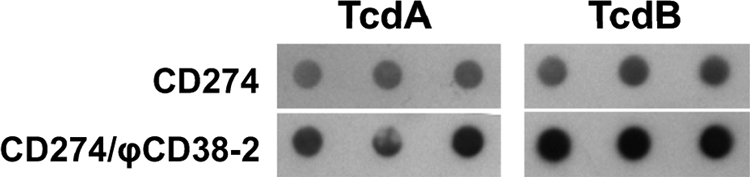
Immunodot blot detection of toxins in cleared supernatants from 24-h cultures of wild-type CD274 and a CD274/φCD38-2 lysogen. TcdA and TcdB toxins were detected using monoclonal anti-TcdA and anti-TcdB antibodies. Each spot represents an independent biological experiment.
Fig. 6.
Fig. 6.
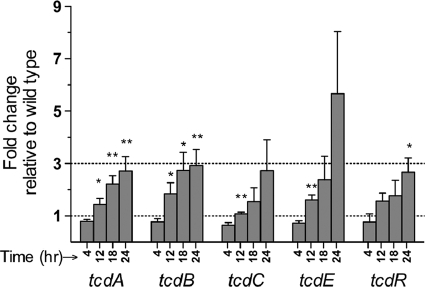
Relative expression of PaLoc genes in the CD274/φCD38-2 lysogen versus the wild-type CD274 strain at different time points. Data are presented as the fold change in gene expression in the lysogen relative to that for the wild-type strain and represent the means ± standard errors of the means from 4 independent biological replicates. A value of 1 means that there is no difference in mRNA levels between the two strains. For each gene, the fold change at 12, 18, and 24 h was compared to the value at 4 h by using the Student t test (*, P < 0.05; **, P < 0.01).

References

    1. Ackermann H. 2007. 5500 phages examined in the electron microscope. Arch. Virol. 152:227–243 - PubMed
    1. Altschul S., et al. 1997. Gapped BLAST and PSI-BLAST: a new generation of protein database search programs. Nucleic Acids Res. 25:3389–3402 - PMC - PubMed
    1. Bidet P., Barbut F., Lalande V., Burghoffer B., Petit J. 1999. Development of a new PCR-ribotyping method for Clostridium difficile based on ribosomal RNA gene sequencing. FEMS Microbiol. Lett. 175:261–266 - PubMed
    1. Bourhy P., et al. 2005. Complete nucleotide sequence of the LE1 prophage from the spirochete Leptospira biflexa and characterization of its replication and partition functions. J. Bacteriol. 187:3931–3940 - PMC - PubMed
    1. Brussow H., Canchaya C., Hardt W. 2004. Phages and the evolution of bacterial pathogens: from genomic rearrangements to lysogenic conversion. Microbiol. Mol. Biol. Rev. 68:560–602 - PMC - PubMed

Publication types

MeSH terms

Associated data

LinkOut - more resources