


PMX-53 as a dual CD88 antagonist and an agonist for Mas-related gene 2 (MrgX2) in human mast cells
- PMID: 21441599
- PMCID: PMC3102546
- DOI: 10.1124/mol.111.071472
PMX-53 as a dual CD88 antagonist and an agonist for Mas-related gene 2 (MrgX2) in human mast cells
Abstract
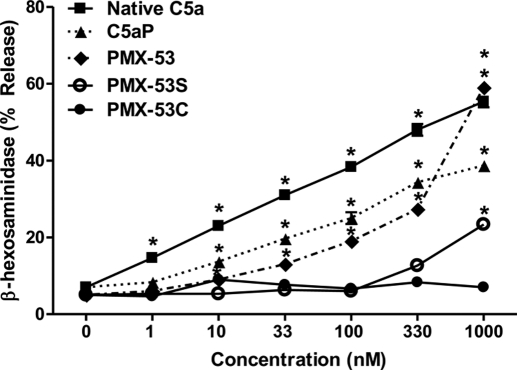
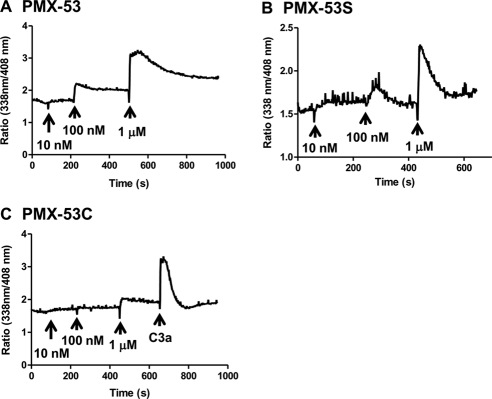
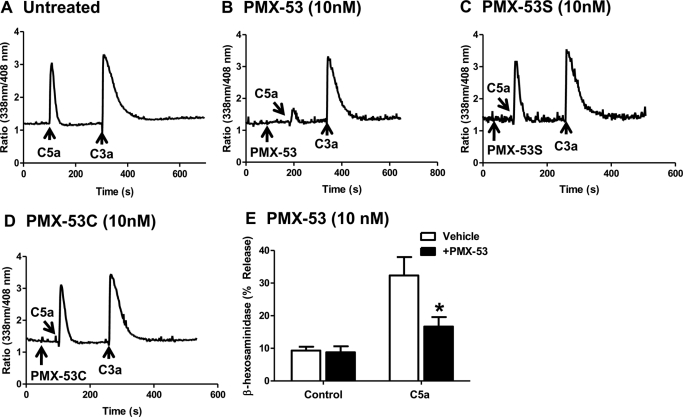
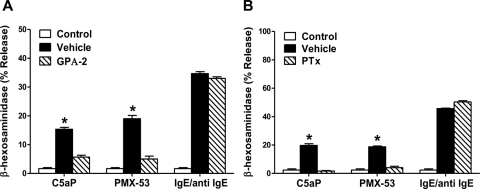
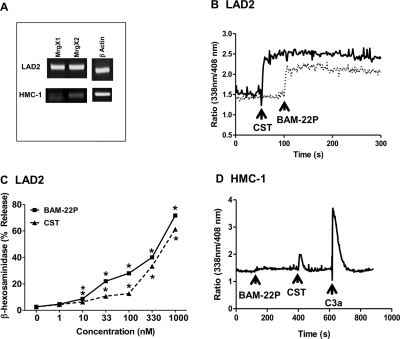
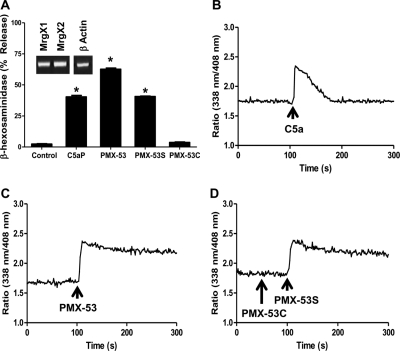
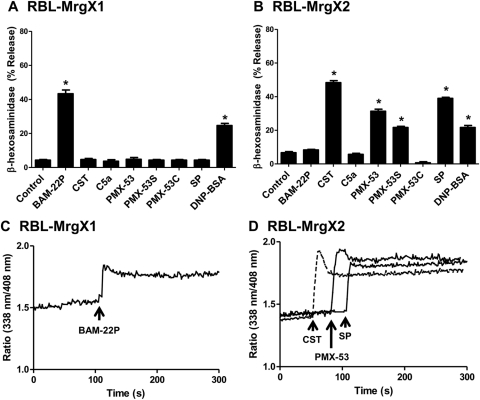
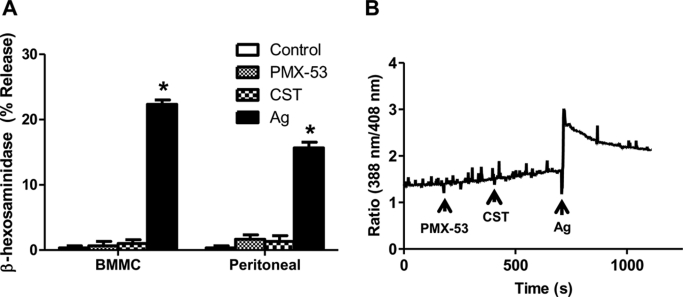
Human mast cells express the G protein coupled receptor (GPCR) for C5a (CD88). Previous studies indicated that C5a could cause mast cell degranulation, at least in part, via a mechanism similar to that proposed for basic neuropeptides such as substance P, possibly involving Mas-related gene 2 (MrgX2). We therefore sought to more clearly define the receptor specificity for C5a-induced mast cell degranulation. We found that LAD2, a human mast cell line, and CD34(+) cell-derived primary mast cells express functional MrgX1 and MrgX2 but the immature human mast cell line HMC-1 does not. A potent CD88 antagonist, PMX-53 (10 nM) inhibited C5a-induced Ca(2+) mobilization in HMC-1 cells, but at higher concentrations (≥30 nM) it caused degranulation in LAD2 mast cells, CD34(+) cell-derived mast cells, and RBL-2H3 cells stably expressing MrgX2. PMX-53 did not, however, activate RBL-2H3 cells expressing MrgX1. Although C5a induced degranulation in LAD2 and CD34(+) cell-derived mast cells, it did not activate RBL-2H3 cells expressing MrgX1 or MrgX2. Replacement of Trp with Ala and Arg with dArg abolished the ability of PMX-53 to inhibit C5a-induced Ca(2+) mobilization in HMC-1 cells and to cause degranulation in RBL-2H3 cells expressing MrgX2. These findings demonstrate that C5a does not use MrgX1 or MrgX2 for mast cell degranulation. Moreover, it reveals the novel finding that PMX-53 functions as a potent CD88 antagonist and a low-affinity agonist for MrgX2. Furthermore, Trp and Arg residues are required for the ability of PMX53 to act as both a CD88 antagonist and a MrgX2 agonist.
Figures
References
-
- Ali H, Ahamed J, Hernandez-Munain C, Baron JL, Krangel MS, Patel DD. (2000) Chemokine production by G protein-coupled receptor activation in a human mast cell line: roles of extracellular signal-regulated kinase and NFAT. J Immunol 165:7215–7223 - PubMed
-
- Ali H, Richardson RM, Tomhave ED, Didsbury JR, Snyderman R. (1993) Differences in phosphorylation of formylpeptide and C5a chemoattractant receptors correlate with differences in desensitization. J Biol Chem 268:24247–24254 - PubMed
-
- Ali H, Richardson RM, Tomhave ED, DuBose RA, Haribabu B, Snyderman R. (1994) Regulation of stably transfected platelet activating factor receptor in RBL-2H3 cells. Role of multiple G proteins and receptor phosphorylation. J Biol Chem 269:24557–24563 - PubMed
-
- Arumugam TV, Shiels IA, Woodruff TM, Reid RC, Fairlie DP, Taylor SM. (2002) Protective effect of a new C5a receptor antagonist against ischemia-reperfusion injury in the rat small intestine. J Surg Res 103:260–267 - PubMed
-
- Arumugam TV, Woodruff TM, Stocks SZ, Proctor LM, Pollitt S, Shiels IA, Reid RC, Fairlie DP, Taylor SM. (2004) Protective effect of a human C5a receptor antagonist against hepatic ischaemia-reperfusion injury in rats. J Hepatol 40:934–941 - PubMed
Publication types
MeSH terms
Substances
Grants and funding
LinkOut - more resources
Full Text Sources
Other Literature Sources
Molecular Biology Databases
Miscellaneous
