


Diagnosis and treatment of pulmonary chronic GVHD: report from the consensus conference on clinical practice in chronic GVHD
- PMID: 21441964
- PMCID: PMC7094778
- DOI: 10.1038/bmt.2011.35
Diagnosis and treatment of pulmonary chronic GVHD: report from the consensus conference on clinical practice in chronic GVHD
Abstract
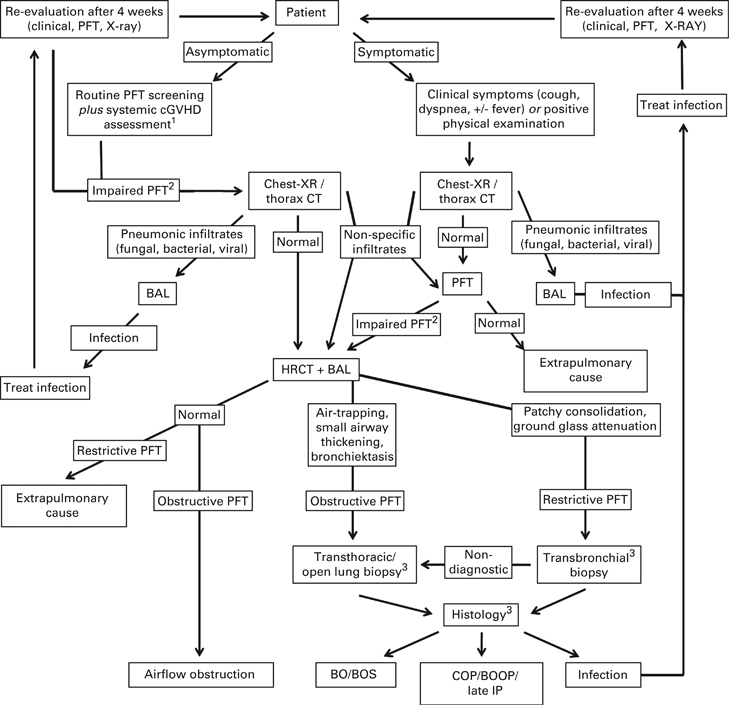
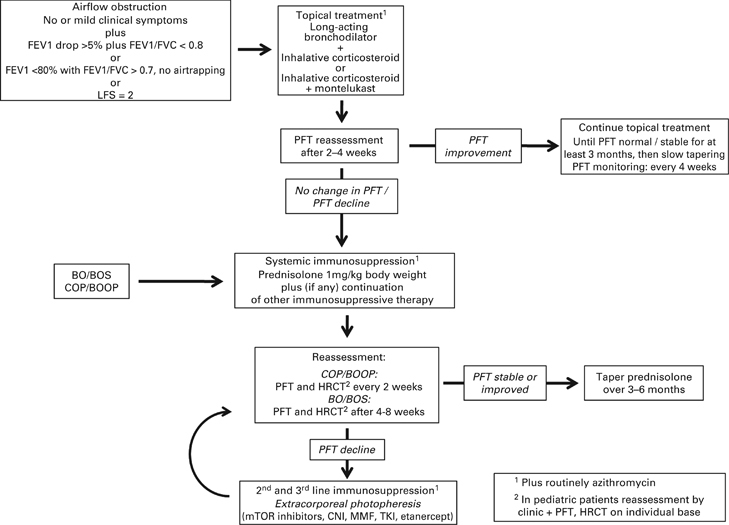
This consensus statement established under the auspices of the German working group on BM and blood stem cell transplantation (DAG-KBT), the German Society of Hematology and Oncology (DGHO), the Austrian Stem Cell Transplant Working Group, the Swiss Blood Stem Cell Transplantation Group (SBST) and the German-Austrian Pediatric Working Group on SCT (Päd-Ag-KBT) summarizes current evidence for diagnosis, immunosuppressive and supportive therapy to provide practical guidelines for the care and treatment of patients with pulmonary manifestations of chronic GVHD (cGVHD). Pulmonary cGVHD can present with obstructive and/or restrictive changes. Disease severity ranges from subclinical pulmonary function test (PFT) impairment to respiratory insufficiency with bronchiolitis obliterans being the only pulmonary complication currently considered diagnostic of cGVHD. Early diagnosis may improve clinical outcome, and regular post-transplant follow-up PFTs are recommended. Diagnostic work-up includes high-resolution computed tomography, bronchoalveolar lavage and histology. Topical treatment is based on inhalative steroids plus beta-agonists. Early addition of azithromycin is suggested. Systemic first-line treatment consists of corticosteroids plus, if any, continuation of other immunosuppressive therapy. Second-line therapy and beyond includes extracorporeal photopheresis, mammalian target of rapamycin inhibitors, mycophenolate, etanercept, imatinib and TLI, but efficacy is limited. Clinical trials are urgently needed to improve understanding and treatment of this deleterious complication.
Conflict of interest statement
Hildegard Greinix served as member of a steering committee for a chronic GVHD study of Therakos and received honoraria from Therakos for research presentations in corporate symposia at international scientific meetings. The authors declare no conflict of interest.
Figures
Comment in
-
What we know and mostly do not know about bronchiolitis obliterans syndrome.Bone Marrow Transplant. 2012 Jan;47(1):1-4. doi: 10.1038/bmt.2011.38. Bone Marrow Transplant. 2012. PMID: 22233966 No abstract available.
References
-
- Bhatia S, Francisco L, Carter A, Sun CL, Baker KS, Gurney JG. Late mortality after allogeneic hematopoietic cell transplantation and functional status of long-term survivors: report from the Bone Marrow Transplant Survivor Study. Blood. 2007;110:3784–3792. doi: 10.1182/blood-2007-03-082933. - DOI - PMC - PubMed
-
- Schmitz N, Eapen M, Horowitz MM, Zhang MJ, Klein JP, Rizzo JD. Long-term outcome of patients given transplants of mobilized blood or bone marrow: a report from the international bone marrow transplant registry and the European group for blood and marrow transplantation. Blood. 2006;108:4288–4290. doi: 10.1182/blood-2006-05-024042. - DOI - PMC - PubMed
-
- Fraser CJ, Bhatia S, Ness K, Carter A, Francisco L, Arora M. Impact of chronic graft-versus-host disease on the health status of hematopoietic cell transplantation survivors: a report from the Bone Marrow Transplant Survivor Study. Blood. 2006;108:2867–2873. doi: 10.1182/blood-2006-02-003954. - DOI - PMC - PubMed
Publication types
MeSH terms
LinkOut - more resources
Full Text Sources
Other Literature Sources
Medical
