


Elk-1 a transcription factor with multiple facets in the brain
- PMID: 21441990
- PMCID: PMC3060702
- DOI: 10.3389/fnins.2011.00035
Elk-1 a transcription factor with multiple facets in the brain
Abstract
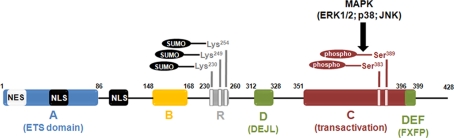
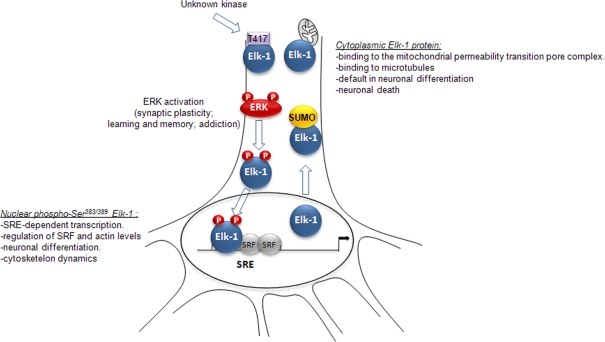
The ternary complex factor (TCF) Elk-1 is a transcription factor that regulates immediate early gene (IEG) expression via the serum response element (SRE) DNA consensus site. Elk-1 is associated with a dimer of serum response factor (SRF) at the SRE site, and its phosphorylation occurs at specific residues in response to mitogen-activated protein kinases (MAPKs), including c-Jun-N terminal kinase (JNK), p38/MAPK, and extracellular-signal regulated kinase (ERK). This phosphorylation event is critical for triggering SRE-dependent transcription. Although MAPKs are fundamental actors for the instatement and maintenance of memory, and much investigation of their downstream signaling partners have been conducted, no data yet clearly implicate Elk-1 in these processes. This is partly due to the complexity of Elk-1 sub-cellular localization, and hence functions, within neurons. Elk-1 is present in its resting state in the cytoplasm, where it colocalizes with mitochondrial proteins or microtubules. In this particular sub-cellular compartment, overexpression of Elk-1 is toxic for neuronal cells. When phosphorylated by the MAPK/ERK, Elk-1 translocates to the nucleus where it is implicated in regulating chromatin remodeling, SRE-dependent transcription, and neuronal differentiation. Another post-translational modification is the conjugation to SUMO (Small Ubiquitin-like MOdifier), which relocalizes Elk-1 in the cytoplasm. Thus, Elk-1 plays a dual role in neuronal functions: pro-apoptotic within the cytoplasm, and pro-differentiation within the nucleus. To address the role of Elk-1 in the brain, one must be aware of its multiple facets, and design molecular tools that will shut down Elk-1 expression, trafficking, or activation, in specific neuronal compartments. We summarize in this review the known molecular functions of Elk-1, its regulation in neuronal cells, and present evidence of its possible implication in model systems of synaptic plasticity, learning, but also in neurodegenerative diseases.
Keywords: A; ERK signaling; brain plasticity; chromatin remodeling; gene regulation; long-term neuronal adaptation; memory formation.
Figures
References
-
- Berman D. E. (2003). Modulation of taste-induced Elk-1 activation by identified neurotransmitter systems in the insular cortex of the behaving rat. Neurobiol. Learn. Mem. 79, 122–126 - PubMed
LinkOut - more resources
Full Text Sources
Other Literature Sources
Research Materials
Miscellaneous
